






A business engaged in related-party transactions may incur interest expenses that are not deductible if such expenses exceed the prescribed limit. The non-deductible portion of the expenses may be carried forward to the next tax period if certain conditions are met.
Effective July 1, 2026, the determination of deductible interest expenses shall be carried out in accordance with Decree 255/2026/ND-CP, effective for the 2026 corporate income tax period. Pursuant to Clause 3 of Article 16 of Decree No. 255/2026/ND-CP, interest expense, after deducting interest income from deposits and interest income from loans, is deductible up to 30% of the total net profit from business operations plus interest expense, after deducting interest income from deposits, interest income from loans, and depreciation expenses incurred during the period.
The portion of interest expenses that is not deductible may be carried forward to the next tax period if it meets the prescribed conditions. The carryforward period may not exceed five years, starting from the year following the year in which the non-deductible interest expenses were incurred.
Where does the regulation that interest expense cannot be carried forward to the next period originate from?

The story begins in 2017, when Decree 20/2017/ND-CP This was the first time a threshold of 20% EBITDA was set for interest expense in related-party transactions. At that time, the regulation did not allow the carry-forward of the amount exceeding the threshold, causing a strong backlash from the business community, especially foreign-invested corporations (FDI) with centralized financial models.
By 2020, Decree 68/2020/ND-CP was issued urgently to apply retroactively to the years 2017–2018, raising the threshold to 30% and, for the first time, introducing a five-year carryover mechanism. However, this was only a stopgap measure. At the end of 2020, Decree 132/2020/NĐ-CP was issued, fully replacing Decree 20/2017 and Decree 68, and was subsequently supplemented by Decree 20/2025/NĐ-CP.
Effective July 1, 2026, Decree No. 255/2026/NĐ-CP officially takes effect, fully replacing Decree No. 132/2020/NĐ-CP and Decree No. 20/2025/NĐ-CP, It will become the current legislation governing related-party transactions, including all provisions on interest expense, effective for the 2026 corporate income tax filing period.
Scope of Application and Cases Where the Interest Expense Limit Does Not Apply
Pursuant to Paragraph 3 of Article 16 of Decree No. 255/2026/ND-CP, the limit on the total deductible interest expenses specified in subparagraph a of this paragraph applies to enterprises engaged in related-party transactions that fall within the scope of this Decree.
However, the provision set forth in Article 16, paragraph 3, subparagraph a, does not apply to loans falling under the cases specified in Article 16, paragraph 3, subparagraph c, including:
- Loans to taxpayers that are credit institutions as defined in the Law on Credit Institutions No. 32/2024/QH15, as amended and supplemented by Law No. 96/2025/QH15;
- Loans taken out by insurance companies under the Insurance Business Law No. 08/2022/QH15, as amended and supplemented by Law No. 139/2025/QH15;
- Official development assistance (ODA) loans and preferential government loans are implemented through a method where the government borrows from foreign sources and then lends to businesses.;
- Loans for implementing national target programs, including the New Rural Development Program and the Sustainable Poverty Reduction Program;
- Loans for programs and projects that implement the State’s social welfare policies, including resettlement housing, housing for workers and students, social housing, and other public welfare projects.
Therefore, when determining deductible interest expenses, a business must first determine whether the loan falls under the exception to the 30% limit under Point c, Paragraph 3 of Article 16, before calculating the portion of interest expenses that is not deductible.
How to calculate non-deductible interest expense in the period: A preliminary step before carrying it over to the next period.

Pursuant to Paragraph 3 of Article 16 of Decree No. 255/2026/ND-CP, a business engaged in related-party transactions shall determine deductible interest expenses based on the 30% ratio of total net profit from business operations for the period, plus interest expenses after deducting interest on deposits and interest on loans incurred during the period, plus depreciation expenses incurred during the period.
The determination process can be summarized as follows:
Step 1: Determine net interest expense.
The formula for determining net interest expense is as follows:
Net interest expense = Total interest expense incurred during the period – (Interest on deposits + Interest on loans incurred during the period) |
Step 2: Determine tax-determined EBITDA
Here's how to determine EBITDA for tax purposes:
EBITDA before taxes = Net operating profit + Net interest expense + Depreciation expense for the period |
Note:
- Net operating profit does not include other income or other depreciation and amortization expenses. A company with significant other income—such as gains on the disposal of assets—will see its pre-tax EBITDA be significantly lower than the EBITDA calculated from pre-tax profit.
Step 3: Determine the 30% threshold.
Deduction threshold:
Deduction threshold = 30% x Taxable EBITDA |
Step 4: Interest expense is not deductible in the current period.
To determine which interest expense is not deductible in the current period:
Interest expense not deductible in the current period = Net interest expense – Deduction threshold |
Note: If the result is less than or equal to 0, the entire interest expense is deducted and there is no carry-forward.
Tax-based EBITDA is not the same as accounting EBITDA. These two figures can differ significantly due to:
- Depreciation for tax purposes is applied according to Circular 45/2013 (State depreciation framework), which is different from accounting depreciation according to IAS/IFRS or the company's internal policy.
- Adjustments that increase or decrease taxable income (unreasonable expenses, tax-exempt income, etc.) change pre-tax profit compared to accounting profit.
- Interest expense capitalized on fixed assets under construction is not included in net interest expense but must be consistent with the treatment throughout the entire documentation.
Common mistakes when determining tax-determined EBITDA
Based on our consulting experience, there are three mistakes that occur most frequently:
- The cost of allocating tools and equipment was mistakenly included in the depreciation expense. This is not depreciation of fixed assets and therefore cannot be included in EBITDA for tax purposes.
- Failure to adjust interest expense capitalized on fixed assets under construction results in underestimating net interest expense.
- Using EBITDA directly from audited financial statements without recalculating based on tax figures can result in significant discrepancies between the two numbers.
- Use profit before tax instead of net operating profit.
- With the exception of interest on deposits, interest on loans is included in interest expense but is added to EBITDA as gross interest expense.
Interest expenses cannot be carried forward to the next period: How does the 5-year operating mechanism work?
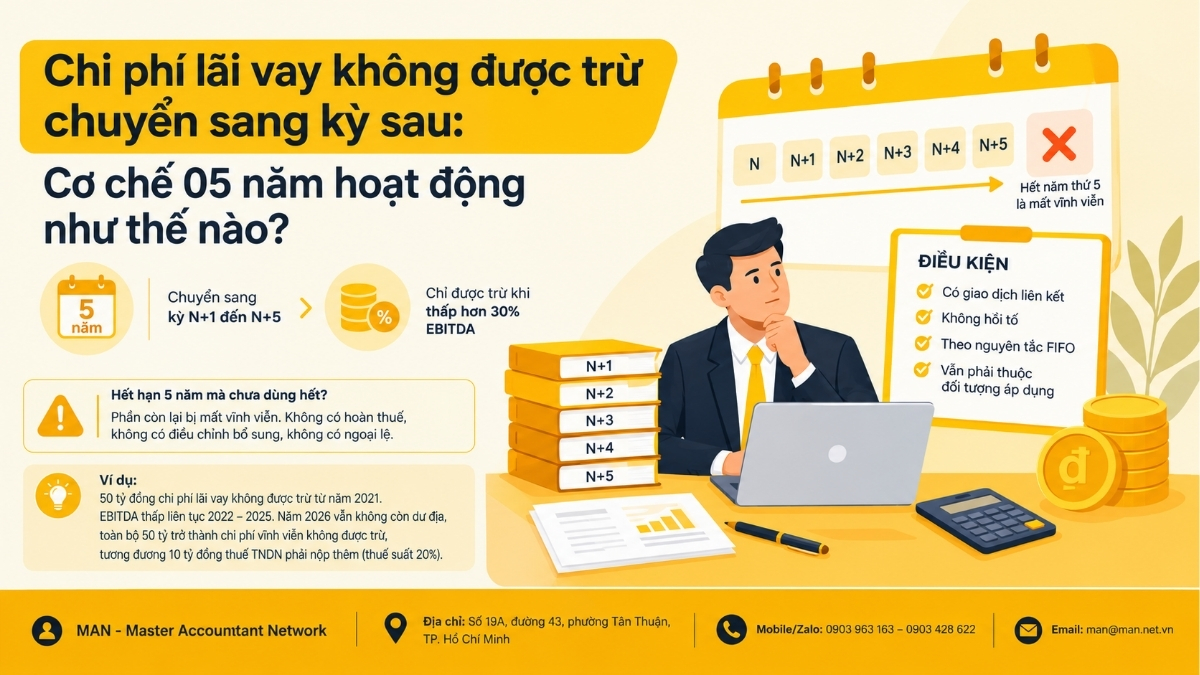
The mechanism for not being able to carry forward interest expense deductions is designed to prevent businesses from being unfairly penalized in years with low EBITDA due to cyclical factors. However, this mechanism comes with strict conditions and time limits.
The operating principle of the period carryover mechanism is as follows:
- Maximum term of 5 years: Any interest expense not deductible in period N is carried over to periods N+1, N+2, N+3, N+4, and N+5. If the entire amount remains unused after the 5th year, it is permanently forfeited, without exception.
- Conditions for deduction in the following period: The carried-forward amount may be deducted only if deductible net interest expense is incurred in the following period. lower the 30% EBITDA threshold for that period. The maximum amount that can be deducted is equal to the remaining difference.
- FIFO Principle: Tracking by the year incurred: A five-year limitation period applies separately to each year in which non-deductible interest expenses were incurred. The Decree does not specify the order of use, but in practice, businesses should prioritize using the amounts that arose earlier (following the FIFO principle) to avoid the expiration of older balances.
- No retroactive application: Once a declaration has been filed, it cannot be adjusted back to the period for which it was already paid. All processing can only be done forward.
- The following conditions must still be met: The period in which the carryover is recognized must include related-party transactions: Subparagraph b permits a carryover only after determining the total deductible interest expense under subparagraph a. This determination applies only to businesses with related-party transactions during the period. If no related-party transactions occur during a period, the carryforward amount from the previous period may not be included in the deduction, while the five-year period still continue running continuously.
What happens if, after the 5-year period, the unused interest expense is not fully deductible?
The rest is lost permanently. There is no tax refund mechanism, no additional adjustments, no exceptions. This is a point that many businesses overlook in their long-term financial planning.
For example: A company with 50 billion VND in non-deductible interest expenses carried forward from 2021, but with consistently low EBITDA from 2022 to 2025. 2026 is the final year of the carryforward period. If there is still no carryforward allowance available in 2026, the entire 50 billion VND will become a permanently non-deductible expense, equivalent to an additional corporate income tax liability of up to 10 billion VND (at a tax rate of 20%).
Important Note: Failure to monitor and plan for carry-over mechanisms can lead to businesses incurring increased corporate income tax each year if they do not fully utilize the carry-over balance by the 5-year deadline.
A real-world case study on interest expense that is not deductible and carried forward to the next period.
To understand how non-deductible interest expense carried over to the next period works in practice, let's examine three scenarios with increasing levels of complexity with MAN – Master Accountant Network.
Case 1: Company ABC reported the following figures for the 2026 tax year and the corresponding carryover years 2027–2031 (in billions of dong):
| Index | Value | Note |
| Total interest expense | 50 | This includes interest expenses from both related and independent parties. |
| Interest income | 5 | Interest on deposits and loans |
| Net interest expense | 45 | Total interest expense – Interest income |
| Profit before tax | 40 | Net operating profit |
| Depreciation of fixed assets | 15 | According to the framework of Circular 45/2013/TT-BTC |
| EBITDA after tax | 100 | Profit before tax + Net interest expense + Depreciation |
| 30% EBITDA threshold | 30 | 30% x 100 |
| Deductible during the period | 30 | Maximum equal to threshold |
| No deductions or carry-overs to the next period are allowed. | 15 | Net interest expense – 30% EBITDA threshold, carried over to 2024 to 2028 |
Case 2: Carryover over multiple years with fluctuating EBITDA
Let's assume 15 billion VND from 2023 is carried over. EBITDA in subsequent years will fluctuate due to market conditions:
| Period | Net interest expense | EBITDA after tax | Threshold 30% | Remaining | The amount transferred will be deducted. | Excess carryover |
| 2026 (original) | 45 | 100 | 30 | 15 | ||
| 2027 | 20 | 120 | 36 | 16 | 15 (end) | |
| 2028 | 0 | 0 (out of stock) |
In this example, net interest expense for 2027 is only 20 billion, while the 30% EBITDA threshold is 36 billion, leaving a surplus of 16 billion dong. The entire 15 billion carried forward is fully deducted in 2024, with no need for carryover.
Case 3: Risk of expiration in 5 years
Suppose a real estate company has 30 billion VND in non-deductible interest expenses incurred in 2021, in accordance with Decree 132/2020/ND-CP. Since the carryforward period runs continuously starting in 2022, the 2026 tax period is the final period in which these expenses can be utilized, and this period falls under the scope of Decree 255/2026/ND-CP. Due to a sluggish market from 2022 to 2025, annual EBITDA is only sufficient to cover newly incurred interest expenses. If there is still no room for carryover in 2026, this 30 billion VND will be lost, equivalent to an additional 6 billion VND in corporate income tax payable. For carryovers from periods prior to 2026, the company must review the transitional provisions of Decree 255/2026/ND-CP and consult with the directly managing tax authority.
See also: How to Calculate Deductible Interest Expenses Under Decree No. 255/2026/NĐ-CP
How should interest expense that is not deductible be carried forward to the next period on tax returns?
Accurate declaration is a prerequisite for tax authorities to accept the carry-forward. Errors in declaration may lead to the tax authorities rejecting the entire carry-forward right, even if the business meets all the data requirements.
- Appendix I, issued pursuant to Decree No. 255/2026/ND-CP, must be submitted along with the annual corporate income tax return for businesses engaged in related-party transactions.
- Interest expense declaration section: Clearly state the total net interest expense, tax-deductible EBITDA, 30% threshold, deductible and non-deductible portions for the period.
- Period carry-over section: Declare the balance carried over from each previous period (according to each base year), the amount deducted in this period from each year carried over, and the remaining balance carried forward.
- The amounts incurred each year must be tracked and reported separately for reconciliation over a 5-year period: The amounts from the previous years (N) must be reported prior to years N+1 and N+2.
See also: Instructions for declaring related-party transactions on HTKK.
What risks could cause a business to lose the right to use non-deductible interest expenses carried over to the next period?

In reality, many businesses are aware of the regulations but still lose their carryover rights due to operational risks. Below are four of the most common risks and how to prevent them.
Monitoring in violation of the FIFO principle.
When carryovers from multiple years coexist (for example, carryovers from 2021, 2022, and 2023), businesses sometimes mistakenly report the year 2023 before the year 2021. The actual risk is that the carryover balance from the previous year expires after five years, while the carryover allowance has already been used for the balance of a more recent year.
EBITDA is expected to fall sharply in the next period.
In highly cyclical industries (real estate, construction, large-scale manufacturing), EBITDA can decline by 50-70¢ TP3T during unfavorable market years. In such cases, not only will carry-forward not be eligible, but even new net interest expenses incurred during the period may exceed 30¢ TP3T, creating additional carry-forward balances and increasing time pressure.
Restructuring eliminates the conditions for related-party transactions.
When a corporate group undergoes restructuring, a corporate spin-off, or a change in ownership structure that results in the enterprise no longer being an affiliate of any entity in the subsequent period, the entity falls outside the scope of application of Clause 3, Article 16 of Decree No. 255/2026/ND-CP for that period; therefore, the carryover amount from the prior period may not be deducted. The five-year period is not suspended: periods with no related-party transactions are still counted toward the time limit. Therefore, decisions to settle related-party loans or restructure ownership must be considered in conjunction with the carryover balances being tracked.
Errors in determining net interest expense.
Interest expense capitalized on fixed assets under construction (according to VAS 16) is not included in interest expense on the income statement, but some businesses mistakenly include it in net interest expense when calculating the 30% threshold, leading to underestimation of the deductible amount and unnecessary carry-forward.
To avoid unfortunate risks that could affect your company's finances, please refer to the following: related party transaction advisory services We seek support and assistance from professional, reputable, and experienced organizations.
Conclusion and recommendations
The regulation regarding the non-deductible carry-forward of interest expenses is a crucial legal basis in Vietnam's anti-transfer pricing system. Understanding and correctly applying this regulation not only helps businesses comply with tax obligations but also protects their legitimate financial interests in the long term.
Four key points to remember:
- The 30% threshold, calculated based on after-tax EBITDA, is derived from net income from operating activities, and interest expenses are always the number pure (net of interest on deposits and interest on loans).
- The non-deductible portion is carried forward to subsequent periods for a continuous period not exceeding 5 years, and may only be used in periods in which related-party transactions occur.
- If you haven't used it all within 5 years, it will be permanently lost. Even if there are no related transactions during that period, the time still counts toward the expiration period.
- Properly completing the appendix attached to Decree No. 255/2026/NĐ-CP, tracking balances by fiscal year, and maintaining complete EBITDA worksheets are prerequisites for the protection of rights.
To optimize the impact of non-deductible interest expense carried forward to the next period, businesses should develop a 5-year financial plan from the time the balance is generated, assess their ability to absorb future EBITDA, and consider adjusting their capital structure or investment timing to maximize room for growth in subsequent periods.
Contact MAN – Master Accountant Network For free support and advice!
Contact information MAN – Master Accountant Network
- Address: No. 19A, Street 43, Tan Thuan Ward, Ho Chi Minh City
- Mobile/Zalo: 0903 963 163 – 0903 428 622
- E-mail: man@man.net.vn
- Google Business Profile: View MAN – Master Accountant Network's Google Business Profile
- LinkedIn Founder: View expert Le Hoang Tuyen's LinkedIn profile.
Responsible for production and professional content review by: Mr. Le Hoang Tuyen – Founder & CEO of MAN – Master Accountant Network. He is a CPA Vietnam auditor with over 30 years of in-depth experience in accounting, auditing, taxation, and corporate legal consulting.
Frequently Asked Questions about Interest Expenses That Cannot Be Carried Forward
Does the policy of not being able to carry forward interest expense to the next period apply to branches?
Dependent branches file corporate income tax returns together with the head office; therefore, net interest expense and EBITDA figures are aggregated at the legal entity level (head office). Independent branches with their own tax identification numbers file tax returns independently and apply separate regulations regarding non-deductible interest expense carried forward to the next period, within the scope of that legal entity.
If a business dissolves before the 5-year period is over, how are the remaining balances handled?
When a business is dissolved, all tax settlements are carried out at the dissolution period. Any unused carry-over balances cannot be deducted, similar to the situation after the expiration of a 5-year term. Currently, there are no regulations allowing the inheritance of carry-over balances in cases of mergers or consolidations; therefore, caution is needed when planning M&A deals involving entities with such balances.
Should interest expense carried over to another period be declared separately or included in the total?
Each year of origin must be declared separately on Appendix 02/TNDN. All carry-over amounts cannot be combined into a single line because the tax authorities need to verify the 5-year period of each balance.
Will businesses that sign APA agreements be affected by this regulation?
Point c of Paragraph 3 of Article 16 of Decree No. 255/2026/ND-CP does not list enterprises with an APA among the cases where the 30% threshold does not apply. Therefore, businesses should not assume that having an APA automatically grants an exemption; rather, they should review the scope of transactions covered by the signed APA and consult with the tax authorities.
Does Decree No. 255/2026/NĐ-CP change the 30% threshold and the 5-year transfer period?
No. Decree No. 255/2026/NĐ-CP maintains the 30% threshold and the carryover period of no more than 5 years, starting from the year following the year in which the non-deductible interest expenses were incurred. The Decree takes effect on July 1, 2026, and applies to the 2026 corporate income tax filing period.