





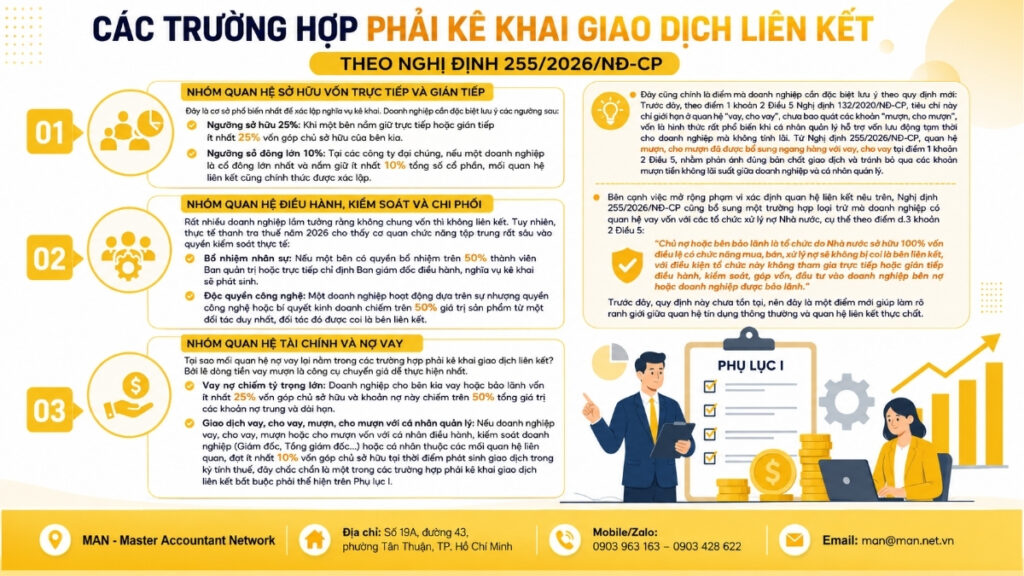
Cases requiring declaration of related-party transactions include: Decree 255/2026/ND-CP The new regulations officially add related-party transactions through lending and borrowing of capital with individual executives, along with a series of changes to the threshold for exemption from reporting requirements and the method for determining Country-by-Country Profit Reporting. In practice, these are crucial points that can lead to businesses having their income assessed or their reports rejected, even if they did not intentionally violate the law. This article comprehensively systematizes the cases requiring declaration of related-party transactions according to the latest legal regulations, helping businesses accurately review their declaration obligations and proactively avoid the risk of back taxes and penalties.
The context for managing Related-Party Transaction Tax in 2026
2026 marks a turning point in tax management for corporations with internal transactions. With the support of artificial intelligence (AI) in data analysis, the tax authorities can easily detect discrepancies between actual profits and transaction costs through fully digitized financial reports.
Businesses failing to proactively review cases requiring the declaration of related-party transactions can lead to extremely serious legal and financial consequences:
- Tax assessment: The tax authorities have the right to reject the transaction value declared by the business and assess a price based on industry data if the supporting documentation is not convincing enough.
- Administrative penalties: The fines for late or incomplete submission of related-party transaction appendices have been significantly increased to deter transfer pricing practices.
- Loss of business reputation: Once a company receives a low compliance rating, it will be placed on a blacklist for regular annual tax audits.
Related Parties and prerequisites for determining cases requiring declaration of related-party transactions.

To accurately determine which cases require the declaration of related-party transactions, the first and most important step is to identify the related parties. Under the current legal framework, related-party relationships are established based on two factors: Ownership and Effective Control.
Group of direct and indirect capital ownership relationships
This is the most common basis for establishing reporting obligations. Businesses should pay particular attention to the following thresholds:
- Ownership threshold for 25%: When one party directly or indirectly holds at least 25% of the other party's equity capital.
- Major shareholder threshold for 10%: In publicly traded companies, if a business is the largest shareholder and holds at least 10% of the total shares, the affiliation is officially established.
The group of relationships involving management, control, and dominance.
Many businesses mistakenly believe that without joint ventures, there can be no collaboration. However, the reality of the 2026 tax audit shows that authorities are focusing very deeply on actual control:
- Personnel appointments: If one party has the right to appoint more than 50% members to the Board of Directors or directly appoint the Executive Board, a disclosure obligation will arise.
- Exclusive technology: A business that operates based on the licensing of technology or trade know-how that accounts for more than 50% of the product value from a single partner is considered an affiliate.
Financial and Debt Relationships Group (Inspection Focus)
Why are loan relationships subject to the declaration of related-party transactions? Because borrowed cash flows are the easiest tool for transfer pricing.
- Debt accounts for a large proportion of the economy: The business lends or guarantees capital to the other party equivalent to at least 25% of the owner's equity, and this debt accounts for over 50% of the total value of medium and long-term debt.
- Loan, borrowing, and lending transactions with individual managers: If a business borrows or lends, borrow or lend Capital contributed by individuals managing or controlling the business (Directors, General Directors, etc.) or individuals with related relationships, reaching at least 10% owner's equity at the time the transaction occurs during the tax period, this is certainly one of the cases where related-party transactions must be declared and shown in Appendix I.
This is also a point that businesses need to pay special attention to according to the new regulations: Previously, according to Point 1, Clause 2, Article 5 of Decree 132/2020/ND-CP, this criterion was limited to "lending and borrowing" relationships, not encompassing "borrowing and lending," which is a very common form where individuals in charge provide temporary working capital support to businesses without charging interest. From Decree 255/2026/ND-CP, the borrowing and lending relationship has been added to the same level as lending and borrowing in Point 1, Clause 2, Article 5, to accurately reflect the nature of the transaction and avoid overlooking interest-free loans between businesses and individuals in charge.
Besides expanding the scope of defining the aforementioned related-party relationship, Decree 255/2026/ND-CP also adds an exclusion case where an enterprise has a loan relationship with state debt resolution organizations, specifically according to point d.3, clause 2, Article 5:
A creditor or guarantor that is a state-owned organization with the function of buying, selling, and handling debt will not be considered an affiliated party, provided that this organization does not directly or indirectly participate in the management, control, capital contribution, or investment in the debtor or guaranteed enterprise.
Previously, this regulation did not exist, so this is a new point that helps clarify the boundary between ordinary credit relationships and genuine affiliated relationships.
See details: Is taking out a bank loan considered a related-party transaction?.
Detailed analysis of cases requiring declaration of related-party transactions.

Once a relationship is established, all flows of money, goods, or services between the parties must be reported. Below is an in-depth analysis of each specific type of transaction:
Transactions involving the purchase, sale, and exchange of tangible and intangible assets.
These transactions include raw materials, finished products, machinery (tangible assets) and trademarks, software, patents (intangible assets). Among the categories requiring declaration of related-party transactions, intangible assets are the most difficult to value. Tax authorities often scrutinize whether the royalty fees paid to the parent company are commensurate with the benefits received by the subsidiary in Vietnam.
Loan, lending and specific financial assistance transactions
These transactions include raw materials, finished products, machinery (tangible assets) and trademarks, software, patents (intangible assets). Among the categories requiring declaration of related-party transactions, intangible assets are the most difficult to value. Tax authorities often scrutinize whether the royalty fees paid to the parent company are commensurate with the benefits received by the subsidiary in Vietnam.
Internal service transaction
In line with the centralized management trend of 2026, multinational corporations often establish shared service centers for IT, human resources, and accounting. The allocation of these service costs from overseas to Vietnam must strictly adhere to market pricing principles. To be accepted as a legitimate expense when declaring related-party transactions, the service must be genuinely necessary for the recipient's business operations and not be duplicated.
Loan, borrowing, lending, and specific financial assistance transactions.
This is the core content of every transfer pricing audit. Businesses need to declare:
- All loans have interest, including temporary loans that are interest-bearing. Many accountants believe that interest-free loans have no fees and don't need to be declared, but this is a common mistake that leads businesses to have their interest income assessed at market rates.
- Loan guarantee fees collected by the parent company from its subsidiary. In cases where related-party transactions must be declared, these guarantee fees are often overlooked, leading to incomplete documentation.
As explained above, Decree 255/2026/ND-CP clearly stipulates the basis for establishing affiliated relationships, similar to lending and borrowing relationships. Therefore, interest-free loans between enterprises and their Directors or General Directors need to be reviewed and fully declared in Appendix I.
Internal service transaction
In line with the centralized management trend of 2026, multinational corporations often establish shared service centers for IT, human resources, and accounting. The allocation of these service costs from overseas to Vietnam must strictly adhere to market pricing principles. To be accepted as a legitimate expense when declaring related-party transactions, the service must be genuinely necessary for the recipient's business operations and not be duplicated.
Agreements for the purchase, shared use of resources, and cost sharing.
Joint ventures often sign agreements to jointly develop a project or share warehousing and transportation systems. The distribution of these costs requires absolute transparency regarding the allocation method to demonstrate its justification to regulatory authorities.
Capital transfer and financial investment transactions
The transfer of shares between subsidiaries within the same system also falls under the category of related-party transactions that must be declared. The tax authorities will check whether the transfer price has been artificially inflated to avoid income tax on capital gains.
Procedures and documentation for transfer pricing
Identifying cases requiring the declaration of related-party transactions is only the first step; the next step is completing the compliance documentation. Previously, the main legal framework was... Decree 132/2020/ND-CP, From Decree 255/2026/ND-CP, the appendices to the dossier continue to be inherited but are issued according to the new mẫu attached to Decree 255/2026/ND-CP itself:
- Appendix I: The consolidated declaration form on related-party relationships and related-party transactions requires businesses to list in detail the names of related parties, the transaction value, and the pricing method used, and must be submitted together with the Corporate Income Tax Return.
- Local File (Appendix II): Focus on analyzing the economic viability of the business in Vietnam. The business must describe its supply chain, analyze its functions and risks, and compare its profit margins with those of similar independent businesses.
- Global Profile (Master File – Appendix III): This report provides information on the ownership structure, value chain, and overall transfer pricing policies of the entire group on an international scale.
- Country-by-Country Profit Report (CbC Report – Appendix IV): A tool for countries to exchange tax information, ensuring that corporations do not shift profits to "tax havens".
Note: The deadline for submitting Appendix I is the same as the deadline for submitting the corporate income tax return (usually March 31st of each year). Other documents (Local File, Master File) must be prepared and stored at the enterprise for presentation upon request during an audit.
The threshold and obligation to submit the Country-by-Country Report (CbCR) under Decree 255/2026.
Regarding the Country-by-Country Profit Report (CbCR), Decree 255/2026/ND-CP (Article 19) has made significant adjustments compared to previous regulations. Businesses required to prepare this report need to update their information immediately to avoid submitting it to the wrong threshold, deadline, or to the wrong entity.
- Revenue threshold: The obligation to prepare the CbCR Report is now based on: Global consolidated revenue equivalent to 750 million Euros., This replaces the previous fixed amount of VND 18,000 billion, in order to align with exchange rate fluctuations and in accordance with OECD guidance in BEPS Action 13. The exchange rate is determined uniformly according to the central exchange rate or the average cross-exchange rate of the following December, as published by the State Bank of Vietnam.
- Basis for determining revenue threshold: Shift from consolidated global revenue for the tax period to revenue of the fiscal year immediately preceding the reporting year.
- Cases where a CbCR report is not required in Vietnam: Further clarification is needed, for example, if the report has been automatically exchanged with the Vietnamese tax authorities under an agreement with the competent authority; if a designated organization submits the report on their behalf; or if there are differences in revenue thresholds, exchange rates, or principles for determining revenue between countries or territories.
- Submission format and deadline: The CbCR report must be submitted according to XML format has been encoded, via the Tax Management Information System; the deadline for submission is no later than 12 months from the end of the fiscal year of the ultimate parent company of the reporting year.
- Announcement regarding the entities required to submit the CbCR Report: Decree supplementing the mẫu (template). Notification (Form No. 01/TB-BCLN), The notification only needs to be submitted once when the obligation first arises, with the deadline being the end of the fiscal year of the parent company of the reporting year. If there are changes to the information compared to the most recent submission (including cases of termination of the obligation), the enterprise must submit an updated notification no later than 90 days from the date the change occurs.
- Data usage limits: The tax authorities may only use the taxpayer's CbCR report for risk management and information exchange purposes in accordance with Vietnam's international tax commitments; The CbCR report must not be used to adjust or fix the price of related-party transactions..
Update on cases exempted from preparing Transfer Pricing Documentation.
To ease the burden on businesses, Decree 255 updates regulations and raises the threshold for exemption from filing, however, businesses still need to be aware of the cases where related-party transactions must be declared on the tax return:
- Revenue and transaction thresholds: If annual revenue is below VND 50 billion and the value of related-party transactions is below VND 30 billion, the enterprise is exempt from preparing a Transfer Pricing Documentation.
- Decree 255/2026/ND-CP Raise the revenue threshold to below 500 billion VND. and Remove the criterion of "business with simple functions".“, This expands the scope of taxpayers with low tax risk who are exempt from preparing Transfer Pricing Documentation.
Important Note: Even if exempt from filing, businesses must still submit Appendix I and list all related-party transactions that occurred during the year.
See also: Exemption from preparing Transfer Pricing Documentation under Decree 255.
Risk of controlling interest expense.
One of the most direct consequences of having to declare related-party transactions is the limitation on interest expense deductions under Article 15 of Decree 132/2020/ND-CP (amended and supplemented by Decree 20/2025/ND-CP). Accordingly, the total deductible interest expense for corporate income tax purposes cannot exceed 30% EBITDA. It is noteworthy that this regulation applies to total interest expense, including interest on commercial bank loans, if the enterprise has any other related-party transactions.
Updated Decree 255/2026/ND-CP: For businesses eligible for the carryforward of interest expense under Article 3 of Decree 20/2025/ND-CP (dated February 10, 2025), the business The remaining time will be carried over. In accordance with the provisions of Article 3 of Decree 20/2025/ND-CP, this regulation aims to ensure the continuity of policies and protect the rights of businesses in the transitional period, preventing interruptions caused by the issuance of Decree 255/2026/ND-CP.
Reference: How to calculate interest expense according to Decree 132.
Common mistakes when determining cases requiring declaration of related-party transactions.

Based on our experience advising and supporting over 500 businesses with related-party transactions, MAN has identified common mistakes businesses often make:
- Omitting family relationships: Do not declare transactions with the company of your spouse/sibling.
- Failure to disclose loans or borrowings by the managing individual: Borrowing money from the Director to supplement working capital without declaring it in Appendix I.
- Confusion between partnership and association: Failure to recognize that 50%'s dependence on revenue or materials from a partner constitutes an established affiliation.
- Incorrect pricing method: Using price comparison methods that are inappropriate for the industry or lack accurate reference data can lead to application rejection.
New points businesses need to be aware of: According to Article 17 of Decree 255/2026/ND-CP, when analyzing and comparing related-party transactions, businesses must adhere to the correct order of priority for using databases, starting with publicly available databases, then commercial databases, and finally the tax authority's database. This regulation did not exist previously, and disregarding the order of priority could lead to the dossier being considered unconvincing during tax authority audits.
Compliance management strategy for businesses
To proactively manage risks arising from cases requiring the declaration of related-party transactions, businesses need to take the following steps:
- Conduct a review: Establish a list of related parties at the beginning of the fiscal year, including loan and lending relationships., borrow, lend with individuals in charge and control according to the new regulations.
- Documentation: Establish comprehensive and detailed contracts for all internal transactions, clearly stating the economic objectives and interests of all parties involved.
- Benchmarking: Use the database in the correct order of priority to check if your profit margin falls within the market range.
Conclude
A thorough understanding of the circumstances requiring the declaration of related-party transactions is key to safe business operations and optimized tax costs. With Decree 255/2026/ND-CP officially adding related-party relationships through borrowing/lending, raising the threshold for exemption from reporting requirements, adjusting the threshold and procedures for submitting the CbCR report, and implementing a voluntary compliance management model, proactiveness and transparency in reporting related-party transactions are not only legal obligations but also key to a company's competitiveness.
Don't let small omissions in reporting lead to significant financial losses. Proactively consult transfer pricing experts to ensure that all of your company's related-party transactions are conducted according to the Arm's Length principle.
Contact MAN – Master Accountant Network For free support and advice!
Contact information MAN – Master Accountant Network
- Address: No. 19A, Street 43, Tan Thuan Ward, Ho Chi Minh City
- Mobile/Zalo: 0903 963 163 – 0903 428 622
- E-mail: man@man.net.vn
- Google Business Profile: View MAN – Master Accountant Network's Google Business Profile
- LinkedIn Founder: View expert Le Hoang Tuyen's LinkedIn profile.
Responsible for production and professional content review by: Mr. Le Hoang Tuyen – Founder & CEO of MAN – Master Accountant Network. He is a CPA Vietnam auditor with over 30 years of in-depth experience in accounting, auditing, taxation, and corporate legal consulting.
Frequently Asked Questions about Cases Requiring Declaration of Related-Party Transactions
What categories of transactions are required to be declared under the new regulations?
Essentially, the cases requiring declaration of related-party transactions still revolve around five main groups of transactions between related parties: buying, selling, and exchanging tangible/intangible assets; borrowing, lending, and providing financial support; providing internal services; agreements on shared resource use and cost sharing; and capital transfers and financial investments. The most significant difference under Decree 255/2026/ND-CP is that the scope of defining related-party relationships has been expanded to include borrowing and lending relationships with individuals managing or controlling businesses.
Is a business borrowing from a bank considered a related-party transaction?
A bank loan becomes an related-party transaction when the bank lends at least 25% of equity capital and this amount accounts for over 50% of the enterprise's total medium and long-term debt. This is a potential risk that limits total interest expense to 30% EBITDA. However, according to point d.3, clause 2, Article 5 of Decree 255/2026/ND-CP, a related-party relationship will not be established if the creditor or guarantor is a state-owned organization with the function of buying, selling, and handling debt, provided that the organization does not directly or indirectly participate in the management, control, capital contribution, or investment in the debtor or guaranteed enterprise.
Does borrowing money from the Director without interest require declaring it as a related-party transaction under the new regulations?
Yes, and this is the most important point businesses need to note after Decree 255/2026/ND-CP comes into effect. If the individual managing or controlling the business holds at least 10% of the owner's equity at the time the transaction occurs, borrowing money, even without interest, is still considered a related party relationship according to Point 1, Clause 2, Article 5.
Do two businesses with the same owner but no buying or selling activities need to declare their income?
The obligation to declare related-party transactions only arises when there are actual economic transactions. Even if two entities are related by ownership criteria, if no buying, selling, borrowing, or service transactions occur during the tax period, the business does not fall under the cases requiring declaration of related-party transactions.
What is the latest threshold for exemption from preparing transfer pricing documentation according to Decree 255/2026?
For businesses with low-risk functions, Decree 255/2026/ND-CP (point c, clause 2, Article 20) raised the revenue threshold from below VND 200 billion to below VND 500 billion, while completely removing the criterion of having a simple business function. Businesses wishing to be exempt from filing under this category still need to meet the remaining criteria: no revenue or expenses arising from the exploitation or use of intangible assets and achieving a minimum net profit margin for each sector.
At what revenue level must a business prepare a Country-by-Country Statement of Profit and Loss (CbCR)?
Previously, the threshold was global consolidated revenue of VND 18 trillion or more during the tax period. According to Decree 255/2026/ND-CP (Article 19), this threshold has been adjusted to the equivalent of €750 million, based on the revenue of the fiscal year immediately preceding the reporting year and converted using the central exchange rate or the average cross-exchange rate for December published by the State Bank of Vietnam.