





In the context of tax authorities increasingly tightening the management of related-party transactions and conducting transfer pricing audits for FDI enterprises, proactively controlling tax risks has become a strategic requirement for business leaders. One of the most effective tools currently available is the APA (Authorized Purchase Agreement) method, a mechanism that allows businesses and tax authorities to agree on the principles for determining the price of related-party transactions before filing tax returns.
Besides minimizing the risk of tax assessments or profit adjustments after audits, the APA (Authorized Purchase Agreement) method for determining taxable value also creates transparency, stability, and high predictability in long-term financial management. However, not all businesses fully understand the conditions for application, the timing of establishment, the principles of implementation, and the eligible participants in this mechanism as stipulated by regulations. Tax Administration Law 2019 and Decree 126/2020/ND-CP.
This article will help businesses understand the nature of the APA tax valuation method, related legal regulations, application conditions for businesses with related-party transactions, and provide important practical notes for preparing effective APA documentation in 2026.
What is the APA (Authorized Approval) method for determining taxable value?
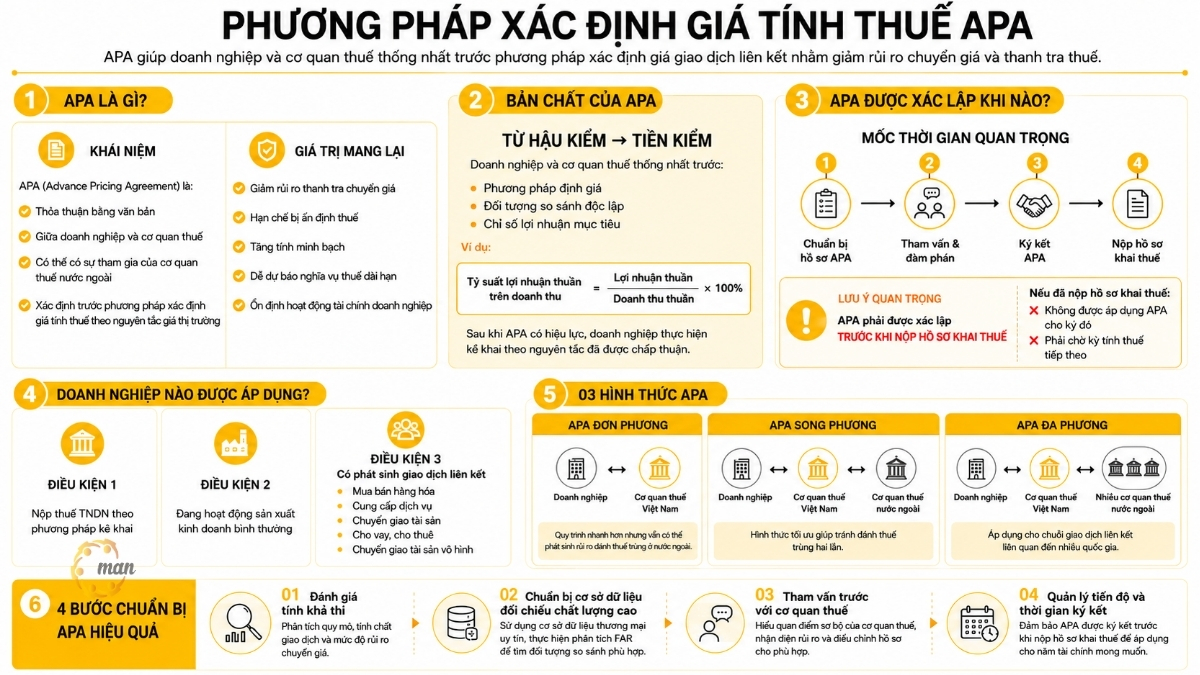
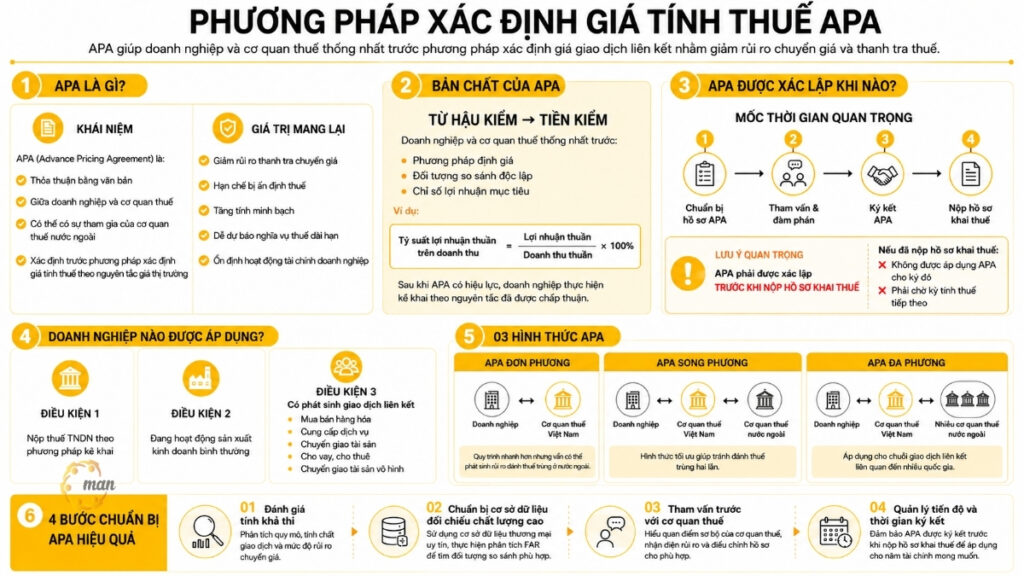
An Advance Pricing Agreement (APA) is a written agreement between the tax authority and the taxpayer, or between the tax authority and the taxpayer and a foreign tax authority or territory with which Vietnam has signed a double taxation avoidance and anti-tax evasion agreement for income tax for a specified period. This agreement specifically defines the tax base, the method of determining the taxable price, or the market price for tax calculation.
The essence of the APA (Authorized Approval) method for determining taxable value is a shift from a post-audit mechanism to a pre-audit mechanism. This is a highly consensual agreement, established in a spirit of bilateral or multilateral cooperation.
Through this agreement, businesses and tax authorities sit down together to agree on a formula, a set of independent comparable entities, or target financial indicators such as gross margin or operating margin:
Net profit margin = (Net profit from business operations / Net revenue) x 100% |
Once the agreement has been signed, the business only needs to operate and file taxes according to the agreed rates, thereby completely eliminating the worry of tax adjustments or transfer pricing audits for transactions within the scope of the agreement throughout the validity period of the APA.
When is the Advance Pricing Agreement (APA) established?

One of the crucial questions for chief accountants and chief financial officers (CFOs) when planning taxes is determining the optimal time to file and sign this agreement. Businesses cannot arbitrarily request retroactive application or apply it at any time according to their subjective wishes.
Based on the last paragraph of Clause 16, Article 3 of the 2019 Tax Administration Law, this timeframe is stipulated extremely strictly:
A prior agreement on the method for determining the taxable price is established before the taxpayer submits their tax return.
This regulation is fully compatible with the proactive, risk-prevention nature of APA. To help businesses understand, here is a detailed analysis of the importance of this timeline:
- Mandatory pre-approval principle: Businesses must submit an application, go through a consultation and negotiation process, and reach a formal agreement with the tax authorities before filing their corporate income tax return for the first tax period in which APA is applied. If the tax return for that year has already been filed, the business will not be able to apply APA for that fiscal year and must wait until the next period.
- Avoiding the risk of legal disputes: Because the parties have reached an agreement before filing, the tax authorities will not conduct a re-audit of the valuation method for related-party transactions included in the APA. This provides complete peace of mind for the business operations.
- Early preparation is required: Negotiating an APA (especially a bilateral or multilateral APA) is a lengthy process, ranging from one to several years, due to the complexity of the economic analysis involved. Therefore, to ensure the agreement is finalized on time before taxpayers file their tax returns, businesses need to proactively plan and submit their applications very early, right at the start of the investment project or before a new business cycle.
Can businesses with related-party transactions apply the APA (Authorized Purchase Agreement) pricing method for tax purposes?

The answer is definitely yes. In fact, businesses that conduct transactions with related parties are not only eligible to apply this mechanism, but are also the target and central focus of this mechanism aimed at minimizing the burden of administrative compliance.
Specifically, Clause 1, Article 41 of Decree 126/2020/ND-CP, which provides detailed guidance on the application of the advance pricing mechanism for related-party transactions, clearly states:
Taxpayers subject to corporate income tax under the declaration method who, during their business operations, have transactions with related parties, are entitled to request the application of the Advance Pricing Agreement (APA) mechanism.
Based on the above regulations, in order to be eligible to propose the application of the APA (Advanced Pricing Agreement) method for determining taxable prices, businesses only need to meet the following three basic conditions:
- Regarding the declaration method: This applies to businesses that pay corporate income tax using the declaration method in Vietnam (this does not apply to businesses that pay tax directly on revenue).
- Regarding operational status: Currently engaged in normal and stable production and business operations in Vietnam.
- In terms of the nature of the transaction: Related-party transactions occur (transactions involving the purchase, sale, exchange, lease, rental, borrowing, lending, transfer of goods, services, intangible assets, etc., with related parties as defined by current tax laws).
This is considered a legitimate and extremely important right that helps FDI enterprises and multinational corporations stabilize their investment and business environment in Vietnam, avoiding unnecessary financial fluctuations arising from prolonged transfer pricing audits.
Conditions and principles for applying the APA tax valuation method.

Although businesses have the right to voluntarily propose such agreements, the tax authorities' approval and signing of the agreement requires businesses to meet very strict technical standards. According to Clause 2, Article 41 of Decree 126/2020/ND-CP, the application of such agreements must strictly adhere to the principles stipulated in Clause 6, Article 42 of the 2019 Law on Tax Administration.
Specifically, the core principles include:
The principle of consensus based on proposals and forms of agreement.
The application of the advance pricing mechanism is based on the taxpayer's proposal, the agreement between the tax authority and the taxpayer through unilateral, bilateral, and multilateral agreements between the tax authority, the taxpayer, and the relevant foreign tax authority or territory.
This principle affirms the equitable and consensual nature of APA. Depending on the supply chain structure and the parent company's country of origin, businesses can choose one of the following three methods to apply the APA pricing method:
- Unilateral APA: An agreement signed only between the taxpayer and the Vietnamese tax authorities. This process is usually faster but does not completely eliminate the risk of double taxation from the partner country where the related party resides.
- Bilateral APA: This involves negotiations and agreement between the Vietnamese tax authorities, the taxpayer, and the foreign tax authorities (where the affiliated company conducting the transaction resides). This is the most optimal method to avoid double taxation.
- Multilateral APA: This applies when a related-party transaction chain spans multiple countries, requiring the agreement of the Vietnamese tax authorities along with the tax authorities of the relevant countries.
The principle of proof by commercial databases has legal validity.
The application of a pre-agreement mechanism on the method of determining the taxable price must be based on taxpayer information and a legally verified commercial database.
This is the biggest technical hurdle businesses must overcome. Any argument for selecting an appropriate APA (Authorized Purchase Agreement) pricing method (such as the independent transaction price comparison method, the resale price method, the cost plus profit method, or the profit margin comparison method) must be based on objective data. Businesses are required to prepare supporting documentation based on:
- Internal financial information is transparent and subject to clear, independent audits.
- Reputable global trade databases (e.g., Orbis, Bloomberg, etc.) with clear origins and recognized by Vietnamese and international tax authorities are used to find independent businesses with similar functions for profit margin comparison.
Therefore, consultation is essential. related party transaction advisory services Consulting with specialized and experienced units like MAN – Master Accountant Network is the optimal solution for FDI businesses today to build a solid portfolio and minimize potential risks.
Principle of ultimate approval authority
The application of the pre-agreement mechanism on the method of determining the taxable price must be approved by the Minister of Finance before implementation; for bilateral and multilateral agreements involving foreign tax authorities, the provisions of the law on international treaties and agreements shall apply.
The final approval authority for all APA agreements in Vietnam rests with the Minister of Finance. This highlights the national importance of this mechanism. For bilateral and multilateral agreements, the negotiation and approval process must also strictly adhere to Double Taxation Avoidance Agreements (DTAs) and other international commitments that Vietnam has signed.
Which entities are subject to the Advance Pricing Agreement (APA) mechanism applied to by the tax authorities?
To fully understand the legal structure of an APA agreement, businesses need to know which specific entities the Vietnamese tax authorities are authorized to establish this mechanism with, according to the law.
Based on Clause 9, Article 19 of the 2019 Tax Administration Law:
The tax authorities apply a mechanism of prior agreement on the method of determining the taxable price with taxpayers, with foreign tax authorities, and with territories with which Vietnam has signed double taxation avoidance agreements and tax evasion prevention agreements with respect to income tax.
Thus, the entities directly involved in signing and implementing the Advance Pricing Agreement (APA) with the Vietnamese tax authorities include:
- Taxpayers: These are foreign-invested enterprises (FDI) or domestic enterprises with related-party transactions that meet the conditions in Article 41 of Decree 126/2020/ND-CP (as analyzed in section 4).
- Foreign tax authorities or territories: A prerequisite for Vietnamese tax authorities to negotiate bilateral/multilateral APAs is that the country or territory must have a valid Double Taxation Avoidance and Anti-Tax Evasion Agreement with Vietnam.
This regulation aims to ensure the legitimate tax revenue interests of the Vietnamese state, prevent the erosion of tax revenue sources, and create a parallel protection mechanism to help businesses avoid double taxation in both the origin and destination countries of related-party transactions.
Practical solutions for businesses when preparing APA documents in 2026.
Implementing the APA (Authorized Approval) method for determining taxable value offers significant benefits, but in return, the process requires thorough investment and perseverance. To best prepare for fiscal year 2026, businesses should refer to the steps below:
- Step 1 – Feasibility Assessment: Businesses need to analyze whether the scale of their related-party transactions is large enough and the nature of the transactions is complex enough to qualify for this APA method. Generally, transactions with high value, repeated over many years, and with a high transfer pricing risk are the most suitable.
- Step 2: Prepare a high-quality comparative database: Adhering to the principle in Clause 6, Article 42 of the Law on Tax Administration, businesses need to invest in purchasing or leasing highly reliable commercial databases to conduct a filtering process to find the most similar independent comparable entities in terms of function, assets, and risks (FAR Analysis).
- Step 3 – Conduct preliminary consultation: Before submitting the official application, businesses should send a request for informal consultation to the tax authorities. This step helps businesses understand the tax authorities' preliminary views, identify potential risks that may arise during the formal negotiations, and adjust the application accordingly.
- Step 4 – Strict Time Management: Always remember that the agreement must be signed before filing your tax return. Any delays in data preparation or negotiation could cause your business to lose the opportunity to apply for the desired fiscal year.
To reduce manpower pressure and optimize the accuracy of records, businesses can proactively consider this option. hire someone to prepare related party transaction documents. from reputable sources to ensure the quality of comparative trade databases is always compliant with the law.
Frequently Asked Questions about the APA Taxable Price Determination Method
No. An APA is a voluntary mechanism proposed by taxpayers to the tax authorities to agree in advance on a method for determining the taxable price for related-party transactions.
According to current regulations, the specific timeframe is determined in the agreement between the business and the tax authority, based on the characteristics of the transaction and the actual documentation.
Unilateral APAs are signed between businesses and Vietnamese tax authorities. Bilateral APAs involve foreign tax authorities to mitigate the risk of double taxation.Is an APA mandatory for businesses with related-party transactions?
How long is an APA agreement valid?
What is the difference between unilateral and bilateral APAs?
Conclude
The Advance Pricing Agreement (APA) mechanism is a strategic solution for managing tax risks for businesses with related-party transactions in Vietnam. By adhering to the detailed guidelines in the 2019 Tax Administration Law and Decree 126/2020/ND-CP, businesses can proactively protect themselves against the risks of transfer pricing tax assessments, creating a safe, transparent, and sustainable operating environment in the long term.
Contact MAN – Master Accountant Network For free consultation and prompt support!
Contact information MAN – Master Accountant Network
- Address: No. 19A, Street 43, Tan Thuan Ward, Ho Chi Minh City
- Mobile/Zalo: 0903 963 163 – 0903 428 622
- Email: man@man.net.vn
Content production by: Mr. Le Hoang Tuyen – Founder & CEO of MAN – Master Accountant Network, CPA Vietnam auditors with over 30 years of experience in accounting, auditing, and financial consulting.