





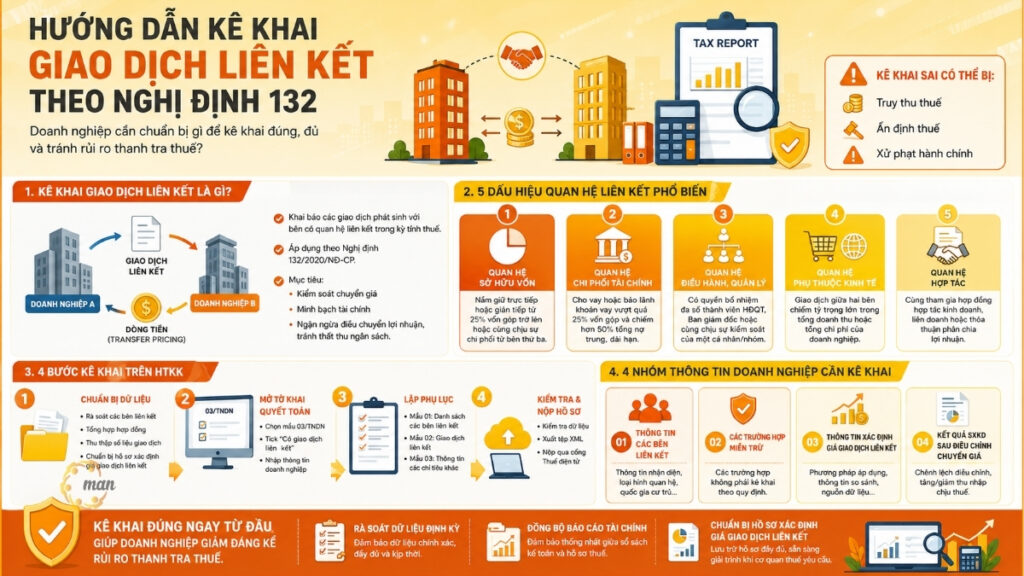
In the context of increasingly stringent tax authorities' anti-transfer pricing measures, declaring related-party transactions under Decree 132 has become a mandatory obligation for many businesses with transactions involving related parties. More than just an administrative procedure, proper declaration helps businesses increase transparency in their financial operations, reduce the risk of tax arrears, tax assessments, or administrative penalties.
In reality, many businesses still make mistakes when declaring related-party transactions according to Decree 132 due to incorrect identification of the related-party relationship, missing appendices, or applying the wrong method for determining independent transaction prices. This can lead to serious financial consequences and directly affect the company's reputation during tax audits and inspections.
What constitutes declaring related-party transactions according to Decree 132?
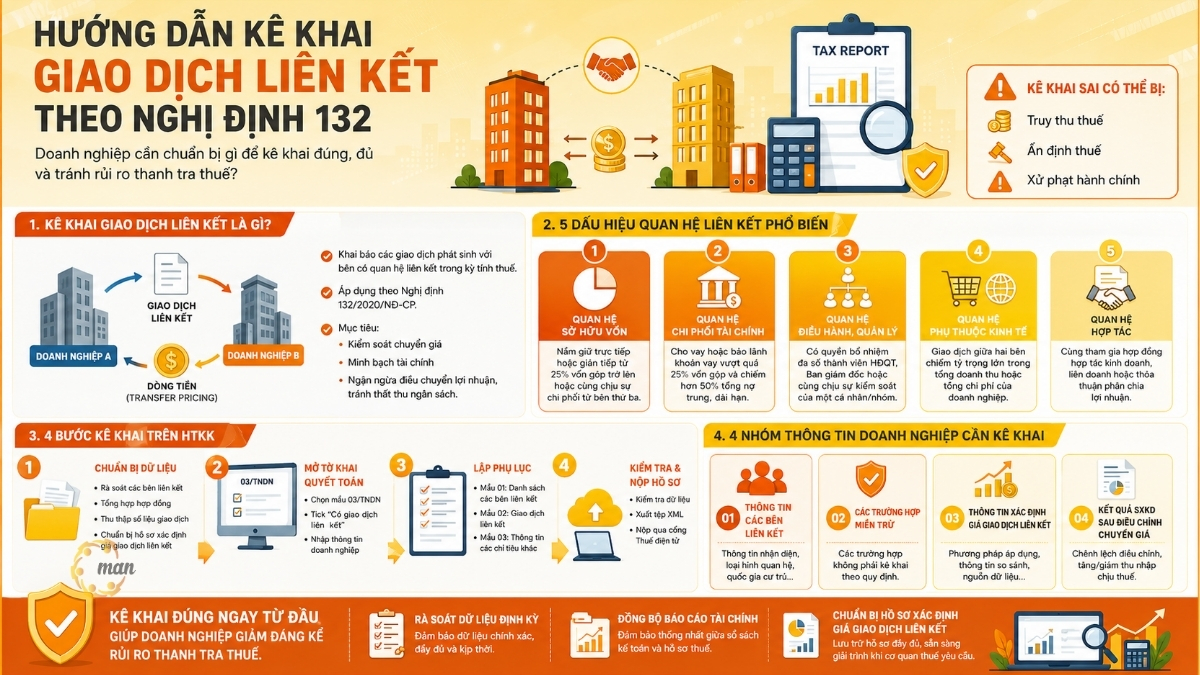
Declaring related-party transactions under Decree 132 is the process by which businesses provide information to the tax authorities about transactions arising with related parties during the tax period. The declaration includes:
- Information to identify affiliated parties
- Type of relationship
- Transaction value generated
- Methods for determining transfer pricing
- Results of business operations after adjustment for transfer pricing.
The objective of declaring related-party transactions under Decree 132 is to help tax authorities control transfer pricing activities, ensure the arm's length principle, and prevent profit shifting aimed at reducing tax obligations.
According to Decree 132/2020/ND-CP, An affiliated relationship is defined when one party directly or indirectly participates in the management, control, capital contribution, or investment in the other party; or when both parties are under the control of a third party.
Why do businesses have to declare related-party transactions?

Declaring related-party transactions under Decree 132 is not only a mandatory legal requirement but also has significant implications for corporate tax management. When declared fully and accurately, businesses can:
- Minimize the risk of being subject to retroactive corporate income tax collection.
- Reduce the risk of being assessed taxes during an audit.
- Demonstrate the transparency of financial operations.
- Effectively control internal transfer pricing risks.
- Synchronize data between financial reports and tax records.
Conversely, failure to comply with Decree 132 may result in administrative penalties for tax violations, disallowance of unreasonable expenses, or an upward adjustment of taxable income.
Cases considered to be linked

According to Clause 2, Article 5 of Decree 132/2020/ND-CP, an enterprise is considered to have an affiliated relationship if it falls into one of the following cases:
Capital ownership relations
One party directly or indirectly holds 25% or more of the other party's capital contribution; or both parties together hold at least 25% of capital contribution owned by the same third party.
Additionally, a shareholder owning at least 101% of the total voting shares of the company may also be considered an affiliated company according to regulations.
Financial control relationship
A lender or guarantor provides a loan with a value exceeding 25% of the borrower's equity and simultaneously accounts for more than 50% of the borrower's total medium and long-term debt.
This is one of the common types of relationships that need to be considered when declaring related-party transactions according to Decree 132.
Executive and management relationships
One business has the right to appoint a majority of the members of the Board of Directors, the Management Board, or key management positions of the remaining business.
Additionally, two businesses that are controlled by the same individual or group of individuals are also considered to be related.
Economic interdependence
If the buying and selling of goods or provision of services between the two parties accounts for a significant proportion of the total revenue or total expenses of the business, then an affiliated relationship may also arise.
For example, a business that relies heavily on revenue from a single customer might be considered to have signs of economic collusion.
Relationship through a cooperation agreement.
Parties involved in business cooperation contracts, joint ventures, or profit-sharing agreements are also subject to the requirement of declaring related-party transactions according to Decree 132.
See also: Forms of related party transactions
How to declare related-party transactions according to Decree 132 on the HTKK system?
Currently, businesses declare related-party transactions according to Decree 132 through the Tax Declaration Support Software (HTKK) of the General Department of Taxation.
The basic process includes the following steps:
Step 1: Prepare affiliate transaction information
Businesses need to review all related parties and transactions that occurred during the period, including:
- Buying and selling goods
- Providing services
- Borrowing and lending
- Transfer of assets
- Payment of royalties
- Internal cost sharing.
At the same time, it is necessary to determine an appropriate valuation method in accordance with the arm's-length principle.
Step 2: Open the Corporate Income Tax Return form.
On the HTKK software, businesses select:
- Corporate Income Tax Return Form 03/TNDN
- Check the box "Transactions have occurred"“
After this step, the system will display the relevant appendices for declaration.
Step 3: Prepare an addendum to the related party transaction.
Depending on the specific circumstances, businesses will fill out the following forms:
- Form No. 01: Information on related party relationships and related party transactions
- Form No. 02: List of information and documents to be provided
- Form No. 03: Information exempted from preparing documentation for determining transfer pricing.
During the process declaration of related party transactions, Businesses need to ensure that the data is consistent with their financial statements and transfer pricing documentation.
Step 4: Review and submit your application.
After completing the data, the business:
- Check for errors in HTKK.
- Export XML file
- Submit electronic documents through the General Department of Taxation's portal.
Filing on time is crucial to avoid administrative penalties for tax violations.
See details: Detailed instructions for declaring related-party transactions on HTKK software.
The criteria in the Appendix on Related-Party Transactions
Understanding the content and criteria in the appendix on related-party transactions is a crucial step in the process of declaring related-party transactions. This is because it forms the basis for the tax authorities to assess the nature of the related-party relationship, the pricing method, and the extent of the enterprise's compliance with anti-transfer pricing regulations. Each item in the appendix has its own role, requiring taxpayers to declare accurately and consistently with their financial statements and related-party transaction pricing documentation. Below is the important information in each item of the appendix.
Section I: Information of related parties
This section is used to declare the identifying information of the affiliated parties, including:
- Name of the affiliated business or individual
- Tax code
- Country or territory of operation
- Forms of association
Businesses need to correctly identify the related-party relationship symbols as prescribed to avoid errors in declaring related-party transactions under Decree 132.
For foreign organizations and individuals that do not yet have a tax identification number in Vietnam, the identification code must be clearly stated or an explanation provided for the lack of tax information.
Section II: Exemptions
According to regulations, businesses may be partially exempted from the obligation to declare related-party transactions under Decree 132 in the following cases:
- Transactions only occur with affiliated businesses located in Vietnam.
- The parties apply the same corporate income tax rate.
- Neither side is entitled to tax incentives.
Additionally, businesses are exempt from preparing transfer pricing documentation if:
- Total revenue under 50 billion VND
- Total value of related-party transactions is under 30 billion VND.
Or, if you have signed an APA and fulfilled all reporting obligations as required.
See details: No related-party transaction documentation is required.
Section III: Information on determining transfer pricing
This is the most important part of the declaration of related-party transactions under Decree 132, reflecting the valuation method applied to each related-party transaction.
Businesses may apply the methods stipulated in the Decree:
- Compare prices of independent transactions.
- Resale price
- Cost plus profit
- Comparison of net profit
- Profit allocation
In addition to choosing the appropriate method, businesses need to prepare independent comparative data to demonstrate that the transaction price is reasonable according to market principles.
Inadequate declarations or the use of inappropriate data may lead the tax authorities to reject the pricing method and make tax adjustments.
Section IV: Business results after transfer pricing adjustments
Section IV reflects the business results of the enterprise after adjusting for related-party transactions according to the independent pricing principle.
Businesses need to provide complete information:
- Adjusted revenue
- Adjusted cost of goods sold
- Financial costs
- EBIT, EBITDA
- Adjusted corporate income tax
These figures must be consistent with tax return records and financial statements.
During the tax declaration process, if discrepancies arise between accounting figures and figures after transfer pricing adjustments, businesses need to provide clear explanations to avoid audit risks.
What should businesses keep in mind when declaring related-party transactions?
To mitigate risks during the process of declaring related-party transactions under Decree 132, businesses need to pay special attention to the following:
- Accurately identify the relationship between the two parties right from the beginning of the period.
- Keep complete records of contracts and transactions.
- Synchronize data between HTKK, financial reports, and transfer pricing documents.
- Monitor current regulations regarding interest expense limits.
- Review profit margins against industry data.
- Proactively prepare documentation for determining transfer pricing before tax authorities conduct an audit.
In addition, businesses should conduct regular reviews to detect early any data discrepancies or transactions that may pose tax risks.
Frequently Asked Questions when declaring related-party transactions according to Decree 132
Yes. The obligation to declare related-party transactions under Decree 132 is determined based on whether a related-party relationship and related-party transaction occur during the tax period, regardless of whether the business is profitable or loss-making. Even if the business is in the investment phase, has not yet generated profits, or has incurred losses for many consecutive years, it must still declare all relevant appendices if it falls under the applicable regulations.
Yes. Loan transactions, loan guarantees, or internal financing between related parties are all subject to the regulations of Decree 132. Businesses must fully declare information about the loan, interest rate, loan term, and independent transaction pricing method to demonstrate that the transaction conforms to market conditions.
Yes, it is possible. If errors are discovered after submitting tax return documents, businesses have the right to submit supplementary tax returns in accordance with the Law on Tax Administration. However, the adjustments must be made before the tax authorities announce a decision to conduct an inspection or audit.
Yes. Many small businesses believe that only large corporations are required to declare related-party transactions according to Decree 132; however, in reality, any business with related-party transactions may fall within the scope of application.If a business does not generate profit but has related-party transactions, is it required to declare them?
Do intercompany loan transactions need to be declared as related-party transactions?
Is it possible to submit the related-party transaction declaration after the tax return has been filed?
Do small businesses need to be concerned with reporting related-party transactions?
Conclude
Declaring related-party transactions under Decree 132 is a crucial obligation for businesses with related-party transactions. Not only does it help meet legal requirements, but accurate and complete declaration also serves as a mechanism to protect businesses from risks related to tax audits, tax collection, and penalties.
In the context of increased tax authorities' scrutiny of transfer pricing activities, businesses need to proactively build a transparent data system, choose appropriate pricing methods, and standardize tax declaration documents from the beginning of each tax period. This is the foundation for businesses to maintain stable operations, mitigate legal risks, and optimize long-term tax management efficiency.
Contact MAN – Master Accountant Network For free support and advice!
Contact information MAN – Master Accountant Network
- Address: No. 19A, Street 43, Tan Thuan Ward, Ho Chi Minh City
- Mobile/Zalo: 0903 963 163 – 0903 428 622
- Email: man@man.net.vn
Content production by: Mr. Le Hoang Tuyen – Founder and CEO of MAN – Master Accountant Network, CPA Vietnam auditors with over 30 years of experience in accounting, auditing, and financial consulting.