




As tax authorities continue to tighten their transfer pricing audits, accurately reporting information on related-party transactions has become a mandatory requirement for many businesses. However, many accountants and business owners still face difficulties in identifying related parties, determining the appropriate reporting methods, or completing the required schedules in accordance with regulations.
The following article provides a comprehensive, easy-to-understand guide to preparing a related-party transaction report that strictly adheres to current regulations, helping businesses minimize errors and avoid the risk of back taxes or tax penalties.
What is a related-party transaction report?
The Related-Party Transaction Report is a set of schedules that disclose information about related-party relationships and transactions between a business and its related parties during the tax period. This report is filed along with the annual corporate income tax return.
The purpose of the filing is to help tax authorities monitor transactions that may involve transfer pricing and ensure compliance with the arm’s-length principle among related parties.
Under current regulations, businesses that engage in related-party transactions must fully disclose information regarding:
- Affiliate relationships;
- Value of related-party transactions;
- Methods for determining transaction prices;
- Profit margin;
- Obligations to report and maintain records for determining the price of related-party transactions.
Which entities are required to file a related-party transaction report?

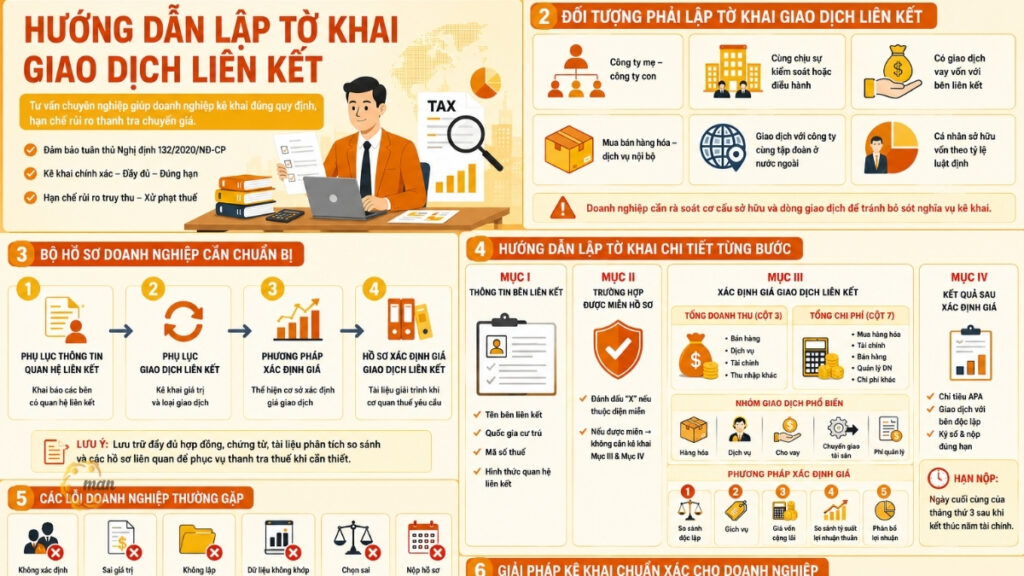
When preparing a related-party transaction report, a business must first determine whether it is required to file such a report. Generally, a business is required to file a report if it falls under one of the following circumstances:
- Parent-subsidiary relationships;
- Are under the common management or control of an organization or individual;
- There were transactions involving loans, the purchase or sale of goods, and services with related parties;
- There are individuals who hold equity interests in accordance with the statutory ratio;
- We conduct business with overseas companies that are part of the same corporate group.
Common transactions you may encounter:
- Buying and selling raw materials;
- Lending – borrowing;
- Transfer of assets;
- Provide internal services;
- Pay management fees;
- Technology transfer or licensing.
Business accountants need to carefully review the ownership structure and transaction flows to avoid overlooking any reporting obligations.
What does a related-party transaction disclosure form include?
Businesses must prepare all required attachments in accordance with regulations. Below is a summary of the documents businesses need to prepare:
| Documents Required | Content |
| Appendix: Affiliate Information | Disclosure of Related Parties |
| Related Party Transaction Appendix | Report the value and type of transaction |
| Appendix Defining Valuation Methods | Explanation of the Basis for Determining the Transaction Price |
| Transfer pricing determination dossier | Supporting documentation to be provided upon request by the tax authority |
Note: In addition, businesses must retain accounting documents, contracts, comparative analysis materials, and other relevant records to assist with tax audits when necessary.
Step-by-Step Guide to Preparing a Detailed Related-Party Transaction Report
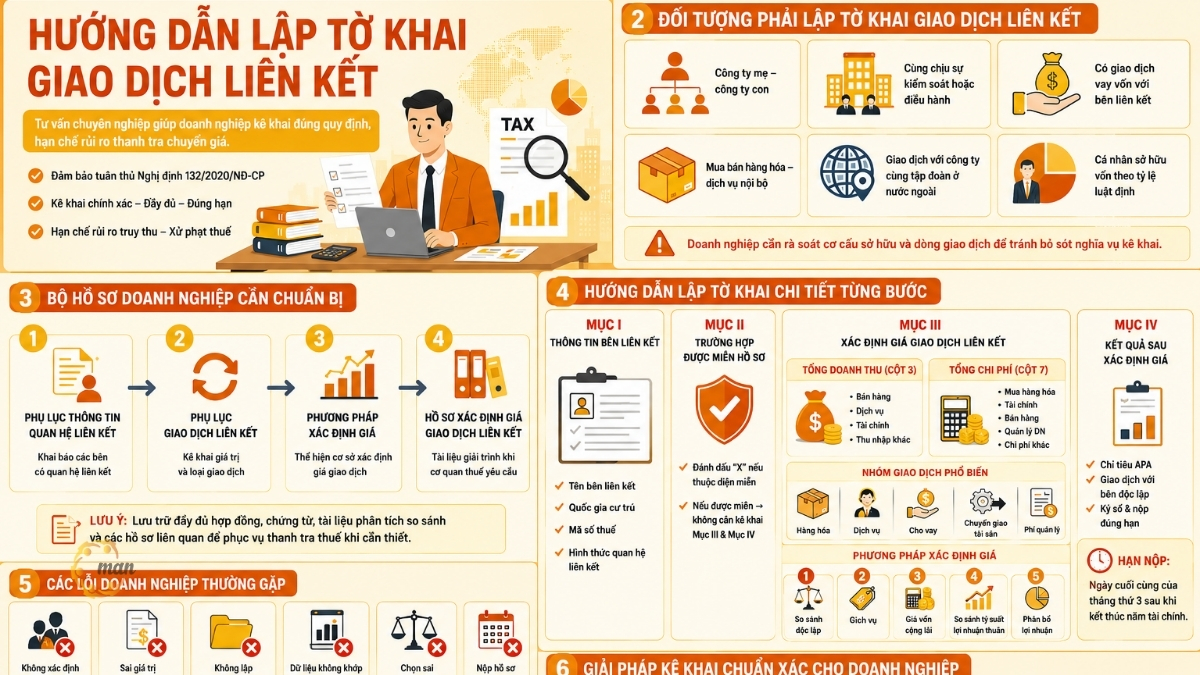
Below is the most detailed guide to preparing a related-party transaction report:
Section I: Information about Affiliated Parties
This section provides general information and an overview of the affiliate, specifically as follows:
Column (2): Name of the affiliated party
Taxpayers must provide the full names of each related party with whom transactions occurred during the reporting period.
For organizations and individuals in Vietnam:
- For businesses, the information must be recorded exactly as stated in the Business Registration Certificate or tax registration documents.
- If you are an individual, use the information from your valid National ID Card or passport.
For organizations and individuals abroad:
- The information reported is based on documents that establish the related-party relationship, such as business licenses, contracts, transaction agreements, or relevant legal records between the taxpayer and the related party.
Column (3): Country/Territory of Residence
Specify the name of the country or territory where the affiliate is deemed to be a tax resident.
Column (4): Tax ID number of the affiliated party
- For domestic organizations and individuals: fully disclose the tax identification number as stated in the tax registration.
- For foreign entities: Enter the tax identification number or tax ID from the country of residence. If this information is not available, the business must specify the reason.
Column (5): Form of association relationship
A business determines related-party relationships in accordance with the provisions of Decree 132/2020/ND-CP and mark an “X” in the corresponding box.
If an affiliated party falls under multiple categories of affiliated relationships at the same time, check the appropriate boxes.
Note: Section I lists only those related parties that engaged in related-party transactions during the tax period, as required by law.
Section II: Cases Exempt from Preparing a File to Determine the Price of Related-Party Transactions
If the business is eligible for an exemption from filing or from preparing a transfer pricing documentation file under Decree 132, mark an “X” in the corresponding box in the “Exemption” column.
- If a business falls under one of the cases exempt from preparing a pricing documentation file as prescribed, it is not required to complete Sections III and IV of Form No. 01.
- If a business is required to prepare a pricing documentation file, it must complete Sections III and IV in detail and in full.
See also: No related-party transaction documentation is required.
Section III: Information on determining transfer pricing
In this section, there are two scenarios:
Cases Exempt from Preparing a Price Determination File
If the business has checked the box to be exempt from filing a report in Section II, it should report as follows:
- Columns (3), (7), (12): Report according to the corresponding instructions in the appendix.
- Columns (4), (5), (6), (8), (9), (10), (11): Leave blank.
In cases where a business is not eligible for an exemption from preparing a pricing documentation file
Report the “Total value of related-party transactions arising from business operations.”.
Column (3): Total Revenue
Record all revenue generated from both related parties and independent parties, including:
- Sales revenue;
- Revenue from the provision of services;
- Financial revenue;
- Other income.
Excludes collections on behalf of others.
Column (7): Total expenses incurred
Report the total expenses payable to both related parties and independent parties, including:
- Costs of purchasing goods and services;
- Financial expenses;
- Cost of goods sold;
- Business management costs;
- Other expenses.
Excludes expenses paid on behalf of others.
Note: Columns (4), (5), (6), (8), (9), (10), (11), (12), and (13) do not need to be reported in this field.
Indicator: Total transaction value arising from related-party activities
In that case, the data in columns (3), (4), (7), and (8) were compiled from:
- Transaction value of goods;
- Transaction value for services.
Commodity Indicators Group
Shows the total value of goods. The corresponding columns are identified by:
- Goods that constitute fixed assets;
- Plus inventory that does not constitute fixed assets.
Of these, the goods that constitute the corresponding fixed assets are:
- Columns (3) and (7): Record the purchase or sale price of fixed assets with an affiliated party based on the accounting records.
- Columns (4) and (8): Report the transaction value after it has been restated using the appropriate transfer pricing method.
Goods that do not constitute fixed assets:
- Columns (3) and (7): Record the value of regular sales and purchases of goods with related parties as per the accounting records.
- Columns (4) and (8): Report the values restated using the transfer pricing method.
Service Indicators Group
The total value of services includes the sum of the following amounts:
- Research and Development;
- Advertising, marketing;
- Management, consulting, training;
- Financial Activities;
- Other services.
Detailed services:
- Columns (3) and (7): Record the actual amounts in the accounting records for each type of service provided to an affiliated party.
- Columns (4) and (8): Record the values restated using the transfer pricing method.
Methods for determining transfer pricing
Columns (6) and (10) indicate the method used to determine the price of related-party transactions. The enterprise records the corresponding method code applied to each transaction:
- Comparison of independent transaction prices.
- The resale method.
- Cost-plus method.
- The method of comparing net profit margins.
- Profit allocation method.
These methods are implemented in accordance with Decree No. 132/2020/ND-CP and related guidance documents.
The remaining columns in Section III should be filled out as follows:
- Columns (5) and (9): Enter the values calculated according to the formula specified in Form No. 01 issued pursuant to Decree 132.
- Column (11): Reflects the additional profit resulting from the adjustment based on the arm's-length transaction price.
- Column (12): Report total revenue collected on behalf of others, total expenses paid on behalf of others, revenue allocated to the permanent establishment, and expenses allocated to the permanent establishment.
Section IV: Operating Results Following the Determination of Transfer Pricing
In Section IV, report the APA indicators and cases that arise only in transactions with independent parties.
APA Guidelines
If the business has previously entered into an Advance Pricing Agreement (APA) with the Vietnamese tax authorities regarding the method for determining the taxable value, check “Yes.”.
APA may include:
- APA (single-sided);
- Bilateral APA;
- Multilateral APA.
If you haven't signed the APA yet:
- Check “No.”.
- There is no need to report the figures in column (4) of the business performance report.
In cases where transactions occur only with independent parties
Businesses need only report the figures in column (6) in accordance with their type of business and the corresponding indicators, as specified in the appendix.
After completing the filing, the business must:
- Verify the data;
- Digital signature;
- Submit the corporate income tax final return along with the application by the deadline.
Generally, the filing deadline is the last day of the third month following the end of the fiscal year. Businesses should retain all relevant records for future tax audits and inspections.
Common Errors in Preparing Related-Party Transaction Reports

In fact, many businesses have had their tax filings rejected by the tax authorities, resulting in back taxes or penalties. The main reasons are:
- The affiliated party has not been fully identified;
- Failure to report loan transactions;
- Incorrect transaction value;
- No appraisal report was prepared;
- Choosing the wrong comparison method;
- The data does not match the financial statements;
- Late filing of tax returns.
Many businesses today, even though they have filed their tax returns, are still being asked by the tax authorities to provide explanations due to illogical data or the incorrect selection of a pricing method. This is also why an increasing number of businesses are turning to related party transaction advisory services to have their records reviewed, data standardized, and to receive assistance in addressing transfer pricing risks in accordance with Decree 132.
MAN—Master Accountant Network—helps businesses file their tax returns accurately
To make the tax return filing process more efficient, businesses should:
- Review affiliate relationships right at the start of the year;
- Monitor internal transactions regularly;
- Standardize contracts and documents;
- Prepare documentation to determine transfer pricing in parallel with business operations;
- Reconcile accounting data on a regular basis;
- Reference related party transaction documentation service for complex transactions.
Conclude
Accurate and complete reporting of related-party transaction information not only helps businesses comply with legal regulations but also minimizes future tax and transfer pricing risks.
We hope this guide on preparing related-party transaction reports has helped businesses understand the process, the step-by-step filing procedure, and important considerations for completing the documentation accurately and on time. If a business has a complex related-party structure or engages in cross-border transactions, it should seek additional advice from a tax expert to ensure legal compliance and optimize compliance costs.
Contact MAN – Master Accountant Network For free support and advice!
Contact information MAN – Master Accountant Network
- Address: No. 19A, Street 43, Tan Thuan Ward, Ho Chi Minh City
- Mobile/Zalo: 0903 963 163 – 0903 428 622
- Email: man@man.net.vn
Content production by: Mr. Le Hoang Tuyen – Founder and CEO of MAN – Master Accountant Network, CPA Vietnam auditors with over 30 years of experience in accounting, auditing, and financial consulting.