





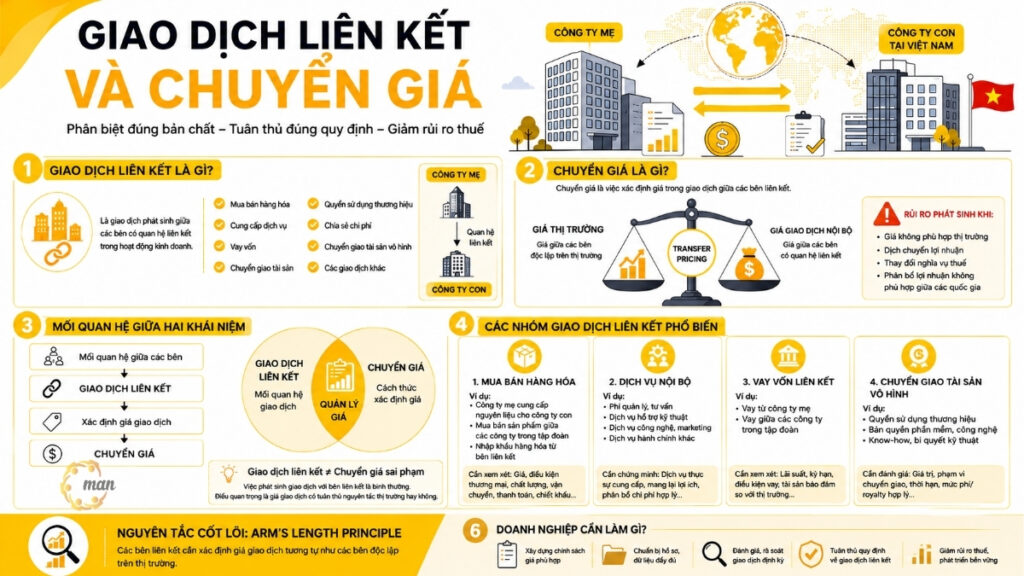
In the context of deep economic integration, an increasing number of Vietnamese businesses are participating in global value chains, especially foreign-invested enterprises (FDI), multinational corporations, or businesses with ownership or control relationships with other organizations.
Along with this development, related-party transactions and transfer pricing have become one of the important issues in corporate tax management. This is not only related to tax declaration obligations but also directly affects the determination of reasonable profits and expenses, as well as the risks when tax authorities conduct audits and inspections.
However, many businesses still confuse these two concepts. Related-party transactions do not equate to illegal transfer pricing. Transactions between businesses and related parties are normal within a corporate structure, but the crucial issue lies in determining whether the transaction prices comply with market principles.
A proper understanding of related-party transactions and transfer pricing helps businesses proactively develop pricing policies, prepare supporting documentation, and mitigate tax risks during their operations.
Overview of related-party transactions and transfer pricing.
What is affiliate trading?
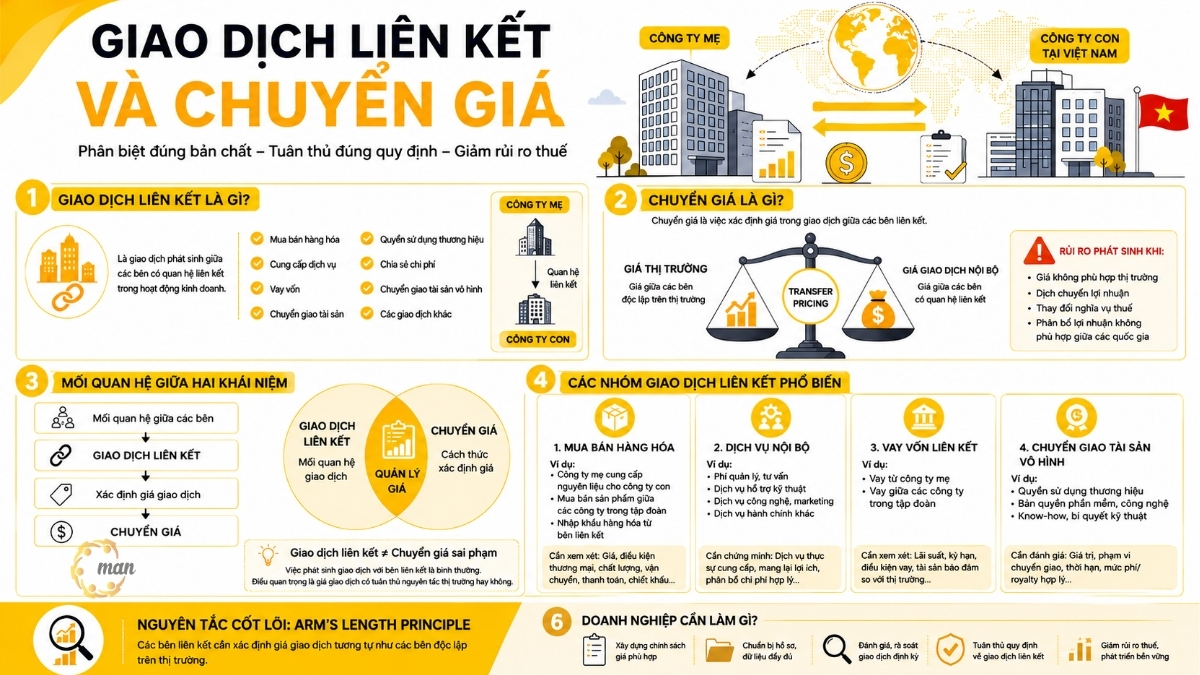
Related-party transactions are understood as transactions arising between parties that have a related relationship in the course of their production and business activities.
These transactions may include:
- Buying and selling goods
- Providing services
- Transfer of assets
- Lending, borrowing
- Transfer of the right to use intangible assets
- Cost sharing
- Granting the right to use trademarks and technologies.
The key to determining whether a transaction is a related-party transaction lies in the relationship between the parties involved.
For example: A manufacturing company in Vietnam purchases raw materials from its parent company abroad. These two businesses have a parent-subsidiary relationship, so the purchase and sale of raw materials is considered an related-party transaction.
What is transfer pricing?
Transfer pricing is the process of determining prices in transactions between related parties.
Transfer pricing is not inherently a wrongdoing. Businesses within the same group can absolutely develop internal pricing policies to serve their management objectives.
However, problems arise when the transaction prices between related parties do not accurately reflect market value, leading to:
- Profit shifting between businesses;
- To change tax obligations;
- Profit distribution is uneven among countries.
For example: A parent company sells raw materials to its subsidiary in Vietnam. The market price is $100 per product, but the internal transaction price is $150 per product.
Without a reasonable basis for this price, the business could be questioned about manipulating profits through purchase prices.
The relationship between related-party transactions and transfer pricing.
Simply put:
- Related party transactions are transactional relationships.
- Transfer pricing is the method used to determine the price in a transaction.
For example: Company A in Vietnam purchases goods from its foreign parent company at a price equivalent to the market price, with complete contracts, supporting data, and a suitable pricing method.
This is a valid affiliate transaction.
Conversely, if the parent company sells goods at unusually high prices to increase costs in Vietnam, reduce taxable profits, and transfer profits abroad, transfer pricing risks may arise.
For businesses with related-party transactions, understanding the nature of related-party transactions and transfer pricing is crucial to ensuring tax compliance. However, in practice, many businesses still struggle to determine which transactions fall under their jurisdiction, how to develop appropriate pricing policies, and how to prepare supporting documentation for tax audits. In this case, businesses can refer to the following information. related party transaction advisory services to receive support in risk assessment, transaction review, and development of appropriate compliance plans.
Common scenarios involving related-party transactions.

In business practice, related-party transactions can arise in various aspects depending on the organizational model, ownership structure, and operating methods of each enterprise. Particularly for enterprises belonging to multinational corporations or enterprises with ownership or control relationships with other parties, internal transactions frequently occur to serve overall production, business, and management activities.
However, each group of related-party transactions will have different characteristics, pricing methods, and risk levels. Some transactions may occur frequently, such as the buying and selling of goods, internal provision of services, borrowing, or transfer of intangible assets. These are also the types of transactions that tax authorities often consider when assessing the appropriateness of pricing policies and compliance with regulations on related-party transactions.
Below are some common types of related-party transactions that businesses need to be aware of:
Transactions involving the buying and selling of goods between related parties.
This is the most common type of transaction within corporations.
For example:
- The parent company supplies raw materials to the subsidiary.
- Companies within the group sell products to each other.
- Vietnamese businesses import goods from affiliated countries.
When evaluating this transaction, the business needs to consider:
- Trading price
- Terms of trade
- Product quality
- Shipping costs
- Payment terms
- Discount policy.
Not only the selling price, but all the terms of the transaction can affect the suitability of the deal.
Intercompany transaction
Many businesses incur service fees from their parent company or companies within the same group, such as:
- Management fee
- Consulting fees
- Technical support services
- Technology services
- Marketing services.
This is a group of transactions that are often of interest to tax authorities.
Businesses need to demonstrate:
- The service is actually provided.
- Businesses benefit from the service.
- Expenses incurred in the course of business operations.
- A rational cost allocation method.
For example: The parent company provides a software management system to its subsidiary in Vietnam. The business needs:
- Service contract
- Documents proving usage
- Pricing method.
Loan transactions between related parties
Internal lending transactions are also a common problem.
For example: The parent company lends capital to the subsidiary to expand its factory.
Factors to be evaluated:
- Is the loan real?
- Are the interest rates appropriate for the market?
- Loan term
- Guarantee conditions
- Ability to repay debt.
If borrowing interest rates are too high, a sharp increase in interest expenses can negatively impact taxable profits.
Transfer of intangible assets
Intangible assets include:
- Trademark
- Technology
- Software
- Patent rights
- Business secrets.
This is a complex group of transactions because determining their value is often more difficult than with tangible assets.
For example: Vietnamese companies pay trademark usage fees to their parent companies.
Businesses need to demonstrate:
- actual right of use
- brand value
- Methods for determining fees.
Determining whether a business is required to declare related-party transactions is crucial for tax compliance. Businesses need to review their related-party relationships, the types of transactions involved, and the applicable conditions to ensure compliance. For a clearer understanding of applicable cases, businesses can refer to detailed guidance on... Cases where related-party transactions must be declared. This aims to minimize the risk of errors during the declaration and documentation process.
The principle for determining transfer pricing is based on market prices.
One of the most important principles in managing related-party transactions is the Arm's Length Principle.
According to this principle:
Related parties must determine transaction prices in the same way that independent parties would agree under similar conditions.
In other words, businesses need to demonstrate that, without any collusion, independent parties in the market can trade at similar prices.
Methods of determining transfer pricing

To ensure that related-party transactions are determined in accordance with the arm's length principle and accurately reflect their true economic value, businesses need to choose a transfer pricing method that is appropriate for the characteristics of each type of transaction.
Choosing the appropriate method for determining transfer pricing should be based on the operational characteristics, functions, assets, and level of risk that each business assumes within the value chain. A suitable method not only helps businesses demonstrate the independence of the transaction but also minimizes risks during tax audits. For more in-depth assessment, businesses can explore further options. Transfer pricing services To receive support in data analysis, method selection, and profile building.
According to the principles of related-party transaction management, businesses can apply one of five pricing methods. Each method has a different scope of application and approach, suitable for specific business models.
Specifically, the methods for determining transfer pricing are analyzed as follows:
Independent transaction price comparison method
This method directly compares the price of a related-party transaction with a transaction between independent parties.
Example: Businesses selling the same product:
- For affiliated companies: $90
- For independent customers: $100
Businesses need to explain the difference.
Resale price method
This applies when a business purchases goods from an affiliated party and then resells them to an independent party.
How to determine:
Purchase price = Resale price – Appropriate profit margin |
Cost plus profit method
Typically applied to the following activities:
- Manufacture
- Machining
- Providing services.
Recipe:
Transaction price = Costs + Reasonable profit margin |
Profitability comparison method
This method evaluates profitability through indicators such as:
- profit margin;
- Profit margin on revenue;
- Profit margin on costs.
The business is compared to other independent businesses with similar characteristics.
Profit allocation method
Applicable in the following cases:
- Complex transactions
- Multiple parties contribute value.
- It is difficult to find data for direct comparison.
Signs that a business is at risk of transfer pricing.

Not all related-party transactions pose transfer pricing risks. However, during the process... Transfer pricing consultancy, Based on experience, MAN – Master Accountant Network has observed that tax authorities often focus on businesses with unusual characteristics in their operations, cost structure, or internal transaction policies. Early identification of these signs helps businesses proactively review and assess the appropriateness of transactions and prepare sufficient supporting evidence when necessary.
Some indicators commonly considered to be potential transfer pricing risks include:
FDI enterprises are consistently reporting losses.
A business that has been operating for many years but continuously:
- Revenue increased
- Expand production
- Still reporting losses.
This is likely to be further reviewed by the tax authorities regarding related-party transaction policies.
High internal service costs
For example, corporate management fees account for a large proportion of total costs. Therefore, the business needs to demonstrate:
- Is the service real?
- Are the allocated costs reasonable?
- Is there an economic benefit?
Large loan from an affiliated party
Risks typically come from:
- Inappropriate interest rates
- High interest costs
- Impact on taxable profit.
A real-world example illustrating related-party transactions and transfer pricing.
Let's assume: A Vietnamese company imports raw materials from its parent company in the US. The data is as follows:
- Market price: $10/kg
- Internal purchase price: 15 USD/kg
- Production volume: 100,000 kg
Difference:
Market difference = (15 – 10) x 100,000 = 500,000 USD |
This difference results in:
- Rising costs in Vietnam
- Reduced profits
- Reduce the amount of corporate income tax payable.
Businesses need to provide evidence to justify the higher price, such as:
- Ingredients of different quality
- Other delivery conditions
- Additional costs incurred (if any).
A comprehensive comparison table between related-party transactions and transfer pricing.
In practice, corporate tax management, related-party transactions and transfer pricing are often mentioned together, but they are not two identical concepts. Confusing these two terms can lead businesses to misassess their declaration and documentation obligations, as well as the level of risk involved in their operations. To clarify the differences, businesses can refer to the comparison table between related-party transactions and transfer pricing below.
| Criteria | Affiliate transactions | Transfer pricing |
| Concept | These are transactions that arise between related parties in the course of production and business activities, such as buying and selling goods, providing services, borrowing capital, transferring assets, etc. | This involves determining the price in transactions between related parties in order to allocate revenue, costs, and profits among the parties involved in the transaction. |
| Nature | A transactional relationship is defined by the fact that the parties have a relationship of ownership, control, or dominance over each other. | This is an issue related to how pricing is established and applied in related-party transactions. |
| Applicable objects | Businesses that have transactions with related parties are subject to the regulations on tax management for related-party transactions. | Businesses with related-party transactions need to determine transaction prices according to the principle of independence, consistent with market prices. |
| For example | The parent company in Japan sells raw materials to its subsidiary in Vietnam; the two companies within the same group provide services to each other. | The parent company sells raw materials to its subsidiary at significantly higher prices than the market rate in order to increase costs in Vietnam and shift profits overseas. |
| Purpose | Serving the business operations, supply chain management, or internal administration of a company or corporation. | This could be aimed at profit management, optimizing corporate operations, or potentially for profit shifting and reducing tax obligations if regulations are not complied with. |
| Is it always a violation? | No. The occurrence of related-party transactions is a normal practice within corporations and businesses that have ownership or control relationships. | Not all transfer pricing activities are violations. Risks arise when businesses determine prices not according to market principles or cannot demonstrate their reasonableness. |
| Assessment basis | Based on the relationship between the parties: ownership, control, dominance, parent-subsidiary relationship, etc. | Based on a comparison of prices, profits, and trading conditions with similar independent transactions. |
| Main content | Determine whether the business falls under the category of having related-party transactions; identify the type of related-party transaction that occurred. | Selecting an appropriate pricing method, performing FAR functional analysis, preparing supporting documentation, and ensuring that the transaction price is in line with market conditions. |
| Tax Risk | Failure to declare or file as required may result in the risk of legal action for tax violations. | Transactions found to be inconsistent may be subject to price adjustments, taxable profit adjustments, tax arrears collection, and penalties by the tax authorities. |
| Relationship | It forms the basis for transactions that require price management. | This is an issue that needs to be controlled during the process of conducting related-party transactions. |
Simply put, related-party transactions and transfer pricing are closely related but not identical. Related-party transactions reflect the relationship between the parties involved, while transfer pricing focuses on how a business determines the value of that transaction. Therefore, businesses with related-party transactions need to pay special attention to developing appropriate pricing policies, adhering to the arm's length principle, and maintaining complete documentation.
Conclude
Related-party transactions and transfer pricing are crucial areas for businesses with related-party relationships, especially in today's global business environment.
Businesses should not view this merely as a tax filing obligation, but as an integral part of their financial and risk management strategy.
An effective affiliate trading system needs to ensure:
- The transaction price has an economic basis.
- Adherence to market principles
- We have all the necessary supporting documents.
- Proactively conduct regular risk assessments.
Good preparation from the outset will help businesses minimize the risk of tax adjustments, while building a foundation for transparent and sustainable operations.
Contact MAN – Master Accountant Network For free support and advice!
Contact information MAN – Master Accountant Network
- Address: No. 19A, Street 43, Tan Thuan Ward, Ho Chi Minh City
- Mobile/Zalo: 0903 963 163 – 0903 428 622
- E-mail: man@man.net.vn
- Google Business Profile: View MAN – Master Accountant Network's Google Business Profile
- LinkedIn Founder: View expert Le Hoang Tuyen's LinkedIn profile.
Responsible for production and professional content review by: Mr. Le Hoang Tuyen – Founder & CEO of MAN – Master Accountant Network. He is a CPA Vietnam auditor with over 30 years of in-depth experience in accounting, auditing, taxation, and corporate legal consulting.