





Who are the beneficiaries of the Double Taxation Avoidance Agreement, and what are the criteria for determining eligibility? This is the first question any individual with foreign income or business with cross-border related-party transactions needs to answer before considering tax incentives. Circular 95/2026/TT-BTC According to Circular 95/2026/TT-BTC issued by the Ministry of Finance on July 1, 2026, not all income generated abroad automatically qualifies for the Double Taxation Agreement. All benefits depend on whether you are classified as a "resident" according to the legally stipulated criteria. Incorrect classification at this stage can lead to the complete loss of tax incentives and even the risk of double taxation on the same income. This article comprehensively and accurately summarizes the latest regulations in Circular 95/2026/TT-BTC regarding the eligibility of businesses for Double Taxation Avoidance Agreements, helping you confidently assess your or your business's tax residency status.
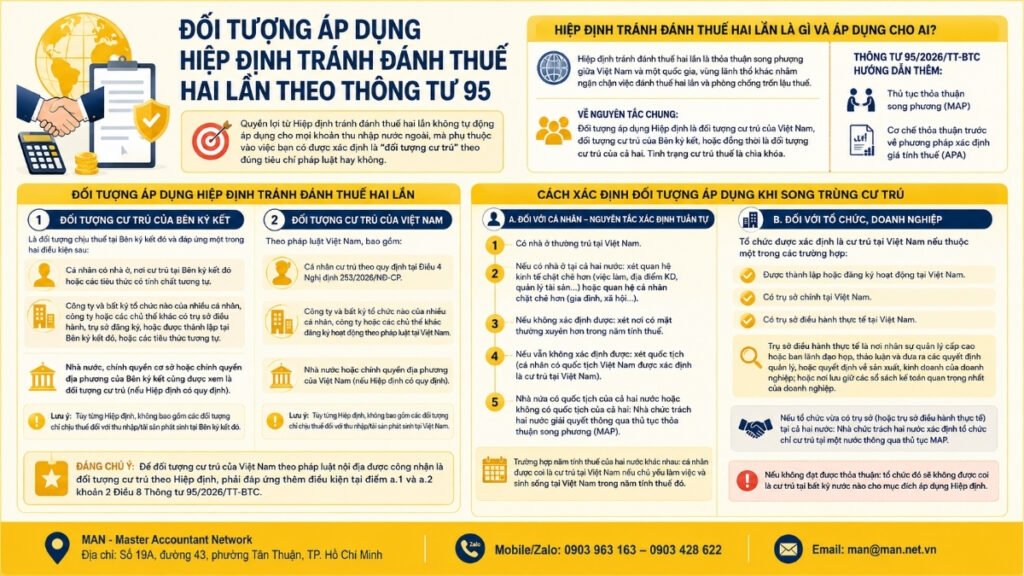
What is a double taxation avoidance agreement and who does it apply to?
A double taxation avoidance agreement (often simply called a tax agreement) is a bilateral agreement between Vietnam and another country or territory aimed at preventing income or assets from being taxed simultaneously in both countries, and at preventing tax evasion through the exploitation of differences in laws between countries.
Circular 95/2026/TT-BTC not only provides guidance on the application of the tax agreement, but also stipulates two closely related contents:
- Instructions for implementing the Mutual Agreement Procedure (MAP) between the competent authorities of Vietnam and the Contracting Party;
- Guidelines for applying the Advance Pricing Agreement (APA) mechanism in tax management for enterprises with related-party transactions.
In general, the subjects to whom a Double Taxation Avoidance Agreement applies are defined as residents of Vietnam, residents of a Contracting Party, or simultaneously residents of both Vietnam and a Contracting Party. In other words, "tax residency status" is the key to determining whether an individual or organization is considered subject to the tax agreement, rather than simply relying on nationality or the place of income.
The subjects to which the Double Taxation Avoidance Agreement applies, according to the latest regulations.
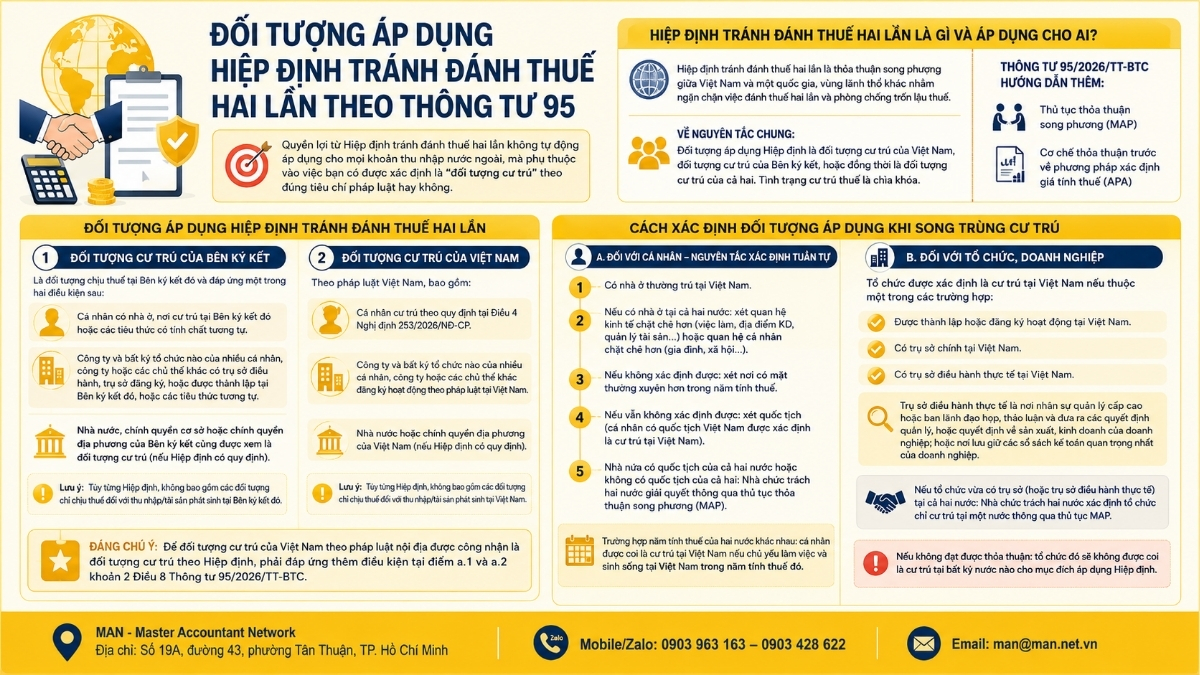
To accurately determine the subjects to which the Double Taxation Avoidance Agreement applies, Circular 95/2026/TT-BTC clearly divides them into two groups:
- Residents of the Contracting Party
- Vietnamese residents.
Residents of the Contracting Party
According to the regulations, residents of a Contracting Party include those who are subject to taxation in that Contracting Party under the laws of that Contracting Party, and who meet one of the following two conditions:
- Being an individual who owns a home or has a place of residence in that Contracting Party, or similar criteria in the case of an individual;
- This refers to a company or any organization of multiple individuals, companies or other entities whose place of operation, registered office or is incorporated in that Contracting Party, or similar criteria in the case of an organization.
In addition, the State, local government or local authority of a Contracting Party shall also be considered a resident of the Contracting Party, in cases where the tax agreement so provides.
One point that needs special attention: Depending on the specific tax agreement, the definition of a resident of a Contracting Party may exclude those whose income is taxable only on income derived from sources or assets within that Contracting Party. This provision aims to exclude cases where an individual or organization may have tax obligations in a country but does not actually have a permanent resident relationship with that country.
Vietnamese residents
In parallel with the categories of residents of the Contracting Parties, Circular 95/2026/TT-BTC also clearly defines the categories of residents of Vietnam under Vietnamese law, including:
- Individuals residing in accordance with the regulations at Article 4 of Decree 253/2026/ND-CP Regulations detailing certain provisions of the Personal Income Tax Law;
- Companies and any organizations of multiple individuals, companies, or other entities registered to operate under Vietnamese law;
- The State or local authorities of Vietnam, in cases where the tax agreement so provides.
Similarly to the resident subjects of the Contracting Party, depending on the specific tax agreement, the resident subjects of Vietnam will not include those who are only subject to tax on income from sources or assets arising in Vietnam.
Remarkable: For a Vietnamese resident under domestic law to be officially recognized as a resident under a tax agreement, that individual must meet additional conditions stipulated in points a.1 and a.2 of Clause 2, Article 8 of Circular 95/2026/TT-BTC. This is an additional verification step that individuals and businesses need to carefully review before confirming their eligibility under a double taxation avoidance agreement.
How to determine the subjects to whom the Double Taxation Avoidance Agreement applies when there is duplex residency.

In practice, it is not uncommon for an individual or organization to be simultaneously identified as a resident of both Vietnam and a Contracting Party under the laws of each country. This is the most complex situation, requiring the application of the criteria for breaking duplication of residency as detailed in Circular 95/2026/TT-BTC.
For individuals: The principle of sequential determination
Determining whether an individual is a resident of Vietnam in the case of duplication of residence is carried out sequentially according to the following criteria; only if the first criterion is ineffective will the next criterion be considered:
- That individual has a permanent residence (owned, rented, or used by that individual) in Vietnam.
- If an individual has a permanent residence in both Vietnam and a Contracting Party, consideration shall be given to whether that individual has closer economic ties in Vietnam (e.g., employment, place of business, management of personal property, or other economic ties), or closer personal ties in Vietnam (such as family ties, social ties).
- If it is not possible to determine where the economic or personal relationship is closer, or if the individual does not have a permanent residence in both countries, then the place where the individual was more frequently present during the tax year will be considered.
- If an individual is present regularly or irregularly in both countries in a way that cannot be distinguished, then nationality will be taken into consideration: an individual with Vietnamese nationality will be determined to be a resident of Vietnam.
- In cases where an individual holds both Vietnamese citizenship and the citizenship of a Contracting Party, or is stateless in both countries, the competent authorities of Vietnam shall resolve the individual's residency status through bilateral agreement procedures with the competent authorities of the Contracting Party.
Another specific situation to note: In cases where, according to the laws of both Vietnam and the Contracting Party, an individual is simultaneously determined to be a resident of both countries in the same tax year, but the tax year is defined differently in the two countries, the individual is considered a resident of Vietnam if, during that tax year, the individual primarily works and habitually resides in Vietnam. However, for the period at the beginning of the Vietnamese tax year that falls within the preceding tax year of the Contracting Party (due to the difference in the definition of the tax year between the two countries), the individual will be considered a resident of the Contracting Party for tax settlement purposes in both Vietnam and the Contracting Party.
For organizations and businesses
For entities other than individuals, based on the provisions of each specific tax agreement, an organization is determined to be a resident of Vietnam if it falls under one of the following cases:
- Established or registered to operate in Vietnam;
- Headquartered in Vietnam;
- Having a physical operating headquarters in Vietnam. According to Circular 95/2026/TT-BTC, a physical operating headquarters is understood as the place where senior management personnel or the business leadership team hold meetings, review, discuss, and make management decisions, or decisions regarding the business's production and operations; or the place where the most important accounting records of the business are kept.
In cases where an organization is newly established or registered in both countries, or has its principal place of business or actual operating headquarters in both countries, the competent authorities of Vietnam and the competent authorities of the Contracting Party shall jointly determine that the organization is a resident of only one of the two countries, through a bilateral agreement procedure. It is noteworthy that if Vietnam and the Contracting Party do not reach a mutual agreement, the organization will not be considered a tax resident of either country for the purposes of applying the Tax Agreement. This is an important legal consequence that multinational corporations need to pay particular attention to.
Why do businesses with related-party transactions need to understand the applicable parties?

For businesses with related-party transactions, correctly identifying the scope of application of the Double Taxation Avoidance Agreement is not only theoretical but also directly impacts actual tax benefits. A business can only enjoy the benefits under the tax agreement (such as tax exemptions or reductions on income from dividends, interest on loans, royalties, or profits from cross-border business activities) when it can prove that it is a resident entity according to the criteria mentioned above.
Furthermore, determining tax residency status is closely related to two other mechanisms also guided by Circular 95/2026/TT-BTC: the bilateral agreement (MAP) procedure and the advance pricing agreement (APA) mechanism. For businesses with related-party transactions, when preparing an APA application or when disputes arise that need to be resolved through a MAP, incorrectly determining tax residency status from the outset can affect the entire application, leading to risks in terms of time and compliance costs. In such complex situations, businesses should consider using a MAP. related party transaction advisory services To conduct a review of tax residency status in parallel with a comprehensive assessment of related-party transaction risks.
Conversely, if a business misidentifies and mistakenly believes itself to be subject to the tax agreement while in reality it does not fully meet the conditions, it may face the risk of being subject to tax audits, reassessment of tax obligations, or even double taxation on the same income—a situation precisely designed to prevent by the tax agreement.
See also: Full text of Circular 95/2026/TT-BTC.
Conclude
As can be seen, the entities to which the Double Taxation Avoidance Agreement applies, as stipulated in Circular 95/2026/TT-BTC, are determined based on their tax residency status. This is a fundamental aspect that needs to be understood before individuals or businesses proceed with further steps such as applying for residency confirmation, preparing documents to apply for tax agreement benefits, or developing APA documents for related-party transactions.
If your business has cross-border related-party transactions and needs to review its tax residency status before final settlement, now is a good time to carefully consider the new regulations in Circular 95/2026/TT-BTC.
Contact MAN – Master Accountant Network For timely advice and support!
Contact information MAN – Master Accountant Network
- Address: No. 19A, Street 43, Tan Thuan Ward, Ho Chi Minh City
- Mobile/Zalo: 0903 963 163 – 0903 428 622
- E-mail: man@man.net.vn
- Google Business Profile: View MAN – Master Accountant Network's Google Business Profile
- LinkedIn Founder: View expert Le Hoang Tuyen's LinkedIn profile.
Responsible for production and professional content review by: Mr. Le Hoang Tuyen – Founder & CEO of MAN – Master Accountant Network. He is a CPA Vietnam auditor with over 30 years of in-depth experience in accounting, auditing, taxation, and corporate legal consulting.
Frequently Asked Questions about the Scope of Application of Double Taxation Agreements
Are individuals with foreign nationality but residing permanently in Vietnam subject to the tax agreement?
Possibly. According to Circular 95/2026/TT-BTC, nationality is not the sole determining factor. If an individual meets the residency requirements in Article 4 of Decree 253/2026/ND-CP (for example, having a permanent residence or being present in Vietnam for the specified number of days) and simultaneously satisfies the conditions in points a.1 and a.2 of Clause 2, Article 8 of Circular 95/2026/TT-BTC, that individual will still be determined to be a resident of Vietnam under the tax agreement, regardless of their nationality.
If a business has its registered office abroad but its management meets and makes decisions in Vietnam, can it be considered a resident of Vietnam?
Yes. Circular 95/2026/TT-BTC stipulates that an organization is considered a resident of Vietnam if it has its actual operating headquarters in Vietnam, meaning where senior management or the board of directors holds meetings, discussions, and makes management and business decisions, or where the most important accounting records are kept. This factor is independent of the place of registration.
What happens if a business is determined to be a resident of both countries, and Vietnam and the Contracting Party fail to reach an agreement?
According to regulations, if the two parties fail to reach a mutual agreement through bilateral negotiation procedures, the enterprise will not be considered a tax resident of any country for the purposes of applying the tax agreement. This means the enterprise may not be entitled to any tax benefits under the tax agreement until its residency status is clarified.
Can an individual who is only taxed on income earned in one country be considered a resident under a tax agreement?
No, in most cases. Circular 95/2026/TT-BTC clarifies that, depending on the specific tax agreement, the resident status of a Contracting Party (or of Vietnam) will not include individuals who are only subject to tax on income from sources or assets arising in that country.
How does misidentifying the applicable party of a tax agreement affect the APA filing of a company with related-party transactions?
Tax residency status is a fundamental basis when businesses prepare applications for the Advance Pricing Agreement (APA) mechanism under Circular 95/2026/TT-BTC. If incorrectly determined from the outset, the application may be subject to requests for additional information from the tax authorities, delaying the process or resulting in the denial of tax agreement incentives for related-party transactions.