





On August 4, 2026, the Can Tho City Tax Department issued... Official document 6926/CTH-QLDN4 In response to the request from Phu Cuong Energy Joint Stock Company in công văn (official letter) No. 04/2026/CV-PCNL dated July 14, 2026, regarding the application of preferential corporate income tax rates for enterprises with related-party transactions, the document was signed and issued by Mr. Nguyen Thanh Tam, Deputy Head of the Tax Department of Can Tho City.
This document is noteworthy for many businesses that have parent-subsidiary relationships or related-party transactions, because since Corporate Income Tax Law No. 67/2025/QH15 With the effective date, determining whether to qualify for preferential tax rates 15% or 17% is no longer as simple as before, but directly depends on the revenue status of all parties involved in the related-party relationship. This article summarizes the main content of Official Letter 6926/CTH-QLDN4, adhering closely to the original legal basis, to help businesses understand the principles of application accurately.
Legal basis of Official Letter 6926/CTH-QLDN4

The guidance contained in Official Letter 6926/CTH-QLDN4 is based on the following legal documents:
- Law on Corporate Income Tax No. 67/2025/QH15 dated June 14, 2025: Clauses 2 and 3 of Article 10 and Clause 4 of Article 18.
- Decree 320/2025/ND-CP dated December 15, 2025: Clause 4, Article 11, specifies how to determine total revenue as a basis for applying preferential tax rates.
- Decree 132/2020/ND-CP dated November 5, 2020 and Decree 20/2025/ND-CP dated February 10, 2025 (amending and supplementing Decree 132/2020/ND-CP) regulate tax management for related-party enterprises.
The full reference to these documents shows that Circular 6926/CTH-QLDN4 does not introduce new regulations, but is merely a document guiding the uniform application of existing regulations in the current tax legal system.
Two preferential tax rates under Article 10 of the Corporate Income Tax Law 67/2025/QH15.
According to the content quoted in Official Letter 6926/CTH-QLDN4, Article 10 of the Corporate Income Tax Law 67/2025/QH15 stipulates two preferential tax rates based on revenue size:
| Tax rate | Annual revenue requirements |
| 15% | Total annual revenue must not exceed 3 billion VND. |
| 17% | Total annual revenue is between 3 billion VND and 50 billion VND. |
The revenue used to determine whether a business is subject to these two tax rates is: total revenue of the immediately preceding corporate income tax period. The determination of the specific total revenue is carried out according to government regulations, specifically Decree 320/2025/ND-CP.
How to determine revenue as a basis for applying incentives.
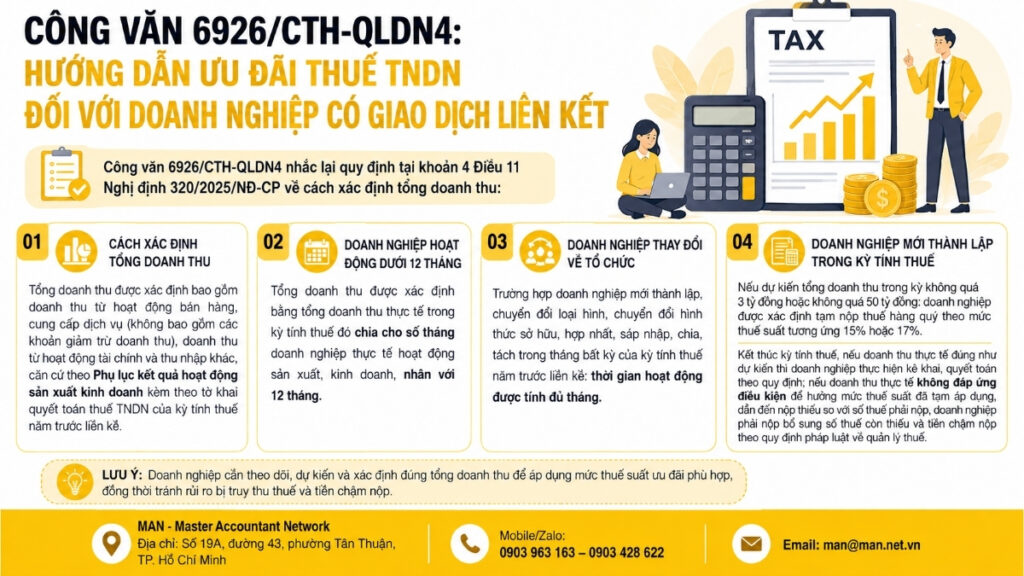
Official document 6926/CTH-QLDN4 reiterates the regulation in Clause 4, Article 11 of Decree 320/2025/ND-CP regarding the method of determining total revenue:
- Total revenue is determined to include revenue from sales and services (excluding revenue deductions), revenue from financial activities, and other income, based on: Appendix to the business performance results attached to the corporate income tax return for the immediately preceding tax year..
- In the case of businesses operating for less than 12 months In the immediately preceding tax year: total revenue is determined by dividing the actual total revenue in that tax period by the number of months the business actually operated, and multiplying by 12 months.
- This applies to newly established businesses, changes in business type, changes in ownership structure, mergers, acquisitions, divisions, and separations. In any month of the immediately preceding tax year: the operating period is counted as a full month.
- In the case of newly established businesses during the tax period And if the projected total revenue for the period does not exceed 3 billion VND or 50 billion VND: the enterprise is determined to make quarterly provisional tax payments at the corresponding tax rates 15% or 17%. At the end of the tax period, if the actual revenue is as projected, the enterprise will declare and settle the tax according to regulations; if the actual revenue is not as projected... Does not meet the conditions In order to benefit from the provisional tax rate, resulting in underpayment of taxes, businesses must pay the outstanding tax amount and late payment penalties in accordance with the tax administration laws.
Conditions for applying for preferential treatment for businesses with related-party transactions.
According to Clause 4, Article 18 of the Corporate Income Tax Law 67/2025/QH15:
The tax rates 15% and 17% stipulated in Clauses 2 and 3 of Article 10 of this Law do not apply to enterprises that are subsidiaries or affiliated companies where the affiliated enterprise does not meet the conditions for applying the tax rates stipulated in Clauses 2 and 3 of Article 10 of this Law.
This regulation is reiterated in point c, clause 4, Article 11 of Decree 320/2025/ND-CP: tax rates 15% and 17% do not apply to enterprises established under Vietnamese law that are subsidiaries or affiliated companies where the affiliated enterprise does not meet the conditions for applying the tax rates in clauses 2 and 3 of this article.
The specific handling principles are outlined in Official Letter 6926/CTH-QLDN4.
Based on the above grounds, the Can Tho City Tax Department has set forth two clear principles for handling the matter:
- Case 1 – Applicable tax rate 15%: If a business has total revenue in the preceding year not exceeding 3 billion VND, and all related businesses in the preceding year also have total revenue in the preceding year not exceeding 50 billion VND, then the business is subject to the application of tax rate 15%.
- Case 2 – Tax rates 15% and 17% are not applicable: If any related enterprise (parent company, subsidiary, or affiliated company) does not meet the conditions for applying the tax rates stipulated in Clauses 2 and 3 of Article 10 of the Corporate Income Tax Law 67/2025/QH15, then according to Clause 4 of Article 18 of the Corporate Income Tax Law 67/2025/QH15, those related enterprises are not allowed to apply the tax rates 15% and 17%.
In other words, if just one link in the supply chain exceeds the stipulated revenue threshold, all the remaining businesses in that chain, even those with very small revenues, will lose their entitlement to preferential tax rates.
What should businesses with related-party transactions review following Circular 6926/CTH-QLDN4?

Based on the guidance in Official Letter 6926/CTH-QLDN4, businesses should proactively review the following points before determining the applicable tax rate:
- The revenue of the business itself during the immediately preceding tax year is compared against two thresholds: VND 3 billion and VND 50 billion.
- The revenue of all parties involved in the affiliated relationship, including the parent company, subsidiaries, and related businesses as stipulated in Decree 132/2020/ND-CP and Decree 20/2025/ND-CP, is subject to the regulations, because failure of even one party to meet the conditions will cause the entire group to lose the preferential treatment.
- How to convert revenue for businesses operating for less than 12 months or newly established businesses during the period, to avoid miscalculating provisional tax payments.
- The risk of underpaying taxes and incurring late payment penalties arises if a business makes provisional tax payments based on the expected preferential tax rate, but fails to meet the actual conditions by the end of the tax period.
Conclude
Official document 6926/CTH-QLDN4 clarified an important principle: the application of preferential tax rates 15% and 17% to enterprises with related-party transactions depends not only on the revenue of that enterprise alone, but also on the revenue of all enterprises in the related-party relationship.
This is a guideline in principle, issued to address a specific case (Phu Cuong Energy Joint Stock Company). Therefore, other businesses should base their actions on the actual situation arising in their unit, comparing it with the Corporate Income Tax Law 67/2025/QH15, Decree 320/2025/ND-CP, and other relevant legal documents to apply it correctly.
For businesses with a parent-subsidiary structure or related-party transactions, proactive consultation is essential. related party transaction advisory services With the support of specialized and experienced units like MAN – Master Accountant Network, reviewing the revenue of affiliated parties right from the beginning of the tax period will help minimize the risk of being subject to back taxes and late payment penalties later on.
Contact MAN – Master Accountant Network For timely advice and support!
Contact information MAN – Master Accountant Network
- Address: No. 19A, Street 43, Tan Thuan Ward, Ho Chi Minh City
- Mobile/Zalo: 0903 963 163 – 0903 428 622
- E-mail: man@man.net.vn
- Google Business Profile: View MAN – Master Accountant Network's Google Business Profile
- LinkedIn Founder: View expert Le Hoang Tuyen's LinkedIn profile.
Responsible for production and professional content review by: Mr. Le Hoang Tuyen – Founder & CEO of MAN – Master Accountant Network. He is a CPA Vietnam auditor with over 30 years of in-depth experience in accounting, auditing, taxation, and corporate legal consulting.
Frequently Asked Questions about Official Document 6926/CTH-QLDN4
Do businesses with related-party transactions always benefit from tax rates 15% or 17%?
No. According to Official Letter 6926/CTH-QLDN4, the preferential treatment can only be applied if the enterprise and all parties in the related-party relationship meet the revenue requirements in Clauses 2 and 3, Article 10 of the Corporate Income Tax Law 67/2025/QH15. If one party does not meet the requirements, the entire related-party group will not be entitled to the preferential treatment.
What is the basis for determining revenue to apply preferential tax rates?
This is the total revenue as shown in the Appendix on business performance results attached to the corporate income tax return for the tax period of the immediately preceding year, as guided in Clause 4, Article 11 of Decree 320/2025/NĐ-CP.
If only one small subsidiary in the affiliated group has low revenue, is the parent company eligible for preferential treatment?
No. According to the principle in Official Letter 6926/CTH-QLDN4, the preferential treatment applies in the reverse direction: if any related party (including parent and subsidiary companies) does not meet the revenue requirements in Clauses 2 and 3 of Article 10, then all related parties, including those with lower revenue, are not eligible for the 15% and 17% tax rates. The preferential treatment is only applied when all related parties simultaneously meet the conditions.
How is the tax rate determined for a newly established business that lacks data from the preceding year?
According to the guidance in point b, clause 4, Article 11 of Decree 320/2025/ND-CP, as cited in Official Letter 6926/CTH-QLDN4, newly established enterprises shall base their quarterly provisional tax payments on projected revenue for the tax period at the rate of 15% or 17%. At the end of the tax period, the enterprise shall finalize the tax return based on actual figures; if the actual revenue does not meet the projected conditions, the enterprise must pay the remaining tax amount along with late payment penalties.