






Interest expense Exceeding the 30% EBITDA target continues to be the issue that causes the most confusion for many chief accountants and CFOs when Decree 255/2026/ND-CP It officially replaces Decree No. 132/2020/ND-CP and Decree No. 20/2025/ND-CP effective July 1, 2026, and applies immediately to the 2026 corporate income tax filing period. Even a minor error in offsetting interest on deposits and interest on loans against interest expense is enough to increase the amount of disallowed expenses by billions of dong, resulting in back taxes and late payment penalties. This article summarizes the entire legal basis, calculation formulas, processing procedures, and new provisions of Decree No. 255/2026/ND-CP, helping businesses prepare proactively for the tax filing period.
Why is interest expense exceeding 30% EBITDA a pressing issue for the 2026 fiscal year-end closing?
Interest expense exceeding 30% EBITDA refers to the portion of net interest expense (interest expense after deducting interest on deposits and interest on loans incurred during the period) that exceeds the 30% pre-tax EBITDA of a company with related-party transactions.
This excess amount is not included in deductible expenses when determining taxable income for corporate income tax purposes, but is carried forward to subsequent tax periods for a period not exceeding 5 years.
Decree No. 255/2026/ND-CP, issued by the Government on June 30, 2026, consists of 4 chapters and 24 articles, effective as of July 1, 2026, and applicable starting with the 2026 corporate income tax filing period, simultaneously replacing Decree No. 132/2020/ND-CP and Decree No. 20/2025/ND-CP. An important point to note right away is The 30% EBITDA control threshold remains unchanged However, the scope of identifying associative relationships has been clarified and expanded.
Failing to account for interest expenses that exceed the EBITDA threshold leads to three distinct financial consequences:
- Corporate income tax is assessed retroactively because expenses exceeding the threshold were disallowed, thereby increasing taxable income;
- Late payment penalties accrue from the date the payment was due, meaning that the later an error is discovered, the greater the loss;
- And lost the right to pass.
The most significant, yet often overlooked, loss occurs when a business fails to track amounts exceeding the threshold in its books, leaving it with no basis to prove its right of use in subsequent periods.
Legal basis for determining interest expenses exceeding 30% of EBITDA under Decree 255/2026/NĐ-CP

All provisions regarding interest expenses exceeding 30% EBITDA are set forth in Clause 3 of Article 16 of Decree No. 255/2026/ND-CP, under Chapter III on the determination of expenses for tax calculation purposes for enterprises engaged in related-party transactions. The chief accountant must thoroughly understand points a, b, and c of this clause.
Original text at point a of paragraph 3 of Article 16
Pursuant to the provisions of Point a, Paragraph 3, Article 16:
The total interest expense after deducting interest on deposits and loans incurred during the period of the taxpayer is deductible when determining taxable income for corporate income tax purposes, provided it does not exceed 30% of the total net profit from business operations during the period plus interest expense after deducting interest on deposits and loans incurred during the period plus depreciation expense incurred during the period of the taxpayer.
5-Year Transition Period under Point b of Paragraph 3 of Article 16
The transitional provisions are set forth in Decree No. 255/2026/ND-CP:
The portion of interest expense not deductible under point (a) of this clause shall be carried forward to the next tax period when determining the total deductible interest expense, provided that the total deductible interest expense incurred in the next tax period is lower than the amount stipulated in point (a) of this clause. The carry-forward period for interest expense shall not exceed 5 years from the year following the year in which the non-deductible interest expense was incurred.
Important Note: The portion of interest expense exceeding the 30% EBITDA limit is not permanently disallowed but is carried forward until a tax period in which the 30% EBITDA allowance is still available. It may only be carried forward to a period in which the interest expense is deductible. lower thresholds and calculation periods continuously no more than 5 years from the year following the year in which the event occurred.
Exceptions under Point c, Paragraph 3, Article 16
The control regulations do not apply to loans taken out by taxpayers that are credit institutions under the Law on Credit Institutions; insurance businesses under the Law on Insurance Business; loans under Official Development Assistance (ODA) and preferential government loans provided through the mechanism whereby the government borrows from foreign sources and on-lends to enterprises; loans for implementing national target programs (the New Rural Development Program, sustainable poverty reduction); and loans for investing in programs and projects that implement the State’s social welfare policies (resettlement housing, housing for workers and students, and social housing).
This is an exception under entities and funding sources, with no exceptions based on the company’s discretion. A typical trading company that borrows from a bank must still account for interest expenses exceeding 30% of EBITDA if the loan gives rise to a related-party relationship under Article 5.
Who is subject to the interest expense control threshold exceeding 30% EBITDA?
The 30% EBITDA threshold applies only to businesses have related-party relationships and engage in related-party transactions during the period. Article 5 of Decree No. 255/2026/ND-CP lists the cases in which entities are considered related parties; among them, the criteria directly related to borrowing activities include:
- Direct or indirect ownership of 25% or more between two enterprises, or both being owned by a third party to the extent of 25% or more.
- Relationships arising from guarantees or loans in any form (including loans from third parties secured by the financial resources of an affiliated party), where the total outstanding balance simultaneously meets both of the following thresholds: at least 25% of the borrowing enterprise’s owners’ equity and more than 50% of the borrowing enterprise’s total outstanding medium- and long-term debt.
- Relationships arising from borrowing, lending, or lending and borrowing transactions with individuals who manage or control the business, or with individuals related to such individuals, subject to the corresponding capital contribution thresholds.
The decree continues to recognize an important exception: a credit institution that grants a loan or provides a guarantee, but does not directly or indirectly participate in, manage, control, contribute capital to, or invest in If the borrower is a business or a business that is guaranteed, that specific loan does not give rise to an affiliated relationship. This provision provides relief for businesses that take out purely bank loans, but supporting documentation is required—it is not assumed by default. Decree No. 255/2026/ND-CP also introduces a new exception: If the creditor or guarantor is a state-owned organization with 100% of charter capital that is authorized to buy, sell, and manage debt, and if it does not participate in the management, control, capital contribution, or investment in the debtor enterprise or the guaranteed enterprise, it is not automatically considered a related party.
Understand the three components correctly before adjusting for interest expenses exceeding 30% EBITDA
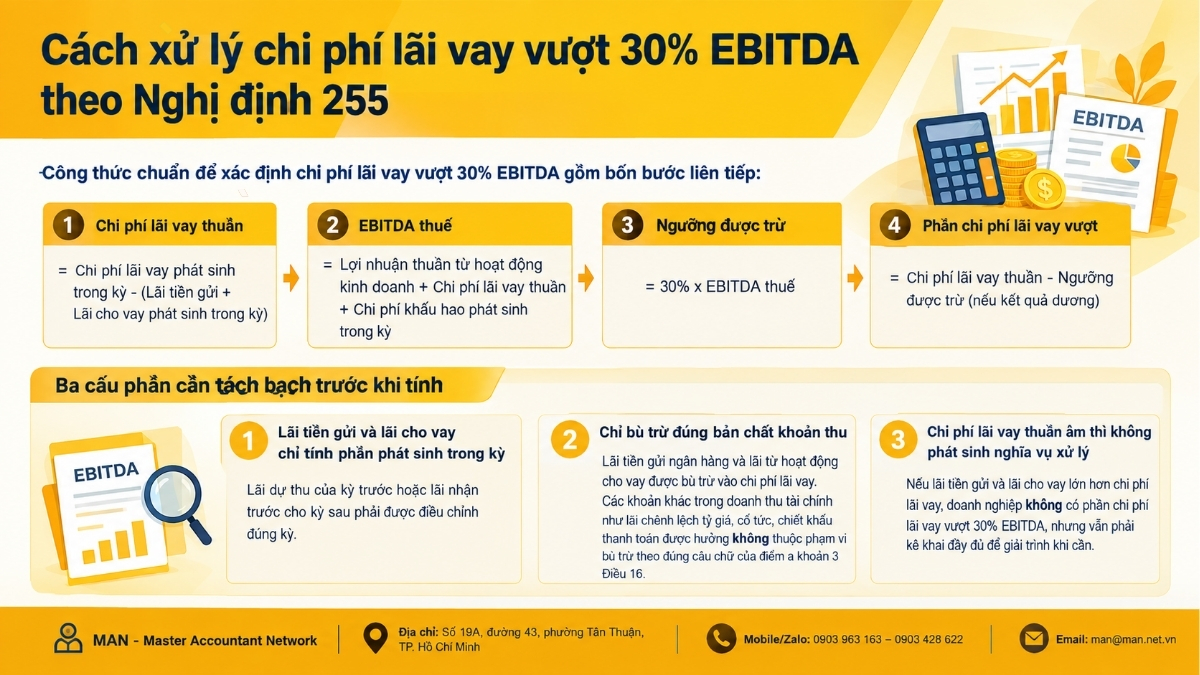
The standard formula for determining interest expense exceeding 30% EBITDA consists of four consecutive steps:
Net interest expense = Interest expense incurred during the period – (Interest on deposits + Interest expense on loans incurred during the period) |
In that case, pre-tax EBITDA is calculated as follows:
Taxable EBITDA = Net operating profit + Net interest expense + Depreciation expense incurred during the period |
The deductible threshold is determined as follows:
Deduction threshold = 30% x Taxable EBITDA |
The portion of interest expense in excess of:
The portion of interest expense exceeding 30% EBITDA is excluded = Net interest expense – Deductible threshold (if the result is positive) |
Three components that must be separated before calculating
Specifically:
- Interest on deposits and interest on loans are calculated only for the portion accrued during the period: Accrued interest from the previous period or interest received in advance for the following period must be adjusted in the appropriate period.
- Offset only the portion of the revenue that meets the criteria: Interest on bank deposits and interest from lending activities are offset against interest expense. Other items in financial income, such as foreign exchange gains, dividends, and payment discounts received, Are not falls within the scope of set-off in accordance with the exact wording of Point a, Paragraph 3, Article 16.
- A negative net interest expense does not give rise to a settlement obligation: If interest income from deposits and loans exceeds interest expense, the company will not have any interest expense exceeding 30% of EBITDA, but it must still report the full amount to provide an explanation when necessary.
Common Mistakes When Calculating Tax-Adjusted EBITDA
Many CFOs are accustomed to using EBITDA for management purposes and then applying it directly to tax calculations. This approach often yields inaccurate results for two reasons:
- EBITDA before taxes is derived from net income from operating activities: The figures include revenue and financial expenses, but not included other income and other expenses;
- And the interest expense component added to the denominator must be interest expense pure, not gross interest.
The difference in other income alone—for example, the gain on the disposal of fixed assets amounting to several tens of billions of dong—is enough to cause the two EBITDA figures to diverge to the point of reversing the conclusion that interest expense exceeds 30% EBITDA.
To avoid potential risks, businesses should consult the following. related party transaction advisory services from professional, reputable, and experienced firms such as the Big 4 and MAN – Master Accountant Network to receive assistance as soon as possible.
5-Step Process for Handling Interest Expenses Exceeding 30% EBITDA
The following is the process for handling interest expenses that exceed 30% EBITDA:
- Step 1 – Determine eligibility: Review the ownership structure, loan agreements, letters of guarantee, and loans to and from management to determine whether the business falls within the scope of Article 5; document the conclusion in writing along with supporting evidence.
- Step 2 – Extract financial data. Prepare a detailed schedule of interest expense by contract, separating interest on deposits from interest on loans, and excluding the portion of interest expense that has been capitalized into work-in-progress.
- Step 3 – Calculate pre-tax EBITDA, determine the 30% threshold, and identify the excess amount Apply correctly EBITDA calculation formula Under subparagraph a of paragraph 3 of Article 16, include a worksheet referencing each line item in the audited financial statements; recognize the portion of interest expense exceeding 30% EBITDA as an adjustment to increase taxable income on the tax return.
- Step 4 – Open the transfer log: Create a separate tracking table for each year the amount was incurred, clearly indicating the amount, the year it was incurred, the year the carryover expires, and the amount used in each period.
- Step 5 – Complete the application and submit the forms: Report the interest expense ratio in accordance with Appendix I issued pursuant to Decree No. 255/2026/ND-CP, submit it along with the corporate income tax return, and complete the transfer pricing documentation unless exempt from the requirement to prepare it.
Example illustrating the calculation of interest expense exceeding 30% EBITDA
Company A (a manufacturer of components that borrows from its parent company overseas) has the following data for the 2026 tax period:
| Indicators | Amount |
| Net operating profit | 50 billion dong |
| Interest expense incurred during the period | 45 billion dong |
| Interest earned on deposits + Interest earned on loans during the period | 5 billion VND |
| Accumulated Depreciation Expense | 10 billion dong |
Calculation steps:
- Net interest expense = 45 − 5 = 40 billion VND
- Taxable EBITDA = 50 + 40 + 10 = 100 billion VND
- Deduction threshold = 30% × 100 = 30 billion VND
- Interest expense exceeds 30%; excluded EBITDA = 40 − 30 = 10 billion VND
Company A adjusted its taxable income upward by 10 billion VND for the 2026 period and recorded this adjustment in the transitional ledger, with a continuous usage period not exceeding five years starting in 2027.
Assuming that in 2027 the company reduces its outstanding debt, net interest expense will be 20 billion VND, while the 30% EBITDA threshold will reach 28 billion VND, leaving a margin of 8 billion VND. The company transfers 8 billion VND from the 2026 carryover to be deducted in the 2027 period; the remaining 2 billion VND will continue to be monitored for subsequent periods within the remaining term.
An important operational note: The carryforward right may only be used in the period in which the business There were related-party transactions. If, in a given year, a business no longer engages in related-party transactions, the company falls outside the scope of Article 16, Paragraph 3, and therefore has no basis for deducting the carryover interest expense from the previous period, while the five-year carryover period continues to run continuously without interruption. This is why businesses need to maintain a tracking ledger that clearly records even those years when they do not qualify to use the carryover amount, along with the reasons, to support explanations when necessary.
In the case of negative or zero EBITDA
This is a particularly dangerous situation. When a business incurs losses resulting in negative EBITDA, the 30% EBITDA threshold will be zero. In this case, any 100% interest expense incurred will be considered as interest expense exceeding the 30% EBITDA. Although it can be carried forward to the following year, the lack of deductible expenses in the current year reduces the reported loss, impacting the ability to offset losses in the future.
New provisions in Decree No. 255/2026/NĐ-CP affecting interest expenses exceeding 30% EBITDA

Decree No. 255/2026/ND-CP retains most of the provisions of Decree No. 132/2020/ND-CP, as amended and supplemented by Decree No. 20/2025/ND-CP, while also adjusting certain provisions to align with the 2025 Tax Administration Law and the 2025 Corporate Income Tax Law. The following three new provisions directly impact the determination and treatment of interest expenses exceeding 30% EBITDA:
Add relationship links from borrowing and lending transactions
Point l of Paragraph 2 of Article 5 adds a provision regarding cases where a business engages in borrowing, lending, borrowing, or lending out at least 10% of the owners’ contributed capital at the time the transaction occurs to individuals who manage or control the business, or to individuals with family ties, shall be deemed to have a related-party relationship. This represents an expansion of the previous legal framework, meaning that certain internal financial transactions that were previously not subject to scrutiny may now result in the business being required to treat interest expenses exceeding 30% of EBITDA as non-deductible.
The threshold for reporting cross-border profits has been raised to 750 million euros
According to Article 19 of Decree 255/2026/NĐ-CP, the global consolidated revenue threshold for the obligation to prepare a country-by-country report is uniformly set at 750 million euros, in accordance with OECD recommended practices. Multinational enterprises must compare this data in conjunction with their review of interest expenses exceeding 30% EBITDA, as both are covered in Chapter III of the Decree.
Transitional provisions safeguarding the interests of businesses
The business is currently eligible to carry forward interest expenses in accordance with Article 3 of Decree 20/2025/ND-CP will continue to be carried forward for the remaining period in accordance with that regulation, even though Decree No. 132/2020/ND-CP and Decree No. 20/2025/ND-CP ceased to be in effect as of July 1, 2026.
This regulation ensures that businesses can continue to carry forward previously recognized interest expense without interruption, preventing the loss of suspended amounts solely due to changes in legislation. Detailed implementation guidelines are set forth in Official Document 4697/CT-CS July 9, 2026, issued by the tax authority, which includes a separate section on interest expense and transitional provisions.
Risks and Consequences of Failing to Properly Address the Amount Exceeding the 30% EBITDA Threshold
Lax management of interest expenses exceeding 30% EBITDA leads to three main risk categories:
- First, tax assessment: The tax authority may disallow all related interest expenses if the business fails to provide sufficient documentation to demonstrate the reasonableness of the loan and the method used to calculate the threshold.
- Second, late payment fees: The back tax arising from the disallowance of interest expenses exceeding 30% EBITDA accrues late-payment interest from the date it was originally due, meaning that the later the error is detected, the higher the cost.
- Third, a loss of credibility in the file used to determine the price of related-party transactions: If a company cannot explain why its interest expense exceeds 30% of EBITDA and how it plans to address this, it is likely to become a priority target for audits in subsequent periods.
A note on the nature of it: If the interest rate on a loan from an affiliated party does not comply with the arm’s-length principle, the tax authority may adjust the interest expense. before Applying the 30% EBITDA threshold. This means that a weak transfer pricing documentation will cause the portion of interest expenses exceeding 30% EBITDA to be inflated many times over compared to the figure calculated by the company itself.
Documentation and reporting of interest expenses exceeding 30% EBITDA
The minimum set of documents includes:
- 30% EBITDA Threshold Calculation Table includes references to financial statement line items and accounting account numbers.
- Schedule of Interest Expenses by Contract, along with the loan agreement, payment documents, and the bank’s interest confirmation.
- Statement of Interest on Deposits and Interest on Loans, reconcile with the bank subledger.
- Multi-Year Progress Tracking Table, showing the beginning balance, transactions, usage, ending balance, and expiration year.
- Appendix I: Statement of Interest Expense Ratio in accordance with the form issued pursuant to Decree No. 255/2026/NĐ-CP, to be submitted along with the final tax return.
- Transfer pricing determination dossier (Country-by-Country Report, Global File, and Cross-Border Profit Report, if required) pursuant to Article 18 of the Decree, which requires demonstrating that interest rates on loans to related parties are consistent with the arm’s-length principle. Businesses should note that the deadline for submitting documents as required by the tax authority is no more than 30 working days, which may be extended once for no more than 15 working days if there is a valid reason.
Long-term solutions to reduce the pressure caused by interest expense exceeding the threshold
Addressing interest expenses that exceed 30% EBITDA during the final accounting process is merely a stopgap measure. In the long term, companies have four legitimate options for adjustment:
- Rebalancing the debt-to-equity structure: Convert a portion of the internal loan into equity to reduce net interest expense.
- Manage cash flow to avoid the situation of having both large loans and large deposit balances: Because gross interest expenses typically rise faster than the interest earned on deposits that offsets them.
- Review internal borrowing rates based on the arm’s-length principle: This reduces the risk of adjustments while also reducing the portion of interest expenses that exceeds 30% EBITDA.
- EBITDA Planning by Investment Cycle: Simulate the 30% EBITDA threshold over a 5-year period to optimally allocate disbursement timelines and the timing for exercising carry-over rights.
Conclude
Decree No. 255/2026/NĐ-CP maintains the 30% EBITDA threshold, but broadens the definition of related-party relationships, meaning the number of businesses required to account for interest expenses exceeding 30% EBITDA in the 2026 fiscal year is likely to be higher than in previous years.
The three most memorable things:
- Deductible expenses are interest expenses pure;
- The portion exceeding the threshold is suspended for a continuous period no more than 5 years;
- And the carryover right is only available during the business period. There were related-party transactions, while the 5-year clock never stops.
If your company’s 2026 interest expense documentation still contains uncertainties—ranging from determining related-party status and separating interest on deposits to the multi-year carryover schedule—our team of experts in related-party transactions at MAN – Master Accountant Network We are ready to review the records with the business before the ledger is locked.
Contact MAN – Master Accountant Network For free support and advice!
Contact information MAN – Master Accountant Network
- Address: No. 19A, Street 43, Tan Thuan Ward, Ho Chi Minh City
- Mobile/Zalo: 0903 963 163 – 0903 428 622
- E-mail: man@man.net.vn
- Google Business Profile: View MAN – Master Accountant Network's Google Business Profile
- LinkedIn Founder: View expert Le Hoang Tuyen's LinkedIn profile.
Responsible for production and professional content review by: Mr. Le Hoang Tuyen – Founder & CEO of MAN – Master Accountant Network. He is a CPA Vietnam auditor with over 30 years of in-depth experience in accounting, auditing, taxation, and corporate legal consulting.
Frequently Asked Questions About Interest Expenses Exceeding 30% EBITDA
Do businesses without related-party transactions need to account for interest expenses that exceed the EBITDA threshold?
No. The restriction set forth in Article 16, Section 3(a) applies only to taxpayers with related-party relationships who engage in related-party transactions during the reporting period. Businesses should still maintain records demonstrating that they do not fall within the scope of Article 5.
Is the portion of interest expense that exceeds 30% EBITDA permanently lost?
It is not lost immediately. According to point b, clause 3, Article 16, the non-deductible portion is carried forward to the next tax period when the total deductible interest expense for that period is lower than the threshold, with the carry-forward period not exceeding 5 years from the year following the year of occurrence.
Does borrowing from a commercial bank result in interest expenses exceeding 30% EBITDA?
It depends on the circumstances. If the lending financial institution does not participate in the management, control, capital contribution, or investment in the borrowing enterprise or the guarantor enterprise, that loan alone does not give rise to a related-party relationship. Conversely, when a loan simultaneously meets the threshold of 25% in contributed capital and exceeds 50% in total medium- and long-term outstanding debt—in the context of other affiliated factors—the enterprise falls within the scope of application.
From which tax period does Decree 255/2026/ND-CP apply?
The Decree takes effect from July 1, 2026 and applies from the corporate income tax period of 2026, replacing Decree 132/2020/ND-CP and Decree 20/2025/ND-CP.
Will businesses that are currently passing on interest expenses in accordance with Decree 20/2025/NĐ-CP experience any disruption when Decree 255 takes effect?
No. Businesses that qualify for the transition period under Article 3 of Decree No. 20/2025/ND-CP will continue to be subject to that transition period for the remainder of the term in accordance with those provisions.
Can exchange rate gains be deducted when calculating net interest expense?
No. Only interest on deposits and interest on loans arising during the period are offset in accordance with the wording of point a, clause 3, Article 16.
If EBITDA is negative, how should expenses exceeding the 30% EBITDA threshold be handled?
When pre-tax EBITDA is zero or negative, and there is no remaining deduction allowance, all net interest expense for the period is excluded and carried forward in accordance with subparagraph b of paragraph 3 of Article 16.