





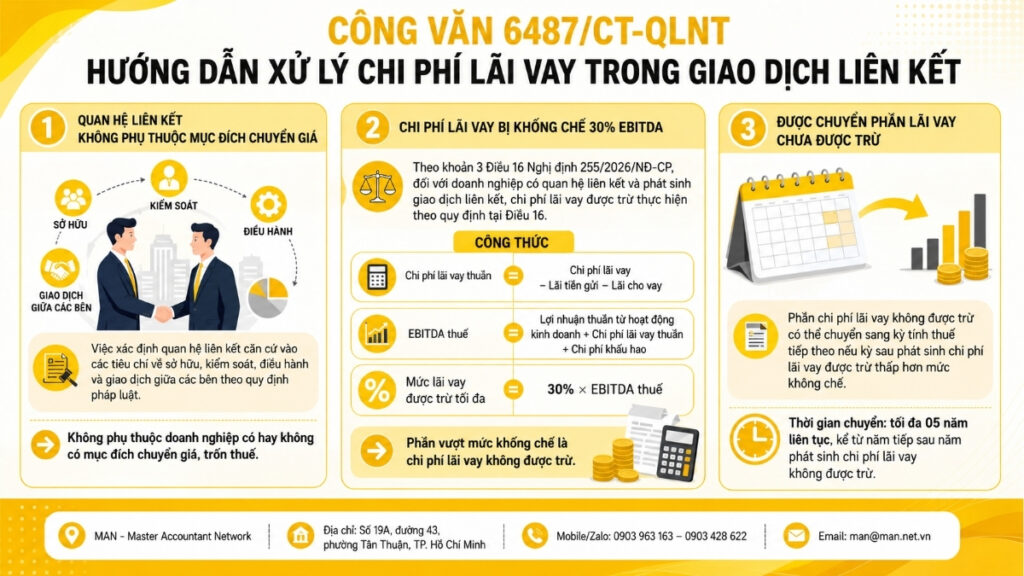
Official Letter 6487/CT-QLNT issued by the Tax Department on August 28, 2026, is a document directly addressing the difficulties faced by the business community regarding the determination and handling of interest expense in related-party transactions. Decree 255/2026/ND-CP. With the chief accountant and CFO preparing for the 2026 corporate income tax return, this is the official basis for answering a seemingly simple but highly debated question: should businesses treat interest expense under the 30% EBITDA threshold, and what criteria should be used to reach this conclusion? The article below summarizes the entire content. Official Document 6487/CT-QLNT, In accordance with Clause 3, Article 16 of Decree 255/2026/ND-CP, and highlighting points that businesses need to pay attention to immediately before the closing date.
What is Official Document 6487/CT-QLNT?
Official Letter 6487/CT-QLNT of 2026 is a document issued by the Tax Department on August 28, 2026, responding to a request from the Vietnam Young Entrepreneurs Association regarding the review of how to determine and handle interest expense in related-party transactions. This is not a new legal document, but rather a professional guidance document explaining how to apply Clause 3, Article 16 of Decree 255/2026/ND-CP to the practical application of related-party transactions.
For professionals in the field, the greatest value of Circular 6487/CT-QLNT lies in its official written confirmation of a principle that many businesses still misunderstand or deliberately manipulate: determining related-party relationships and applying tax management regulations to related-party transactions does not depend on whether or not the business intends to engage in transfer pricing or tax evasion. In other words, a loan that is entirely for legitimate business purposes, not aimed at tax evasion, can still be subject to interest expense limitations if it meets the criteria for related-party relationships as stipulated by law.
The core content of Official Letter 6487/CT-QLNT regarding the handling of interest expense.

The principle for determining related-party relationships is independent of the purpose of transfer pricing.
The first and most important point affirmed by Circular 6487/CT-QLNT is that the determination of related-party relationships and the application of tax management regulations to related-party transactions are carried out on the basis of criteria regarding ownership, control, operation, and transactions between related parties as prescribed by law, regardless of whether the enterprise has or does not have the purpose of transfer pricing or tax evasion.
This is a fundamental statement with significant practical implications. Many businesses, especially family-owned businesses, borrow from each other within the same ecosystem for purely liquidity reasons, often arguing that their loans are “not intended to avoid taxes” and therefore do not require a threshold. As long as they meet the criteria regarding ownership, control, operation, or transactions as stipulated in Article 5 of Decree 255/2026/ND-CP, the business is within the scope of application, regardless of the actual motive behind the loan transaction.
Based on Clause 3, Article 16 of Decree 255/2026/ND-CP
Official document 6487/CT-QLNT quotes almost verbatim the provision in Clause 3, Article 16 of Decree 255/2026/ND-CP:
The total interest expense after deducting interest on deposits and loans incurred during the period is deductible when determining taxable income for corporate income tax purposes, provided it does not exceed the total net profit from business operations during the period plus interest expense after deducting interest on deposits and loans incurred during the period plus depreciation expense incurred during the period of the taxpayer. The regulations also specify certain cases where this provision does not apply.
The fact that Official Letter 6487/CT-QLNT reiterates the full formula, instead of merely referring to specific clauses, shows that the tax authorities want businesses to understand that the 30% EBITDA threshold calculation formula is a unified whole, not to be separated into individual parts for their own benefit.
Official document 6487/CT-QLNT also clearly states:
In cases where businesses have related-party relationships and related-party transactions occur, interest expenses are deductible when determining expenses for corporate income tax purposes, as stipulated in Article 16 of Decree 255/2026/ND-CP.
Key details to note: Both conditions must be met within the tax period for the threshold to be applied.
See also: New points in Decree 255/2026/ND-CP regarding related-party transactions.
How are non-deductible interest expenses determined?
Non-deductible interest expense in related-party transactions is the portion of total interest expense after deducting interest on deposits and loans incurred during the period that exceeds the amount of total net profit from business operations plus net interest expense plus depreciation expense incurred during the period. This can be rewritten as a practical formula:
Net interest expense = Interest expense incurred during the period – (Interest on deposits + Interest expense on loans incurred during the period) |
EBITDA is then determined:
Taxable EBITDA = Net operating profit + Net interest expense + Depreciation expense |
Deduction threshold:
Deduction threshold = 30% x Taxable EBITDA |
Non-deductible portion:
Non-deductible portion = Net interest expense – Deductible threshold |
According to point b, clause 3, Article 16 of Circular 6487/CT-QLNT, this non-deductible portion of interest expense may be carried forward to the next tax period when determining the total deductible interest expense, provided that the total deductible interest expense incurred in the next tax period is lower than the limit. The continuous carry-forward period shall not exceed 5 years from the year following the year in which the non-deductible interest expense was incurred.
See also: Formula for calculating interest on related-party transactions.
What did the Tax Department say in Official Letter 6487/CT-QLNT?
Besides reiterating the formula and principles for determining related-party relationships, Circular 6487/CT-QLNT also directly responds to businesses' proposals regarding mechanisms for exchanging, confirming, or providing advance guidance on complex transactions. This is especially important for transactions that are complex, newly arising, or have unique economic characteristics, aiming to increase transparency and facilitate taxpayers in determining and fulfilling their tax obligations correctly.
This means that at the time Circular 6487/CT-QLNT was issued, Vietnam did not yet have a separate advance pricing agreement (APA) or pre-confirmation mechanism for handling interest expense in related-party transactions under Decree 255/2026/ND-CP. Businesses should not wait for specific guidance for each case, but should compare their transactions with Clause 3 of Article 16 and the criteria in Article 5 to determine their obligations themselves, and keep complete explanatory documents for future inspections.
What should businesses do when Circular 6487/CT-QLNT comes into effect?

More importantly, translate the content of the document into concrete actions before the closing date. Here are some things businesses should do immediately:
- Firstly, review all loan transactions from the perspective of related-party relationships, not based on the purpose of capital use: According to the spirit of Official Letter 6487/CT-QLNT, a loan between a parent-subsidiary company or between companies with a common controlling shareholder is still subject to Article 16, even if the purpose of the loan is to supplement ordinary working capital and is not related to tax optimization.
- Secondly, reconfirm the relationship criteria under Article 5 for each lending partner: It is necessary to check the equity ownership ratio, guarantees, loans and borrowings with individual managers, and especially the double threshold of "25% equity capital and over 50% total medium- and long-term debt" for guaranteed loans or loans of any kind.
- Thirdly, recalculate the net interest expense according to the formula referenced in Circular 6487/CT-QLNT, avoiding confusion between pre-tax profit and net profit from business operations: This is the most common technical error that causes inaccurate calculation results for the 30% EBITDA threshold.
- Fourth, prepare supporting documents for each conclusion: Since Official Letter 6487/CT-QLNT confirms that the application does not depend on the subjective purpose of the enterprise, the explanatory documents must be based on objective evidence (loan agreements, ownership structure, board meeting minutes) and not on statements about the purpose of capital use.
- Fifth, continue monitoring supplementary guidance documents: Since Circular 6487/CT-QLNT indicates that the mechanism for providing advance guidance on complex transactions is still under development, businesses with complex related-party loan transactions should proactively update themselves on subsequent circulars from the Tax Department, instead of applying them once and then disregarding them.
The database used when declaring and determining transfer pricing according to Decree 255/2026/ND-CP.
Another point often found alongside Official Letter 6487/CT-QLNT when businesses search for information on related-party transactions is the provision in Clause 1, Article 17 of Decree 255/2026/ND-CP regarding the database used in declaring and determining the price of related-party transactions. Accordingly, the database includes:
- Commercial databases as stipulated in Clause 15, Article 4 of the 2025 Tax Administration Law and other legal documents on tax administration;
- Information and data of businesses are publicly disclosed on the stock market;
- Information and data published on domestic and international commodity and service exchanges;
- Information from the national database; information from domestic ministries and agencies or other official sources that are publicly available.
Although this content is not directly included in Official Letter 6487/CT-QLNT, it is closely related: if the interest rate on loans between related parties does not conform to the arm's length principle, the tax authorities can use the aforementioned databases to determine a reasonable interest rate before applying the 30% EBITDA threshold as per Article 16. Therefore, businesses should consider preparing data comparing market interest rates as an integral part of handling interest expense in related-party transactions.
Quick checklist after reading Official Document 6487/CT-QLNT
Here's a quick checklist for businesses:
- Review all internal loans based on the criteria of related party relationship as stipulated in Article 5, not on the purpose of capital use.
- Apply the correct formula as stated in Clause 3, Article 16, as referenced in Official Letter 6487/CT-QLNT, clearly distinguishing between the numerator and the denominator.
- Prepare objective documentation (contracts, ownership structure, resolutions) instead of just explaining based on subjective motives.
- Update market interest rate comparison data in accordance with Article 17 to protect internal lending rates.
- Establish a process for tracking subsequent guidance documents related to complex transactions.
Conclude
Official document 6487/CT-QLNT does not create new regulations, but it has significant practical value because it officially resolves two of the most debated issues among businesses: the application of the interest expense limit under Clause 3, Article 16 of Decree 255/2026/ND-CP, which does not depend on the subjective purpose of the business, and the mechanism for providing advance guidance on complex transactions, which is still under development and not yet officially implemented.
If businesses are still unsure about applying Circular 6487/CT-QLNT and Decree 255/2026/ND-CP to their specific interest expense documentation, MAN – Master Accountant Network's team of related party transaction experts is ready to work with businesses to review, compare, and finalize the documentation before the tax settlement period.
Contact MAN – Master Accountant Network For free support and advice!
Contact information MAN – Master Accountant Network
- Address: No. 19A, Street 43, Tan Thuan Ward, Ho Chi Minh City
- Mobile/Zalo: 0903 963 163 – 0903 428 622
- E-mail: man@man.net.vn
- Google Business Profile: View MAN – Master Accountant Network's Google Business Profile
- LinkedIn Founder: View expert Le Hoang Tuyen's LinkedIn profile.
Responsible for production and professional content review by: Mr. Le Hoang Tuyen – Founder & CEO of MAN – Master Accountant Network. He is a CPA Vietnam auditor with over 30 years of in-depth experience in accounting, auditing, taxation, and corporate legal consulting.
Frequently Asked Questions about Official Document 6487/CT-QLNT
When was Official Document 6487/CT-QLNT issued?
Official document 6487/CT-QLNT issued by the Tax Department on August 28, 2026, responds to the request of the Vietnam Young Entrepreneurs Association regarding the handling of interest expense in related-party transactions.
Is Official Document 6487/CT-QLNT a legal normative document?
No. Official Letter 6487/CT-QLNT is an administrative document responding to a request, providing guidance on the application of Clause 3, Article 16 of Decree 255/2026/ND-CP, and is not a legal document promulgating new regulations.
According to Official Letter 6487/CT-QLNT, are businesses that do not intend to engage in transfer pricing exempt from applying the 30% EBITDA threshold?
No. Official document 6487/CT-QLNT affirms that the determination of related-party relationships and the application of tax management regulations are based on ownership, control, operation, and transaction criteria, regardless of whether the enterprise intends to engage in transfer pricing or tax evasion.
Does Official Document 6487/CT-QLNT provide a mechanism for pre-confirmation of complex transactions?
Not yet. Official document 6487/CT-QLNT states that the proposal regarding the mechanism for prior exchange, confirmation, or guidance is being considered and will continue to be monitored for improvement during the implementation of Decree 255/2026/ND-CP, and has not yet come into official effect.
How are non-deductible interest expenses determined according to Official Letter 6487/CT-QLNT?
This is the portion of total interest expense after deducting interest on deposits and loans incurred during the period that exceeds 30% of total net profit from business operations plus net interest expense plus depreciation expense incurred during the period, in accordance with Clause 3, Article 16 of Decree 255/2026/ND-CP.
Do businesses with related parties but no related-party transactions during the period apply Circular 6487/CT-QLNT?
No. Official document 6487/CT-QLNT clearly states that deductible interest expenses under Article 16 only apply when the enterprise has both related-party transactions and related-party transactions during the period – both conditions must be met.
What database is used to determine transfer pricing and demonstrate reasonable interest rates on loans?
According to Clause 1, Article 17 of Decree 255/2026/ND-CP, the database includes commercial databases, information of enterprises published on the stock market, information on domestic and international commodity and service exchanges, and information from the National Database or other official sources.