





Exemptions under Decree 255 are a top concern for businesses with related-party transactions in 2026, especially since the revenue threshold for exemption from filing has officially been raised to below VND 500 billion. This article comprehensively systematizes the three groups of exemption conditions under the latest regulations, ranging from exemption from both declaration and filing, exemption based on revenue threshold, to exemption based on profit margin, helping businesses accurately determine which category applies to them. Notably, the article also clarifies a common misconception: exemption from filing does not equate to exemption from tax obligations, based directly on... Clause 2, Article 18, Decree 255/2026/ND-CP.
Before considering exemption conditions, businesses should also understand the following: The relationship under Decree 255 To accurately determine whether you are conducting transactions with a related party in accordance with regulations.
What are the obligations regarding the preparation of price determination documents?

Before delving into the exemption cases under Decree 255, businesses need to clearly understand the nature of the obligations they may be exempted from. According to current regulations, businesses with related-party transactions must, in principle, prepare all three of the following documents, unless they are eligible for exemption under the law.
Local File
This is a component of the national tax return specifically for taxpayers in Vietnam, compiled according to the information categories specified in Appendix II. The national tax return requires businesses to provide complete core information groups, including:
- Key taxpayer information (organizational chart, management structure of the corporation, business activities, restructuring or capital transfer activities during the year, competitors);
- Information about related transactions (nature of the transaction, transaction value, functional analysis, explanation of the appropriate pricing method, comparative analysis);
- And financial information (financial statements, explanation of the reasons for losses, if any).
Global corporate profile (Master File)
Unlike the National Profile, which focuses solely on businesses in Vietnam, the Global Corporate Profile provides a comprehensive overview of the entire corporation, categorized in Appendix III. The content includes:
- The organizational structure of the group's business (supply chain of key products and services);
- Internal corporate service agreements, functional analysis of the parent company and its subsidiaries);
- Information on intangible assets related to the strategy for building and developing intangible assets and agreements related to their transfer, information on the group's internal financial operations (financial allocation mechanisms, funding agreements, internal transfer pricing policies within the group performing centralized financial functions), along with the group's business results and tax obligations.
Country-by-Country Profit Report
This component is for large multinational corporations and includes information on income distribution, taxes, and business operations by country of residence, along with a list of countries where the corporation's subsidiaries operate, categorized by country of residence.
New points in Decree 255/2026/ND-CP: This report must be submitted in encrypted XML format through the Tax Management Information System, in order to tighten the technical requirements for filing in the current period.
Given the vast amount of information mentioned above, being identified as eligible for exemptions under Decree 255 has significant practical implications, helping businesses save considerable compliance resources while still ensuring legal compliance.
Cases exempted under Decree 255
According to the current regulatory structure, exemptions under Decree 255 are divided into three groups, corresponding to three different levels of exemption:
- Exempt from both declaration and documentation;
- No need to file a report, but you still have to declare it.
- And a new set of revenue conditions. Combine net profit margin.
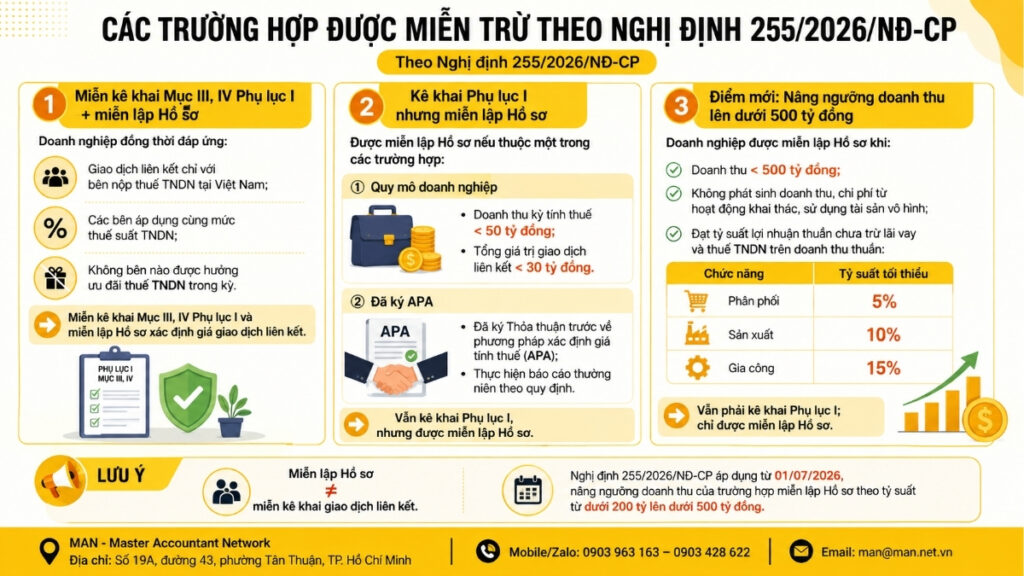
Group 1: Exempt from declaring Sections III and IV of Appendix I and exempt from preparing Transfer Pricing Documentation.
This is the highest level of exemption under Decree 255, applicable to businesses that simultaneously meet the following conditions:
- Related-party transactions of a business only arise with taxpayers located in Vietnam;
- The parties involved in related-party transactions are subject to the same corporate income tax rate.;
- Neither party to the transaction is entitled to corporate income tax incentives during the tax period.
Essentially, this exemption group is designed for purely internal Vietnamese related-party transactions where there is no incentive for transfer pricing to optimize tax obligations. This is because, regardless of the transaction price, the total corporate income tax liability of both related parties remains essentially unchanged as both parties are subject to the same tax rate and neither party benefits from preferential treatment. This is why the tax authorities allow exemption from both the detailed declaration obligation in Sections III and IV of Appendix I and the obligation to prepare a Transfer Pricing Documentation.
Group 2: Declare Appendix I but are exempt from preparing the Transfer Pricing Documentation.
The second group of exemptions under Decree 255, with a lower level of exemption, is that businesses are still required to declare Appendix I, but are exempt from the obligation to prepare a Transfer Pricing Documentation if they fall into one of two cases:
- Businesses with total revenue generated during the tax period below VND 50 billion and total value of all related-party transactions arising during the tax period below VND 30 billion; or
- The company has signed an Advance Pricing Agreement (APA) with the tax authorities.
The first requirement targets small-scale businesses where the value of related-party transactions is not large enough to create a significant risk of tax revenue loss; therefore, requiring the preparation of a complete set of documents according to Appendices II and III would create a compliance burden disproportionate to their scale of operation.
The second condition stems from a different logic: a company that has signed an APA means that the method and price of related-party transactions have already been assessed and approved by the tax authorities, so there is no need to re-submit documentation proving the market price principle for the same transaction.
Group 3: New points in Decree 255: Raising the exemption threshold based on profit margin.
This is the most notable update in Decree 255/2026/ND-CP: The revenue threshold for exemption from preparing Transfer Pricing Documentation based on profit margin has been raised from below VND 200 billion to under 500 billion VND, while removing the condition “"perform a simple function"”, This helps businesses of medium revenue size, which previously did not qualify, to now have the opportunity to be exempt.
Specifically, to be eligible for this exemption, a business must simultaneously meet the following requirements:
- Total revenue generated during the tax period is less than VND 500 billion; and
- Achieve a minimum net profit margin on net revenue corresponding to the main business function: 5% for businesses performing only distribution functions, 10% for businesses performing only manufacturing functions, and 15% for businesses performing only processing functions.
Please note: Even though they fall under this profit margin exemption group, businesses must still fully comply with Appendix I, which only exempts them from the obligation to prepare Transfer Pricing Documentation, not from the obligation to declare information about related-party transactions to the tax authorities.
Summary table comparing 3 exemption cases under Decree 255
To help businesses easily compare and determine their own position, here is a summary table of exemption cases according to Decree 255:
| Group | Condition | Exempt from declaration (Sections III and IV of Appendix I) | No need to prepare price determination documents. |
| 1 | Related-party transactions are only conducted with taxpayers in Vietnam; at the same tax rate; and neither party enjoys tax incentives. | Free | Free |
| 2 | Revenue below 50 billion VND and total value of related-party transactions below 30 billion VND. | Declaration | Free |
| 3 | Revenue below VND 500 billion and achieving a minimum positive profit margin according to the function. | Declaration | Free |
Important Note: Even if exempted from filing, businesses must still fulfill their obligation to declare Appendix I by the deadline for corporate income tax settlement.
Does being exempt from filing a tax return mean being exempt from tax obligations?
This is a point where many businesses, even those with years of experience in related-party transactions, easily misunderstand, leading to unnecessary risks when subjected to tax audits and inspections.
The exemption from preparing a transfer pricing documentation file does not eliminate the obligation to report and determine transfer prices; the exemption from preparing the documentation does not reduce the taxpayer’s corporate income tax liability in Vietnam; and the enterprise must still demonstrate that it has conducted the necessary analysis, comparison, and selection of an appropriate method for determining the price of related-party transactions when requested by the tax authority.
If businesses mistakenly believe that being exempt under Decree 255 means they "don't need to worry" about transfer pricing, this poses a significant legal risk. In reality, when tax authorities conduct audits and discover irregularities in profits, price margins, or request sudden explanations, businesses exempt from filing transfer pricing documents must still be able to demonstrate that their basis for determining transfer pricing is reasonable and consistent with market pricing principles.
Recommendations for businesses eligible for exemption
Although it is not mandatory to prepare a complete Transfer Pricing Documentation form, businesses that are exempt under Decree 255 should still proactively do so:
- Maintain complete records of contracts, documents, and financial data related to related-party transactions that occurred during the period;
- There are internal documents (even at a basic level) showing the basis and methods used to determine the price for related-party transactions;
- Closely monitor fluctuations in profit margins and revenue year after year to promptly detect when a business no longer meets the exemption criteria (for example, revenue exceeds 500 billion VND, or net profit margin falls below the minimum level stipulated according to its function);
- Regularly check the implementing guidelines for Decree 255/2026/ND-CP to avoid missing any changes that may affect your applicable exemption conditions.
What steps should businesses take to properly apply the exemptions under Decree 255?

To accurately and safely apply the exemptions under Decree 255, businesses should follow the following procedure:
Step 1: Review financial data and related-party transactions.
Businesses need to accurately summarize total revenue, total value of related-party transactions arising during the tax period, applicable tax rates for related parties, tax incentive status (if any), and net profit margin on net revenue for each business function.
Step 2: Compare with the exemption conditions.
Based on the reviewed data, businesses compare it against the conditions to accurately determine whether they are exempt from declaration and documentation requirements, only exempt from documentation requirements, or not exempt from any exemptions and still have to fulfill all obligations according to general regulations.
Step 3: Prepare data and supporting documents, even if you are eligible for exemption.
Even if businesses are determined to be exempt under Decree 255, they should proactively maintain records and data proving that the market pricing principle has been followed, in order to be ready to provide explanations when requested by the tax authorities.
Conclude
Proper and complete application of exemption regulations not only helps businesses save significant compliance resources, but is also an important part of a sustainable tax risk management strategy, especially in the context of tax authorities increasingly tightening inspections and audits of related-party transactions.
If a business is unsure whether it qualifies for exemptions under Decree 255, or needs assistance with a comprehensive review of its related-party transaction compliance status, consultation is recommended. related party transaction advisory services Seek advice and support from specialized and experienced units like MAN – Master Accountant Network to avoid unforeseen risks during tax settlement or tax audits.
Contact MAN – Master Accountant Network For timely advice and support!
Contact information MAN – Master Accountant Network
- Address: No. 19A, Street 43, Tan Thuan Ward, Ho Chi Minh City
- Mobile/Zalo: 0903 963 163 – 0903 428 622
- E-mail: man@man.net.vn
- Google Business Profile: View MAN – Master Accountant Network's Google Business Profile
- LinkedIn Founder: View expert Le Hoang Tuyen's LinkedIn profile.
Responsible for production and professional content review by: Mr. Le Hoang Tuyen – Founder & CEO of MAN – Master Accountant Network. He is a CPA Vietnam auditor with over 30 years of in-depth experience in accounting, auditing, taxation, and corporate legal consulting.
Frequently Asked Questions about Exemptions under Decree 255
Are businesses with revenue under VND 500 billion required to prepare a Transfer Pricing Documentation?
No, if the business simultaneously achieves the minimum net profit margin on net revenue according to its function: 5% for distribution, 10% for manufacturing, and 15% for processing. However, the business must still declare Appendix I.
How do the exemption thresholds under Decree 255 differ from previous regulations?
The biggest difference lies in the profit margin exemption group: the revenue threshold has been raised from under VND 200 billion to under VND 500 billion, and the condition of performing with simple functions has been removed.
Are businesses that are operating at a loss or have a profit margin lower than the minimum required level exempt from filing the necessary documents?
No, if the net profit margin on actual revenue is lower than this minimum stipulated level, even if the business is operating at a loss, the business is not exempt under this group and must still prepare a complete Transfer Pricing Documentation.
What profit margin should a business that performs multiple functions simultaneously (both production and distribution) apply?
Decree 255 stipulates the minimum profit margin associated with each individual function. For businesses performing multiple functions simultaneously, it is necessary to identify the main, core function that generates the majority of revenue or profit in order to determine the corresponding profit margin; if the primary function cannot be clearly identified, the business should consult the tax authorities or a consultant to avoid misapplying the exemption conditions.