






In fact, many businesses inadvertently find themselves in situations where they have formed interconnected relationships. Decree 255/2026/ND-CP Unaware of this, they often fail to fulfill their reporting obligations and do not prepare transfer pricing documentation on time. The consequence is that the tax authorities disallow expenses, determine taxable income, and may even impose back taxes and penalties during audits and inspections.
So, exactly what criteria does Decree 255 use to define related-party relationships? This article will provide a detailed analysis to give businesses the most complete and accurate understanding.
A quick summary of the 12 forms of determining relationship status according to Decree 255.
For easy reference, here is a quick summary table of the 12 forms of forming linkage relationships according to Decree 255/2026/ND-CP.
| No. | Form of association | Terms and conditions apply |
| 1 | Direct or indirect ownership of capital contributions | ≥ 25% contributed capital |
| 2 | Both are capitalized by a third party. | Each party contributes ≥ 25% of capital. |
| 3 | Shareholders holding shares | ≥ 10% total number of shares |
| 4 | Guarantees, loans | Outstanding debt ≥ 25% contributed capital and > 50% total outstanding medium and long-term debt |
| 5 | Appointing a leadership member | > 50% members or those with policy decision-making authority |
| 6 | Both are subject to personnel appointments from a third party. | > 50% Joint Leadership Members |
| 7 | Family relationships | Jointly manage and control personnel and finances. |
| 8 | Head office, permanent establishment | Same organization, foreign individual |
| 9 | Controlled by an individual | Through capital contribution or direct management. |
| 10 | Other reality controls | This includes independently accounting branches. |
| 11 | Capital transfer and lending transactions. | ≥ 25% (capital transfers) or ≥ 10% (borrowing/lending) during the tax period |
| 12 | Credit institutions with subsidiaries/controlling/affiliated companies | According to Law on Credit Institutions No. 32/2024/QH15 |
Businesses should compare each form of ownership with their actual ownership structure, personnel, and transactions to avoid overlooking any cases.
The legal basis for determining the affiliation is Decree 255.

Decree 255/2026/ND-CP is a document regulating tax management for related-party transactions of enterprises with affiliated relationships, replacing previous regulations on this matter. Businesses wishing to understand the overall changes compared to the old regulations can refer to the analysis below. New points in Decree 255/2026/ND-CP.
The core legal basis that businesses need to understand is Clause 2, Article 5 of Decree 255/2026/ND-CP. Accordingly, the legislative body has specifically listed 12 forms to determine when two businesses, or a business and an individual, are considered to have an affiliated relationship. This is a crucial point that all businesses need to refer to before conducting transactions with partners, shareholders, or related parties.
Key points to note: These criteria are not limited to ownership of capital contributions, but also extend to aspects such as control, management rights, loan-guarantee relationships, and even family relationships.
Why do businesses need to correctly identify their affiliations according to Decree 255?
Accurately identifying related-party relationships under Decree 255 is the first and most crucial step in the entire process of complying with transfer pricing regulations. This is because only by correctly determining whether a business has related-party relationships can it know if it falls under the scope of the regulations.
- Declare information about related-party relationships and related-party transactions in the corporate income tax return.;
- Prepare documentation to determine transfer pricing.;
- Prepare documentation to prove the reasonableness of the transaction price when requested by the tax authorities.
If a business fails to identify or incorrectly identifies related-party relationships, the legal and financial risks can be significant, such as being disqualified from expenses that violate the arm's length principle, having taxable income assessed incorrectly, incurring administrative penalties for tax violations, or even having to pay additional late payment penalties for back taxes. This is why a thorough review of ownership structure, management personnel, and internal financial transactions should be conducted periodically.
Determine the relationship between the parties according to Decree 255/2026/ND-CP.
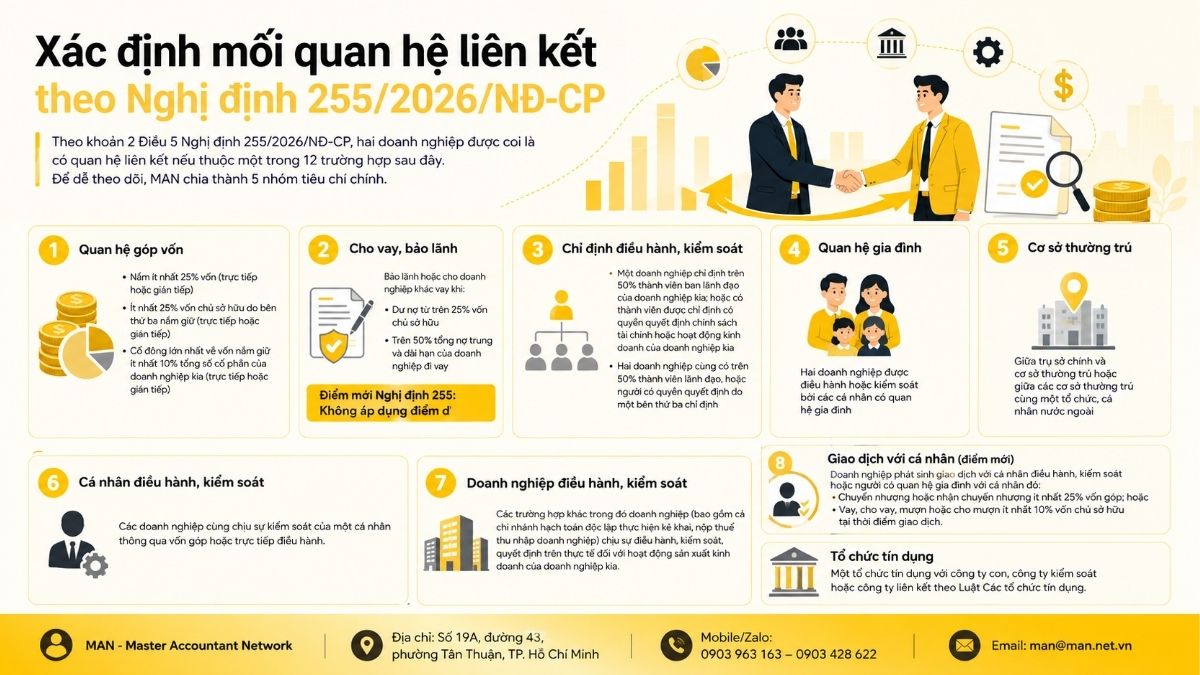
According to Clause 2, Article 5 of Decree 255/2026/ND-CP, two businesses are considered to be related if they fall under one of the following 12 cases. For ease of understanding, MAN has divided them into 5 main groups of criteria.
Capital contribution relationship
This is the most common and easily identifiable set of criteria, based on the ownership ratio between the parties:
- Hold at least 25% capital (direct or indirect)
- At least 25% Equity held by a third party (directly or indirectly)
- The largest shareholder by capital holdings the least 10% total number of shares in the other company (directly or indirectly)
As can be seen, the 25% and 10% thresholds are two important quantitative benchmarks that businesses need to compare when reviewing their shareholder structure and capital contributors, as well as those of their partners.
Loans, guarantees
Guarantee or lend to other businesses (both third-party loans guaranteed by affiliated parties and transactions of a similar nature) when:
- Outstanding debt from over 25% equity
- Over 50% represents the total medium and long-term debt of the borrowing enterprise.
New point in Decree 255: Point d does not apply.
Specifically, the new provisions of Decree 255 stipulate:
- The lender or guarantor is a credit institution that has no equity, investment, management, or control relationship with the borrowing enterprise;
- Neither party is subject to control, capital contribution, or investment from another party;
- Creditor, guarantor is The state-owned organization 100% has the function of buying, selling, and handling debt. and no control over businesses that borrow money.
Appointing managers and supervisors
Specifically:
- A designated business 50% a member of the other company's board of directors; or a designated member with the authority to decide on the financial or operational policies of the other company.
- Both businesses have over 50% A leader, or a person with decision-making authority, is appointed by a third party.
Family relationships
The two businesses are run or controlled by individuals who are related.
Permanent residence
Between the head office and the permanent establishment, or between permanent establishments of the same foreign organization or individual.
Individuals in charge and control.
Businesses are jointly controlled by a single individual through capital contribution or direct management.
Business management and control
Other cases in which an enterprise (including an independent accounting branch that declares and pays corporate income tax) is subject to the actual management, control, and decision-making on the production and business activities of the other enterprise.
New points in Decree 255/2026/ND-CP: Transactions with individuals
Businesses that conduct transactions with individuals who manage, control, or are related to those individuals:
- Transfer or receive at least 25% capital contribution; or
- Borrowing, lending, Borrow or lend at least 10% Equity at the time of the transaction.
Credit institutions
A credit institution with subsidiaries, controlling companies, or affiliated companies as defined by the Law on Credit Institutions.
Notes on determining the relationship between different parties according to Decree 255
Below are five groups of practical considerations when applying the criteria for determining affiliation, compiled from guidelines and related documents.
| Note from the group | Things you need to know |
| Individuals in charge and control. | Business executives include: Director (General Director), Deputy Director (Deputy General Director), Chief Accountant, and other executives as stipulated in the company's charter. |
| Business management and control | According to Circular 66, prior to 2017, businesses controlling the input or output of other businesses were considered related parties. From 2017 onwards, tax authorities may consider this based on operational criteria, control, or actual practices. |
| Loans, guarantees | If there are no medium and long-term debts, then there is no related party relationship (according to Official Letter 915/TCT-TTKT). Medium-term loans are loans with a term of more than 1 year up to 5 years, determined according to item 330 – Long-term debt on the Balance Sheet of the Financial Statement. |
| Transactions with individuals | Family businesses and companies where shareholders or managers regularly provide capital or share assets are directly affected. When falling under the scope of related-party transactions, businesses may incur reporting obligations and be subject to limitations on deductible interest expenses at the level of 30% EBITDA. |
| No penalty points apply. | Businesses with debts that have been transferred to a state-owned debt resolution organization need to verify the actual role of the creditor before concluding that the transaction falls outside the scope of an affiliated relationship. |
It is clear that determining the relationship between the two parties is not limited to quantitative thresholds on paper, but also depends on how the tax authorities assess the nature of control and operation in practice and each specific type of transaction.
What steps should businesses take to review their business relationships according to Decree 255?
After understanding the 12 forms of determining business relationships according to Decree 255, the next step a business should take is:
- Review the shareholder register and list of contributing members to determine the direct and indirect ownership ratios between your company and its partners, customers, and suppliers with whom you regularly do business.
- Check existing loan and guarantee agreements to compare them with the outstanding balance threshold.
- Compile a list of management and executive personnel at the company and related companies.
- Monitor capital transfer and lending transactions occurring during each tax period to avoid omissions.
Early and regular reviews help businesses proactively prepare related-party transaction documentation, avoiding the risk of back taxes and penalties when tax authorities conduct audits and inspections. If a business is unsure about its related-party transaction status or needs assistance with a comprehensive review, it can seek help from a professional. related party transaction advisory services To have the related party properly assessed and identified by MAN – Master Accountant Network's related party transaction experts, thereby proactively ensuring compliance with related party transaction declarations.
Conclude
Decree 255/2026/ND-CP specifies 12 forms of determining related-party relationships, ranging from capital contribution ownership, guarantees, loans, management and control rights, to even family relationships. Understanding these criteria helps businesses proactively review their ownership structure, personnel, and transactions, thereby fulfilling their declaration obligations and preparing related-party transaction documentation, minimizing the risk of tax assessment or penalties during audits and inspections.
For any questions requiring assistance or in-depth consultation, please contact your business. Contact MAN – Master Accountant Network via:
Contact information MAN – Master Accountant Network
- Address: No. 19A, Street 43, Tan Thuan Ward, Ho Chi Minh City
- Mobile/Zalo: 0903 963 163 – 0903 428 622
- E-mail: man@man.net.vn
- Google Business Profile: View MAN – Master Accountant Network's Google Business Profile
- LinkedIn Founder: View expert Le Hoang Tuyen's LinkedIn profile.
Responsible for production and professional content review by: Mr. Le Hoang Tuyen – Founder & CEO of MAN – Master Accountant Network. He is a CPA Vietnam auditor with over 30 years of in-depth experience in accounting, auditing, taxation, and corporate legal consulting.
Frequently Asked Questions about the Linkage Relationship under Decree 255
Are businesses that borrow from banks automatically considered to have an affiliated relationship with the bank?
No, the linkage relationship is only formed when the outstanding loan balance simultaneously reaches two thresholds: at least 25% of the owner's equity of the borrowing enterprise and over 50% of the total medium and long-term outstanding loan balance. In addition, Decree 255 also stipulates specific exclusions for credit institutions operating under the Law on Credit Institutions No. 32/2024/QH15.
How is the relationship between a business and its branches determined when the branches have independent accounting?
An independently accounting branch that declares and pays corporate income tax is also considered in the form (10) if it is actually managed, controlled, and decided upon by another enterprise regarding its production and business activities.
If an individual invests in or manages multiple different businesses, are those businesses considered to be related to each other?
Yes. Businesses controlled by the same individual, either through that individual's capital contribution or through that individual's direct involvement in management, are considered to be affiliated with each other, even if there is no direct capital connection between those businesses.
Is borrowing money from relatives of a business executive considered a related-party transaction?
It is possible that if a business has a loan, lending, borrowing, or lending transaction of at least 10% owner's capital contribution at the time of the transaction in the tax period with an individual managing or controlling the business or with a person with a personal relationship in the form (7), then that transaction will form an affiliated relationship for the corresponding tax period.
How many forms of linkage relationships are there under Decree 255?
According to Clause 2, Article 5 of Decree 255/2026/ND-CP, there are a total of 12 forms of determining the relationship between related parties.