





Businesses with related-party transactions require special attention when settling corporate income tax, because correctly identifying the status of related-party transactions is the basis for declaring, determining the transfer pricing, and preparing documentation in accordance with tax management laws. In reality, many businesses only focus on... Determine the transfer pricing However, they often skip the step of reviewing whether their business falls under the category of related-party transactions. This can lead to incomplete declarations, missed obligations, or increased risks during tax audits and inspections.
According to current regulations at Article 5 of Decree 255/2026/ND-CP (Replacing Article 5 of Decree 132/2020/ND-CP), to determine whether a business has related-party transactions, it is necessary to simultaneously consider the relationship between the parties and the actual transactions arising during the tax period. Only when all the conditions stipulated in the regulations are met can a business be determined to have related-party transactions. This article provides a detailed analysis of the legal basis, conditions for determination, cases of related-party relationships, and important notes to help businesses accurately identify their obligations under the new regulations.
What are related-party transactions in a business?

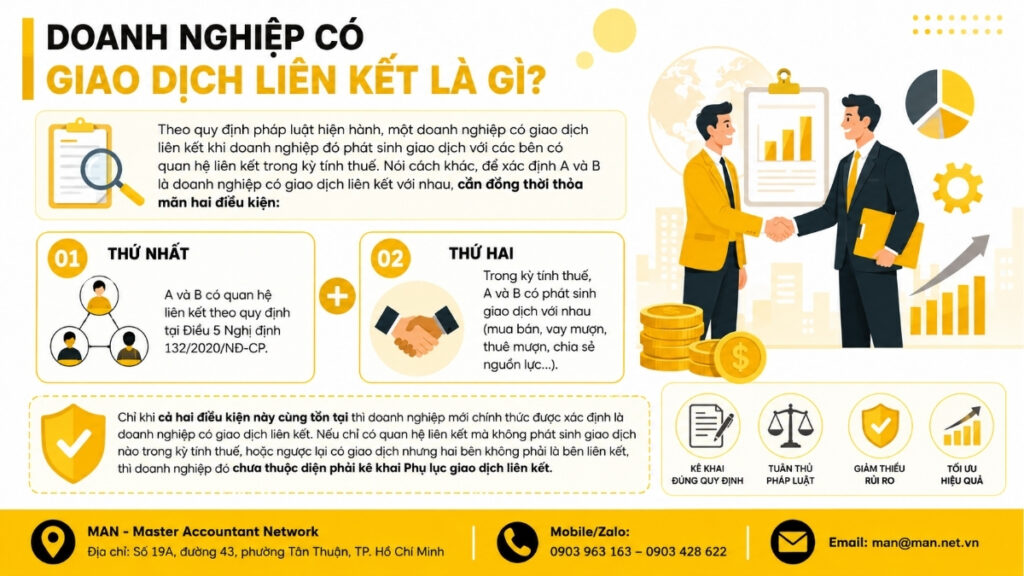
According to current legal regulations, a business has affiliate transactions When a business engages in transactions with related parties during a tax period. In other words, to determine whether A and B are related businesses, two conditions must be met simultaneously:
- Firstly: A and B have a linked relationship as stipulated in Article 5 of Decree 132/2020/ND-CP.
- Secondly: During the tax period, A and B had transactions with each other (buying and selling, borrowing, renting, sharing resources, etc.).
Only when both of these conditions coexist can a business be officially identified as having related-party transactions. If there is only a related-party relationship without any transactions occurring during the tax period, or conversely, if there are transactions but the two parties are not related parties, then that business is not required to declare these transactions. Related Party Transaction Appendix.
Why is it important to correctly identify businesses with related-party transactions?
Accurately determining whether a business has related-party transactions is not only a matter of accounting technique, but also directly affects the business's declaration and tax obligations. Once identified as having related-party transactions, the business must declare information about the related-party relationship and related-party transactions, and prepare accordingly. related-party transaction pricing documentation To demonstrate that the transaction prices between related parties are established according to the arm's length principle.
A common misconception among many small and medium-sized enterprises (SMEs) is that only large corporations or foreign-invested businesses have related-party transactions. In reality, any business with individual shareholders that lends money or loan If capital exceeds the prescribed limit, or if family members jointly manage two different legal entities, the business may unknowingly fall under the category of a related-party transaction company.
Conditions for enterprises to have related-party transactions according to Decree 255/2026/ND-CP

Article 5 of Decree 255/2026/ND-CP stipulates the cases in which related parties are identified. When an enterprise falls into one of these cases and has transactions with a related party during the tax period, it is determined to be an enterprise with related-party transactions. The specific cases are listed below:
| No. | Affiliated Parties |
| 1 | 01 enterprise directly or indirectly holds at least 25% of the capital contribution of the owner of the other enterprise. |
| 2 | Both businesses have at least 25% of owner's equity held directly or indirectly by a third party. |
| 3 | 01 enterprise is the largest shareholder in terms of owner's equity and directly or indirectly holds at least 10% of the total shares of the other enterprise. |
| 4 | One enterprise guarantees or lends capital to another enterprise in any form equal to at least 25% of the owner's equity of the borrowing enterprise and accounts for over 50% of the total value of medium and long-term debts (item 330 on the Financial Statement) of the borrowing enterprise. New features: This does not apply to cases where the creditor or guarantor is a state-owned organization with the function of buying, selling, and handling debt, but does not directly or indirectly participate in the management, control, capital contribution, or investment in the debtor or the guaranteed enterprise. |
| 5 | One business appoints a member of the executive board to manage or control another business. |
| 6 | Two companies that both have more than 50% members on their board of directors/both have one member on their board of directors with the authority to decide on financial and business policies, appointed by a third party. |
| 7 | 02 businesses are run or controlled by individuals with family relationships (spouses, parents and children, siblings, etc.). |
| 8 | Two business establishments that have a head office-permanent establishment relationship/are both permanent establishments of a foreign organization or individual. |
| 9 | These businesses are controlled by a single individual through capital contribution or direct management. |
| 10 | In other cases, the business is subject to the management, control, and decision-making power of the other business regarding its production and business activities. |
| 11 | Businesses that engage in capital transfer transactions of 25% or higher, or borrow or lend, borrow, lend From 10%, the owner's equity contribution is at least equal to that of an individual who manages or controls the business, or a relative of that individual. |
Key new points to note according to Decree 255/2026/ND-CP
Compared to Decree 132/2020/ND-CP, Article 5 of Decree 255/2026/ND-CP has two notable additions directly related to determining the relationship between related parties:
- Adding to the relationship that arises through "borrowing and lending"“ In addition to the previously existing "lending and borrowing" relationship, a business that engages in lending or borrowing transactions involving at least 10% of the owner's contributed capital at the time of the transaction during the tax period with an individual managing or controlling the business, or with an individual belonging to one of the family relationships as stipulated, is also considered to have an affiliated relationship.
- Add cases for excluding related relationships. Regarding guarantee and lending activities: creditors and guarantors that are state-owned organizations with the function of buying, selling, and handling debt will not be considered to have an affiliated relationship if they do not directly or indirectly participate in the management, control, capital contribution, or investment in the debtor enterprise or the guaranteed enterprise.
Group of capital contribution relationships (Cases 1, 2, 3)
This is the most common group when determining whether a business has related-party transactions. If one business directly or indirectly holds 25% or more of the other business's equity, the two are considered related. Similarly, if both businesses are jointly owned by a third party with at least 25% of its capital, or if one business is the largest shareholder and holds at least 10% of the other business's shares, the relationship is also established.
Loan Guarantee Group (Case 4)
This is the most frequently overlooked case. If one business guarantees or lends capital to another business in any form, with a minimum value equal to 25% of the borrower's equity capital, and simultaneously accounts for over 50% of the total value of the borrower's medium and long-term debts, these two businesses are identified as related parties. This regulation applies to loans from third parties secured by the related party's financial resources and financial transactions of a similar nature.
New features: Decree 255/2026/ND-CP adds an exclusion clause for creditors and guarantors that are state-owned organizations with charter capital, whose functions include buying, selling, and handling debt, and which do not directly or indirectly participate in the management, control, capital contribution, or investment in the debtor or guaranteed enterprise. If this condition is met, the relationship is not considered an affiliated relationship, even if the guarantee or loan amounts reach the aforementioned threshold.
Note: It is important to distinguish between loan terms in this case: medium-term (over 1 year to 5 years) and long-term (over 5 years).
Personnel, management and operational designation group (Cases 5, 6)
An entity that appoints a member of the executive board or controlling entity of another entity constitutes an affiliated entity if the number of appointed members exceeds 50% of the total number of executive board members of the other entity, or if even one appointed member has the authority to decide on the financial policies or business operations of that entity. Similarly, if two entities both have more than 50% of executive board members, or both have a executive board member with the authority to decide on financial policies or business operations appointed by the same third party, the two entities are also considered affiliated entities.
Family and blood relationship group (Case 7)
This is the most easily overlooked group of relationships by businesses due to its informal nature, yet it is very common in family business models in Vietnam. Two businesses are managed or controlled in terms of personnel, finance, and business operations by individuals who are related:
- Couple;
- Biological parents, adoptive parents, stepfather, stepmother, parents-in-law;
- Biological children, adopted children, stepchildren of the spouse, daughters-in-law, sons-in-law;
- Siblings with the same parents, half-siblings with the same father, half-siblings with the same mother, and corresponding in-law relationships;
- paternal grandparents, maternal grandparents;
- Grandchildren, great-grandchildren;
- Aunts, uncles, and nieces/nephews.
If two businesses belonging to the same family are engaging in buying, selling, or borrowing transactions with each other, this almost certainly constitutes a case of related-party transactions.
Head office/permanent establishment group (Case 8)
Two business establishments that have a head office and permanent establishment relationship, or are both permanent establishments of a foreign organization or individual, are also defined as affiliated parties under this regulation.
Group of individuals controlling the business (Cases 9, 10)
Businesses controlled by an individual, either through that individual's capital contribution to the business or through direct participation in its management, are also considered to be affiliated businesses.
In addition, the law also includes a comprehensive provision:
- Other cases where a business is under the de facto management, control, and decision-making authority over the production and business activities of another business, even if not falling under the specific criteria mentioned above, are still considered related-party relationships.
Group of transactions involving capital transfers, borrowing, and specific lending activities (Case 11)
Businesses that engage in transactions involving the transfer or acquisition of capital contributions with a minimum ratio of 25% of owner's equity during the tax period, or in borrowing or lending transactions, borrow, lend A minimum of 10% owner's equity at the time of the transaction, with the individual managing or controlling the business, or with individuals related to the family relationships mentioned in case 7, is also determined to be an affiliated relationship.
Important note: A common mistake businesses make.
In practice, after providing consulting support to numerous businesses, MAN – Master Accountant Network has identified two situations that frequently cause businesses to be confused when determining whether they have related-party transactions:
- Renting a house, renting a car, or purchasing goods from the Director: These are not transactions that create an affiliation based on capital contribution or loan criteria.
- Borrowing or lending money from directors, shareholders, contributing members, or related individuals with a value of 10% or more of the charter capital constitutes an affiliated relationship, and if a corresponding transaction occurs, the enterprise will be identified as an enterprise with related-party transactions.
Learn more: Declare related-party transactions involving loans to the director.
What types of transactions are included in related-party transactions?
After identifying the related party relationship, the next step in concluding whether a business has related-party transactions is to check whether, during the tax period, the business has had any transactions falling into the following categories with related parties:
- Buying, selling, exchanging, renting, leasing, borrowing, lending, transferring, assigning goods, and providing services between related parties.
- Borrowing, lending, financial services, financial guarantees, and other financial instruments arising between related parties.
- Buying, selling, exchanging, leasing, renting, borrowing, lending, transferring, assigning tangible and intangible assets, and agreements for the purchase and shared use of resources such as assets, capital, labor, and cost sharing between affiliated parties.
Note: Transactions arising between related parties are all classified as related-party transactions, except for transactions involving collection or disbursement on behalf of others. This is an important basis for businesses to accurately review and avoid overlooking seemingly small transactions that are still subject to declaration.
How to identify businesses with related-party transactions

To ensure the review process is systematic and thorough, businesses should implement the following:
Identify the relationship
Businesses need to review the entire ownership structure (capital contribution ratios, shares), guarantees or loans, management personnel structure, as well as family relationships between individuals holding executive and controlling roles in related legal entities. Compare this with the 11 cases outlined in Article 5 of Decree 132/2020/ND-CP above to determine whether any related-party relationships exist.
Determine whether transactions occurred during the tax period.
After identifying the related parties, the business then reviews whether any transactions with those related parties occurred during the tax period and fall into one of the three transaction categories mentioned above.
Only when both of the above steps are confirmed will the business officially be considered a related-party transaction business and incur the corresponding declaration obligations.
A real-world example of a business engaging in related-party transactions.
To help businesses visualize and compare these examples to real-world situations, here are three typical examples:
Example 1: Borrowing a meeting room between a parent company and a subsidiary company.
Company A is a subsidiary of Company B. On May 8, 2026, Company A borrowed Company B's hall to hold an event. This is identified as a related-party transaction, arising from the shared use of resources, even though there is no direct cash flow for the use of this hall.
Example 2: A company borrows money from its director exceeding the permitted limit.
Company C borrowed money from the company's director at a rate exceeding 10% of the owner's contributed capital. This is identified as a related-party transaction according to Decree 255/2026/ND-CP (which clarifies the form of borrowing and lending), because the nature of the borrowing in this case is essentially an interest-free loan between the enterprise and the individual in charge.
Example 3: Many small loans that, when combined, reach a threshold.
Company C borrows money from Company D, divided into several separate loans. While each individual loan may not meet the threshold to be classified as a related-party transaction, if the total outstanding balance of all loans from Company D during the tax period reaches the required threshold, the company will still be considered to have a related-party transaction. This is a point that businesses need to pay special attention to in order to avoid splitting transactions to evade reporting obligations, as the overall nature of the transaction is the basis for determination, not each individual loan.
What should businesses do when they identify related-party transactions?
Once a business has identified related-party transactions, it should proactively take the following steps to ensure compliance and minimize risks during tax settlement and audits:
- Conduct a comprehensive review of ownership structure, management personnel, and internal loans and borrowings between the enterprise and related individuals and organizations, not limited to companies within the same group, but also including the executives and their relatives.
- Compile a complete list of related parties and related-party transactions arising during the tax period, comparing it with the legal basis in Article 5 of Decree 132/2020/ND-CP.
- Prepare a complete and timely declaration of related-party transactions, including documents and evidence proving that the transaction prices between related parties were established in accordance with the arm's length principle.
- Conduct periodic reviews for each tax period, as related-party relationships and transactions may arise or change over time (changes in capital structure, changes in management personnel, new loans, etc.).
- Consult with a tax expert or a related-party transaction advisory firm in complex situations.
Proactively reviewing and accurately declaring information from the outset not only helps businesses comply with the law but also enables them to proactively manage internal finances and increase transparency in transactions with related parties.
Conclude
Determining whether a business has related-party transactions must be based on the regulations in Decree 255/2026/ND-CP (replacing Decree 132/2020/ND-CP and Decree 20/2025/ND-CP, effective from July 1, 2026). Accordingly, a business can only be determined to have related-party transactions when it simultaneously has a related-party relationship and transactions with the related party during the tax period.
Accurately reviewing the relationships and transactions that arise will help businesses fulfill their declaration obligations, determine transfer pricing, and comply with legal regulations, while also mitigating risks during tax audits and inspections.
For any questions or assistance, please contact your company. Contact MAN – Master Accountant Network:
Contact information MAN – Master Accountant Network
- Address: No. 19A, Street 43, Tan Thuan Ward, Ho Chi Minh City
- Mobile/Zalo: 0903 963 163 – 0903 428 622
- E-mail: man@man.net.vn
- Google Business Profile: View MAN – Master Accountant Network's Google Business Profile
- LinkedIn Founder: View expert Le Hoang Tuyen's LinkedIn profile.
Responsible for production and professional content review by: Mr. Le Hoang Tuyen – Founder & CEO of MAN – Master Accountant Network. He is a CPA Vietnam auditor with over 30 years of in-depth experience in accounting, auditing, taxation, and corporate legal consulting.
Frequently Asked Questions about Businesses with Related Party Transactions
Is borrowing money from shareholders considered a related-party transaction?
Yes, if the loan or borrowing meets the minimum ratio of 10% equity contributed by the owner at the time the transaction occurs, and that shareholder is an individual who manages or controls the business or is related to a specified family relationship.
Are renting a house or purchasing goods from the Director considered related-party transactions?
No. This transaction is not defined as creating a related-party relationship or related-party transaction under current regulations.
Are collection and payment transactions between related parties considered related-party transactions?
No. This is the only exception that is excluded, even when arising between related parties.
Are multiple small loans, each not exceeding the stipulated threshold, considered related-party transactions?
Yes, if the total outstanding balance of all loans taken out during the tax period reaches the prescribed threshold, the business will still be considered to have related-party transactions, even if each individual loan has not met the threshold.
If a business has related-party transactions but no transactions occur during the tax period, is it still considered to have related-party transactions?
Businesses are still considered to have related-party relationships, but are not required to declare related-party transactions in that tax period. According to current principles, related-party relationships and related-party transactions are two parallel elements; only when a transaction occurs does a related-party transaction become required for declaration.
If a business lends capital to a state-owned organization with the function of buying, selling, and managing debt, is that considered a related-party relationship?
No, unless the organization is directly or indirectly involved in the management, control, capital contribution, or investment in the debtor or guaranteed enterprise. This is a new exclusion added in Decree 255/2026/ND-CP.