





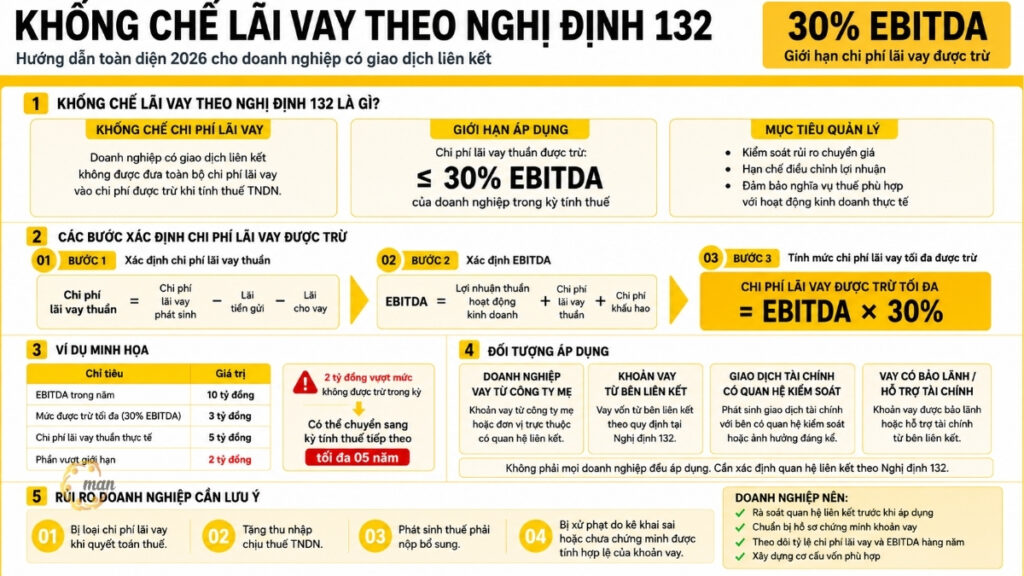
The limitation on interest expense under Decree 132 is one of the important regulations in tax management for businesses with related-party transactions. This regulation sets a limit on the portion of interest expense that can be deducted when determining taxable corporate income.
Under this mechanism, the total net interest expense for the period is only deductible up to a maximum of 30% EBITDA (net operating profit plus interest expense and depreciation expense). Any expense exceeding this limit will not be included as a deductible expense in the tax period, but may be carried forward to subsequent periods for no more than 5 years, subject to legal conditions.
The regulations on interest expense limits under Decree 132 are designed to control transfer pricing risks and restrict businesses from using financial leverage or loans from related parties to reduce taxable profits in Vietnam.
What does "interest rate cap" under Decree 132 mean?
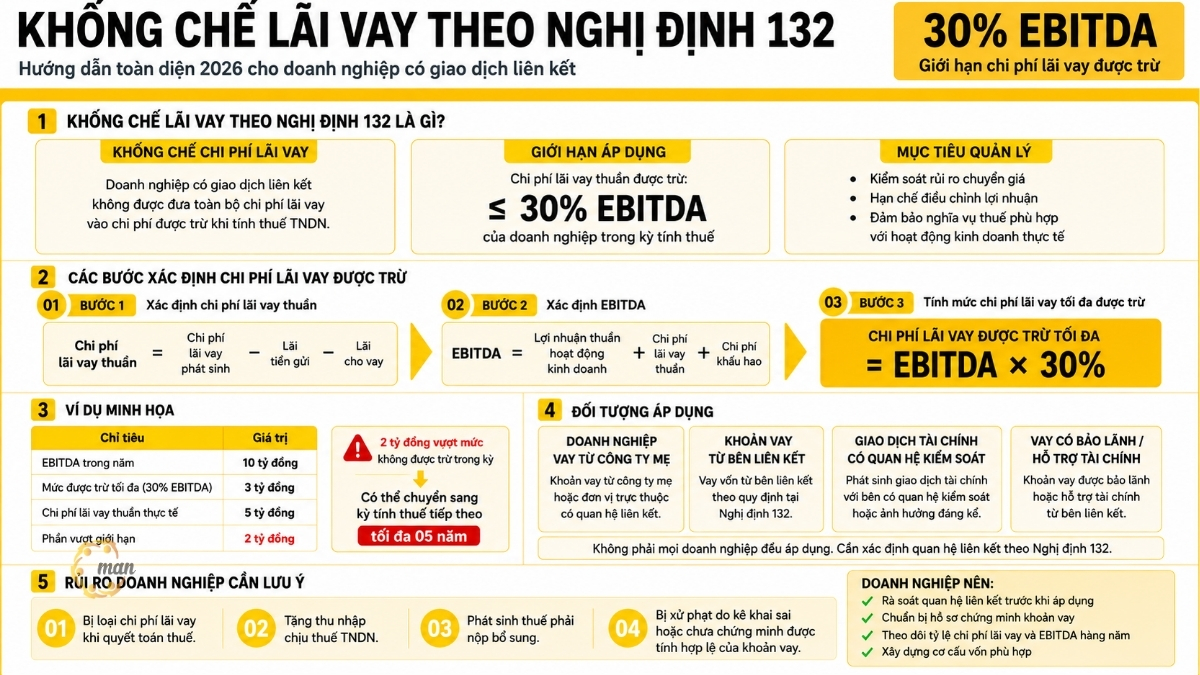
The interest expense limit under Decree 132 is a mechanism to restrict the amount of interest expense that businesses can include as deductible expenses when calculating corporate income tax for businesses with related-party transactions.
Based on Clause 3, Article 16 Decree 132/2020/ND-CP, The total net interest expense incurred during the period, deductible when determining corporate income tax, must not exceed 30% EBITDA.
In which, Net interest expense:
Net interest expense = Total interest expense incurred during the period – Interest on deposits – Interest expense on loans incurred during the period |
And EBITDA is determined:
EBITDA = Net profit from business operations + Net interest expense + Depreciation expense |
For example: For a business with an EBITDA of VND 10 billion for the year, the maximum net interest expense that can be deducted is VND 3 billion (30% EBITDA).
If the actual net interest expense is 5 billion VND, the amount exceeding 2 billion VND will not be deductible in that year.
Current regulations on interest rate caps under Decree 132.

According to the regulations on interest expense limits under Decree 132, enterprises with related-party transactions must determine the portion related party interest expense The deduction is based on the EBITDA ratio. Specifically:
Total interest expense after deducting interest on deposits and loans incurred during the period shall not exceed 30% total net profit from business operations plus net interest expense and depreciation expense during the period.
This means that businesses are not free to include all interest expenses as deductible expenses when calculating taxes if they fall within the scope of Decree 132.
The main objective of this regulation is:
- Control the use of internal loans by businesses to manipulate profits.
- Restrict the practice of transferring profits to countries with lower tax rates.
- Ensure that tax obligations are consistent with actual business operations.
What is the maximum deductible interest expense limit under Decree 132??
According to the interest expense control mechanism under Decree 132, the maximum deductible interest expense is:
30% EBITDA of the enterprise during the tax period
The portion of interest expense exceeding the 30% EBITDA will:
- Not deductible as an expense for the period.
- It can be carried over to the next tax period if the conditions are met.
- The maximum continuous carry-over period shall not exceed 05 years from the year following the year in which the disallowed expense was incurred.
This regulation gives businesses more opportunities to allocate financial costs across appropriate business stages, instead of eliminating them entirely.
Subjects to whom interest rate caps apply under Decree 132

Not all businesses are subject to the mechanism of limiting interest expense.
This regulation primarily applies to businesses that have related-party transactions as stipulated in Decree 132/2020/ND-CP.
Some common cases:
- Businesses borrow capital from their parent company or affiliated parties.
- The business engages in financial transactions with a party that has a controlling relationship.
- Businesses that have loans guaranteed or financially supported by affiliated parties.
Determining whether a business falls within the scope of application depends on an assessment of the related-party relationship and the nature of the transactions involved.
Shortcomings in the regulations controlling interest rates under Decree 132.
One of the most debated issues when applying interest rate caps under Decree 132 is determining related-party relationships through loan transactions.
According to point d, clause 2, Article 5 of Decree 132/2020/ND-CP, a case where one enterprise guarantees or lends capital to another enterprise can be determined as an affiliated relationship if it meets the following conditions:
- The minimum loan amount is equal to 25% of the owner's equity contribution.
- This accounts for over 50% of the total value of medium and long-term debt.
However, this regulation could lead to situations where businesses borrow capital from independent credit institutions but are still considered to be involved in related-party transactions.
In fact:
- The bank provides loans based on its regular credit operations.
- There is no ownership, control, or management relationship between the bank and the business.
- The loan is for the purpose of legitimate business operations.
Therefore, many businesses argue that applying a mechanism to control interest expense in this case does not accurately reflect the nature of the transaction.
Proposal to add exclusion clauses when determining related-party relationships.
In order to alleviate difficulties for businesses, the Ministry of Finance has proposed amending the regulations related to point d, clause 2, Article 5 of Decree 132/2020/ND-CP.
According to the proposal, certain cases of borrowing from independent credit institutions may be excluded from the scope of determining the related party relationship if:
- The lender is an organization operating under the Law on Credit Institutions.
- Do not participate directly or indirectly in the management, control, capital contribution, or investment in the borrowing enterprise.
- The parties are not subject to the control of a single third party.
The addition of this regulation helps to clearly distinguish:
- The loan was intended for transfer pricing purposes.
- A typical commercial loan is used to finance business operations.
How to determine deductible interest expenses according to Decree 132
Businesses need to accurately determine the portion of interest expense that is considered a deductible expense when calculating corporate income tax.
According to the interest rate control mechanism under Decree 132, businesses must comply with the following:
Step 1: Determine net interest expense.
Determine net cost using the formula:
Net interest expense = Interest expense incurred – Interest on deposits – Interest on loans |
Step 2: Determine EBITDA
Determine EBITDA using the formula:
EBITDA = Net operating profit + Net interest expense + Depreciation expense |
Step 3: Calculate the maximum deductible interest expense.
Calculate the maximum deductible interest expense using this formula:
Maximum deductible interest expense = EBITDA x 30% |
Any amount exceeding the limit will be tracked and carried over to subsequent tax periods.
Interest expenses are not deductible when calculating corporate income tax.
In addition to the EBITDA limit, businesses should be aware that some interest expenses may not be deductible. These include:
Interest rates exceeding the permitted limit.
Interest payments on loans for production and business activities by entities other than credit institutions or economic organizations that exceed the permitted limit as stipulated by tax regulations.
Interest accrued on the portion of the registered capital that has not been fully contributed.
If a business has not contributed its charter capital in full according to the registered schedule but incurs a loan, the corresponding interest expense may be excluded from deductible expenses.
How to determine:
- If the loan amount is less than or equal to the remaining capital shortfall: all interest is disallowed.
- If the loan amount exceeds the shortfall in registered capital: only the interest portion corresponding to the shortfall will be disqualified.
Risks businesses need to be aware of when applying interest rate caps under Decree 132.

Failure to comply with the regulations on interest rate caps as stipulated in Decree 132 can expose businesses to significant risks during tax audits and inspections.
Some common risks include:
- Interest expense is disallowed when settling taxes.
- Increase taxable corporate income.
- Additional tax payable has arisen.
- Penalized for falsely declaring or failing to prove the validity of a loan.
Therefore, businesses need to:
- Review the affiliations before implementation.
- Prepare the necessary documents to prove your loan.
- Monitor the annual interest expense ratio and EBITDA.
- Establish a suitable capital structure.
Frequently Asked Questions about Interest Rate Control under Decree 132
The interest expense limit under Decree 132 applies to businesses with related-party transactions falling within the scope of Decree 132/2020/ND-CP. Businesses commonly affected by this include those with loans from parent companies, related parties, businesses with controlling relationships, or financial transactions identified as related-party transactions according to legal regulations. However, not all loans are subject to this limit. Businesses need to accurately determine whether a related-party relationship and transaction fall under the applicable circumstances before calculating the interest expense limit.
No. According to the interest expense limitation mechanism under Decree 132, the portion of interest expense not deductible in a given period can be carried forward to the next tax period if the conditions are met. The maximum continuous carry-forward period is 5 years from the year following the year in which the non-deductible interest expense was incurred. This allows businesses to allocate financial expenses across periods where deductions are appropriate.
This is a matter of concern for many businesses. According to previous regulations, some cases of borrowing from third parties with guarantees or financial support from related parties could be considered related-party transactions. However, in practice, many businesses borrow from banks or independent credit institutions to finance their business operations but still risk being subject to interest rate caps under Decree 132. Therefore, businesses need to assess the nature of the loan, the relationship between the parties, and the relevant conditions to determine their tax obligations accurately.
In addition to the interest expense limits stipulated in Decree 132, businesses may also have other interest expense deductions disallowed, such as: interest exceeding the prescribed limit for loans from non-credit institutions or economic organizations; interest corresponding to the portion of charter capital not yet fully contributed according to the registered schedule; and interest that does not meet the requirements regarding documentation or does not serve production and business activities. Accurately identifying the nature of the loan helps businesses minimize the risk of having expenses disallowed by the tax authorities.Which businesses are subject to interest rate caps under Decree 132?
Will interest expenses exceeding the 30% EBITDA amount be completely lost?
Are businesses that borrow from banks subject to interest rate caps under Decree 132?
Which interest expenses are not deductible when calculating corporate income tax?
Conclude
The interest rate cap under Decree 132 is an important regulation aimed at controlling financial costs and limiting transfer pricing risks in enterprises with related-party transactions.
Understanding how to determine EBITDA, the 30% limit, the circumstances under which expenses can be carried forward, and which expenses are not deductible will help businesses proactively manage their taxes.
With increasingly stringent regulations on related-party transactions, businesses need to regularly review their capital structure, loan records, and reporting obligations to mitigate tax risks and optimize financial performance transparently.
Contact MAN – Master Accountant Network For free support and advice!
Contact information MAN – Master Accountant Network
- Address: No. 19A, Street 43, Tan Thuan Ward, Ho Chi Minh City
- Mobile/Zalo: 0903 963 163 – 0903 428 622
- E-mail: man@man.net.vn
- Google Business Profile: View MAN – Master Accountant Network's Google Business Profile
- LinkedIn Founder: View expert Le Hoang Tuyen's LinkedIn profile.
Responsible for production and professional content review by: Mr. Le Hoang Tuyen – Founder & CEO of MAN – Master Accountant Network. He is a CPA Vietnam auditor with over 30 years of in-depth experience in accounting, auditing, taxation, and corporate legal consulting.