





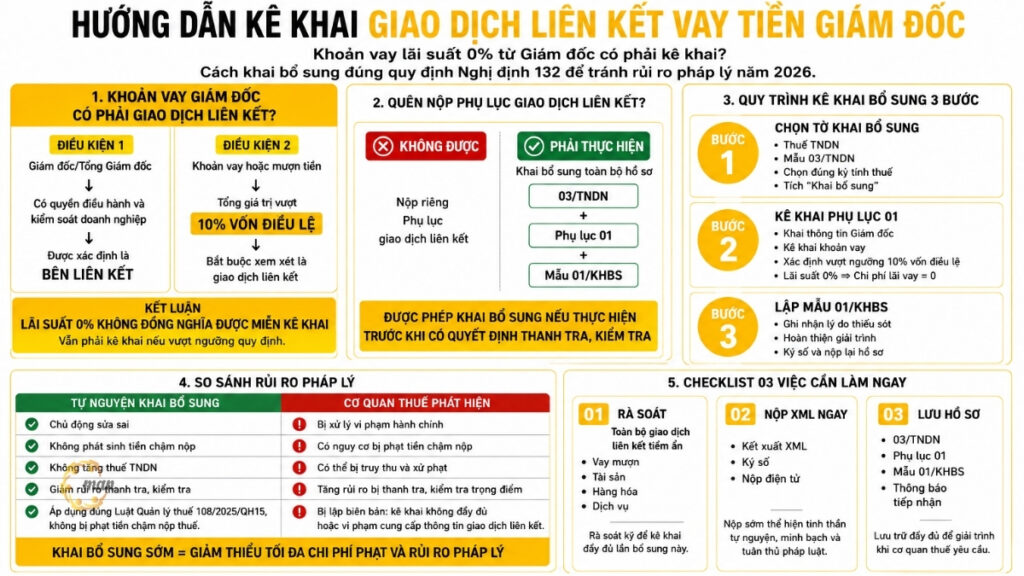
The common psychological state of many accountants is that after submitting their Corporate Income Tax (CIT) return, they suddenly remember that the company has borrowed money from the Director but has not yet prepared and submitted the Related Party Transaction Appendix. They worry about huge penalties or the risk of being placed on a high-priority inspection list.
The modern tax management system in 2026 fully opens up opportunities for businesses to proactively correct and amend these errors. As long as they proactively take action before the tax authorities announce a decision to conduct an on-site inspection or audit, everything can still be resolved.
This article will provide a comprehensive and detailed guide on declaring related-party transactions involving loans from directors, helping businesses easily implement the process and avoid unnecessary risks.
Is borrowing money from the Director with an interest rate of 0% considered a related-party transaction?

To address this issue, let's first work with MAN – Master Accountant Network to clarify the legal nature of this loan from the perspective of the tax authorities.
Conditions for determining the relationship
According to the provisions of Decree 132/2020/ND-CP, The CEO or General Director of a business holds the authority to make decisions, manage, and directly control all production and business activities of the organization. Because of this decisive influence, the relationship between the CEO and the company is always defined by tax law as a related party relationship.
The threshold for loan transactions determines whether a transaction is related to another party.
A common mistake many accountants make is assuming that if a director lends money to the company without charging interest (interest rate 0%), then there is no interest expense that needs to be declared as a related-party transaction.
In reality, the nature of a related-party transaction does not depend on whether or not costs are incurred, but rather on the scale of the transaction.
Specifically, based on the provisions of point d, clause 2, Article 5 of Decree 132/2020/ND-CP:
- Possible scenarios: Businesses engage in borrowing and lending transactions with individuals who manage or control those businesses.
- Quantitative conditions exceeding thresholds: The total value of these loans and borrowings during the tax period exceeds the company's charter capital at the time they occurred.
- Legal conclusion: Although the applicable interest rate is 0% (resulting in no interest expense or financial revenue during the period) and this is essentially an act of cash flow support from the Director to the business, this transaction still constitutes a related-party transaction that is required to be declared.
Therefore, mastering the method is essential. declare related party transactions, loan to the director This is a prerequisite for avoiding unnecessary legal risks for businesses.
If I forgot to submit the Related Party Transaction Appendix, can I file a supplementary declaration?

When discovering an omission in the Related-Party Transaction Appendix, many accountants' first reaction is to try to file a separate appendix declaration. So, what are the legal procedures for this?
Principles for submitting supplementary tax documents.
The answer is: It is not possible to submit a separate Related Party Transactions Addendum.
Technically and legally, related-party transaction information appendices do not function as a standalone tax return. Related Party Transaction Appendix This appendix is an integral and inseparable part of the Corporate Income Tax Return (Form No. 03/TNDN). Therefore, to submit this appendix, accountants are required to follow the prescribed procedure. supplementary declaration Complete Corporate Income Tax Final Settlement Documents.
Deadline for submitting supplementary safety information for businesses.
In accordance with the spirit of the current Tax Administration Law, the taxpayer's right to self-determination and correction is always maximally protected:
- Businesses have the right and the obligation to proactively submit supplementary documents immediately upon discovering errors or omissions in previously submitted tax returns.
- The supplementary declaration must be completed and successfully submitted through the electronic tax system before the competent tax authority announces a decision to conduct a tax audit or inspection at the enterprise's headquarters. After the audit decision is announced, any voluntary supplementary declarations made to avoid penalties for audited items will no longer be valid.
Instructions for declaring related-party transactions involving loans to directors, in accordance with Decree 132.
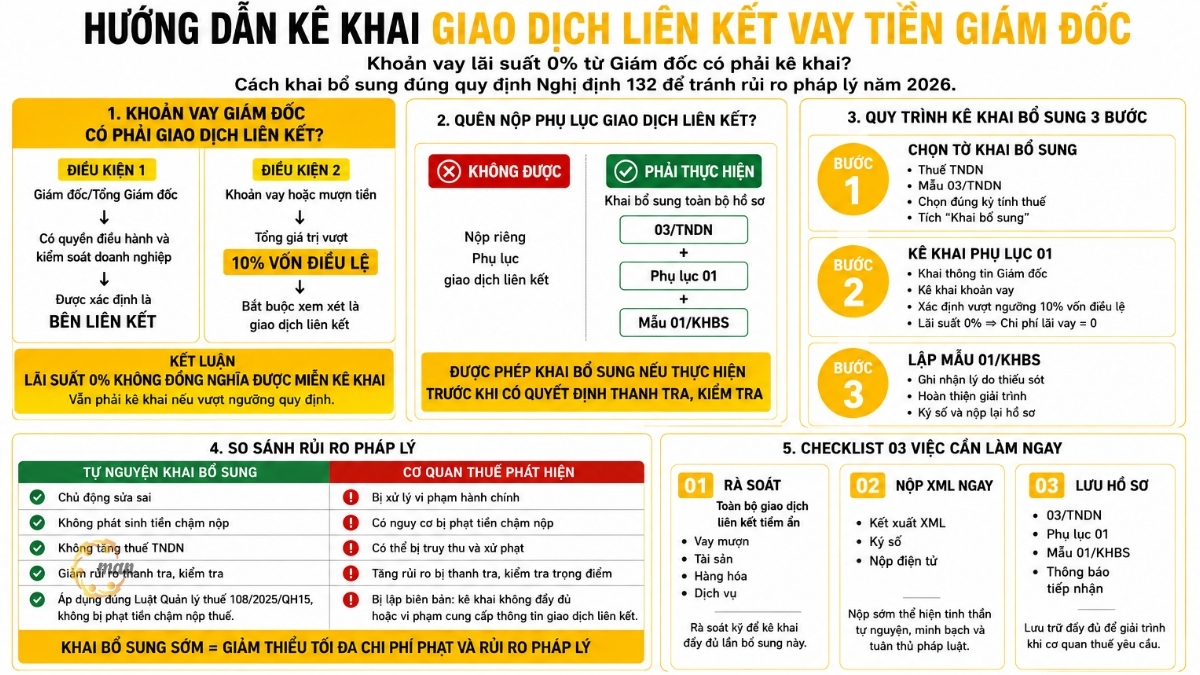
To completely resolve this oversight, please open the latest updated version of the Tax Declaration Support Software (HTKK) from 2026 or log directly into the Electronic Tax system and follow these three steps precisely:
Step 1: Select the Supplementary Corporate Income Tax Return.
Specifically, the tasks to be done in this step are:
- On the HTKK software interface or the Electronic Tax portal, navigate to the Corporate Income Tax folder.
- Select form 03/TNDN (Corporate Income Tax Final Settlement Form).
- Select the correct tax period in which the loan was incurred (for example, tax period 2024 or 2025 depending on when the omission was discovered).
- The system will display a declaration status selection panel. At this point, instead of selecting "Initial Declaration," check the "Supplementary Declaration" option and choose the corresponding number of supplementary declarations (for example, supplementary declaration 1).
Step 2: Select Appendix 01 and fill in the loan information for the Director.
This is a crucial step in the overall process of declaring related-party transactions involving loans from the director:
- In the list of attached appendices displayed below the main declaration form, find and select Appendix 01 (Information on related party relationships and related party transactions) issued with Decree 132/2020/ND-CP.
- When Appendix 01 opens, find the section for declaring information on affiliated parties to declare the Director's identifying information (full name, personal tax code or citizen identification number).
- Continue scrolling down to the section on business transactions between related parties. Here, you will accurately fill in the value of the loan exceeding the 10% charter capital from the Director in the line corresponding to the loan transaction.
Important Note: Since this is a subsidized loan with an interest rate of 0%, you will record a value of 0 in the indicators reflecting interest expense incurred during the period. This loan does not generate any reasonable financial expenses or any interest expense subject to the ceiling of Decree 132.
Step 3: Complete the Supplementary Declaration Explanation Form (Form 01/KHBS)
Specifically, the tasks to be performed are as follows:
- After completing the data entry on Appendix 01 and reviewing the main declaration form 03/TNDN, please click the button. Take note data.
- The tax software system will automatically synchronize the data and generate the supplementary explanatory statement. Form No. 01/KHBS.
In the section explaining the errors in Form 01/KHBS, you need to write truthfully, concisely, and clearly so that tax officials can easily understand the nature of the matter:
Due to an oversight in the year-end document review process, the company failed to declare the related-party transactions appendix with the initial corporate income tax return. The company proactively submitted the supplementary declaration to fulfill its declaration obligations as required by law.
Legal risks and penalties for late filing of related-party transaction declarations in 2026
Voluntarily correcting mistakes always brings significant financial advantages to businesses.
| Situation where a defect is discovered | Legal consequences | Applicable penalty amount |
| Businesses can proactively and voluntarily submit supplementary declarations (before an inspection or audit decision is made). | In accordance with the spirit of the Tax Administration Law No. 108/2025/QH15, since the Director's loan (0%) does not incur interest expenses, it does not change or increase the actual corporate income tax payable by the enterprise. | No penalties or late payment interest will be charged for providing this additional information. |
| To allow the tax authorities to detect the discrepancy before voluntary supplementation. | Businesses are issued violation notices and administrative penalties for failing to fully declare all items on tax returns or violating regulations on providing information on related-party transactions. | Administrative fines will be imposed, depending on the severity of the violation and the number of days of late submission as stipulated. |
The comparison table above shows that immediately applying the guidelines for declaring related-party transactions involving loans from directors and voluntarily submitting supplementary declarations is the optimal solution to help businesses avoid unnecessary financial losses.
Checklist of 3 things to do immediately to keep your business safe.
Accountants should not only complete and submit tax returns on the system, but also fully implement the following post-processing steps to ensure legal compliance.
Review all other potential related-party transactions.
While you're in the process of filing your corporate income tax return, take some time to review your company's accounting records.
Besides cash loans from the Director, did the company borrow other assets (such as office space, vehicles, warehouses) or engage in any transactions involving the purchase or sale of goods or services with the Director's spouse, parents, children, or other contributing members?
If so, please compile the information and submit a complete declaration in this supplement to avoid having to amend the records multiple times, which could negatively impact your company's tax reputation.
Export in XML format and submit immediately.
Once the data has been standardized and thoroughly cross-checked, proceed to export the supplementary tax return and its appendices in XML file format from the HTKK software. Log in to the Electronic Tax system immediately to digitally sign and submit the data file to the tax authority. Submitting the supplementary documents as soon as possible clearly demonstrates the company's voluntary commitment, compliance with the law, and transparency.
Storage system for accountability purposes
Please print hard copies of the supplementary declaration documents, including: the main declaration form 03/TNDN (amended), Appendix 01, the supplementary explanation declaration form 01/KHBS, and especially... Notification of acceptance of electronic supplementary tax return. These documents were sent from the Tax Authority. Please compile all of these documents into a separate file, placing it together with the corporate income tax return for that fiscal year as clear legal evidence to be used in explaining matters to the tax audit team later.
Legal basis applied in the guidelines for declaring related-party transactions involving loans from directors.

All corrective actions and explanations from businesses must be based on the following current legal documents:
- Law on Tax Administration No. 108/2025/QH15This is the supreme legal document that directly regulates the acts of supplementing and amending erroneous information by taxpayers, and also specifies the exemption from penalties for late tax payments when businesses proactively submit supplementary declarations without incurring additional tax obligations.
- Circular 80/2021/TT-BTC and Circular 94/2025/TT-BTC: Detailed guidance documents from the Ministry of Finance on supplementary declaration forms, methods for preparing supplementary explanation declarations (Form 01/KHBS), as well as administrative procedures related to electronic tax transactions.
- Decree 132/2020/ND-CP: The original decree detailing tax management for enterprises with related-party transactions, including all criteria for identifying related parties and thresholds for controlling loan ratios.
Conclude
Discovering errors in tax records is something no one wants, but a thorough and safe solution is always within reach for businesses if they follow the correct guidelines for declaring related-party transactions and director loans. The crucial factor determining success or failure at this point is time: Act today before the regulatory authorities knock on your door.
If businesses encounter difficulties in preparation or fear potential legal errors, they should seek advice. related party transaction advisory services Seek assistance from specialized and experienced units to standardize reporting data and provide explanations to the Tax Authority.
If your business is experiencing any difficulties in the process or requires further consultation. Contact MAN – Master Accountant Network today! To receive quick and accurate support and answers from our team of expert trading partners!
Contact information MAN – Master Accountant Network
- Address: No. 19A, Street 43, Tan Thuan Ward, Ho Chi Minh City
- Mobile/Zalo: 0903 963 163 – 0903 428 622
- Email: man@man.net.vn
Content production by: Mr. Le Hoang Tuyen – Founder & CEO of MAN – Master Accountant Network, CPA Vietnam auditors with over 30 years of experience in accounting, auditing, and financial consulting.