






On June 30, 2026, the Government issued Decree 255/2026/ND-CP to replace Decree 132/2020/ND-CP and Decree 20/2025/ND-CP Regarding tax management for businesses with related-party transactions.
One of the most notable changes is the complete replacement of Appendix I—Information on Related-Party Relationships and Transactions, commonly referred to by businesses as the “related-party transactions appendix”—with the new form issued pursuant to Decree No. 255/2026/NĐ-CP.
This Decree officially takes effect on July 1, 2026, but applies to corporate income tax periods beginning in 2026. This means that when preparing corporate income tax returns, businesses must use the new related-party transaction schedule to avoid errors, missing documentation, or administrative tax penalties. Below is a detailed guide to help businesses understand how to file their returns in accordance with the latest regulations.
Tax Period on the Schedule

In this section, the business must correctly record the tax period corresponding to the Corporate Income Tax Return.
The determination of the tax period is carried out in accordance with the provisions of the Corporate Income Tax Law No. 67/2025/QH15 and current guiding documents. This is the first but very important step in the entire filing process, as an incorrect tax period can lead to discrepancies in all reported data.
General taxpayer information in the related-party transaction appendix.
From indicator [01] to indicator [10], the enterprise fully declares basic information such as:
- Taxpayer's name
- Tax code
- Head office address
- Business lines
- Legal representative information
- The corresponding data has been declared in the corporate income tax return.
It is essential that the information in the Appendix be completely consistent with the tax settlement documents to avoid raising any questions from the tax authorities during an audit.
Section I: Information about Affiliated Parties
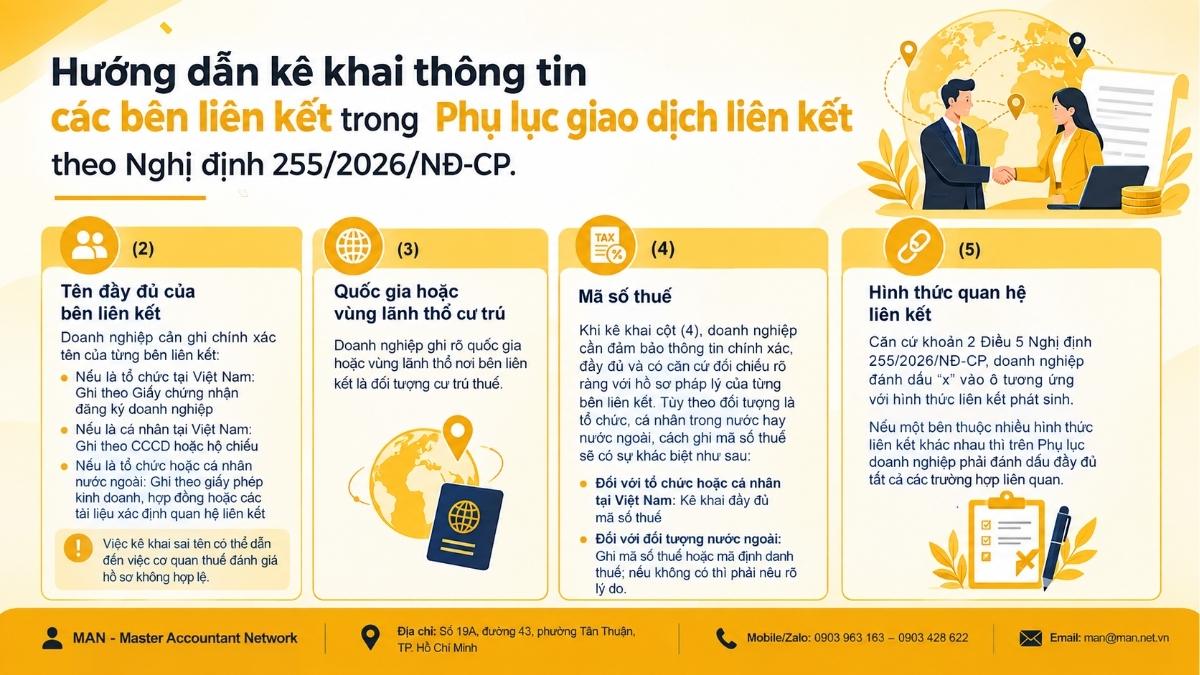
This is the core component of reporting information on related-party transactions, where the business must identify and fully disclose all related parties.
Column (2): Full name of the affiliate
Businesses need to accurately list the names of each affiliate:
- If it is an organization located in Vietnam: Record as stated in the Business Registration Certificate.
- If you are an individual in Vietnam: Fill in the information as shown on your Citizen Identification Card or passport.
- If it is a foreign organization or individual: Record according to the business license, contract, or other documents establishing the affiliation.
Providing an incorrect name may result in the tax authority deeming the filing invalid.
Column (3): Country or territory of residence
Businesses must specify the country or territory where the related party is a tax resident.
Column (4): Tax code
When completing Column (4), businesses must ensure that the information is accurate, complete, and clearly supported by reference to the legal records of each related party. Depending on whether the entity is a domestic or foreign organization or individual, the method for entering the tax identification number will differ as follows:
- For organizations or individuals in Vietnam: Provide a complete tax identification number.
- For foreign entities: Enter the tax identification number or tax identification number; if none is available, state the reason.
Column (5): Form of association relationship
Pursuant to Section 2 of Article 5 of Decree No. 255/2026/ND-CP, enterprises shall mark an “x” in the box corresponding to the type of affiliation that has arisen.
If a party is involved in multiple types of business relationships, all relevant cases must be fully indicated in the Business Appendix.
Section II: Cases exempt from declaration and documentation requirements

Not all businesses are required to prepare a complete set of documentation for determining transfer pricing. Certain cases are exempt under Article 19 of Decree No. 255/2026/ND-CP.
When preparing the Appendix, businesses should carefully verify which category they fall under:
- No declaration or documentation required.
- Only the paperwork needs to be completed.
- Not eligible for exemption.
If eligible for exemption, businesses simply need to mark an "x" in the corresponding column.
Important Note:
- If a business is exempt from filing and preparing documentation under Article 19, paragraph 1, it need only check the box in Section II and is not required to complete Sections III and IV of the Appendix.
- This significantly reduces compliance pressure for many small businesses with related-party transactions.
Section III: Information on determining transfer pricing
This is the most complex section of the entire Appendix, which describes how businesses determine transfer prices for transactions with related parties.
Cases exempt from filing under point a or c, clause 2, Article 19
Accurately identify the case Exemption from filing related-party transaction records., Then the business only needs to fill in the columns:
- Column (3)
- Column (7)
- Column (12)
The remaining columns are left blank. Specifically, if exempted under point a, the total value of related-party transactions arising during the period will be determined as follows:
Total value = Column (3) + Column (7) |
Accurately calculating this value determines whether a business is eligible for an exemption from preparing a transfer pricing documentation file.
Reference: Instructions for declaring related-party transactions on HTKK.
Classifying Transactions When Reporting in the Schedule
Businesses need to declare transactions according to each main group:
- Goods.
- Goods constitute fixed assets.
- Goods do not constitute fixed assets.
- Service.
- Research and development.
- Advertising, marketing.
- Business management, consulting, and training.
- Financial activities.
- Other services.
Each item in the related-party transaction appendix must reflect:
- Book value.
- The value is determined according to the principle of independent transactions.
- Pricing methods.
- Adjusted earnings (if any) are expected to increase.
Businesses need to be especially cautious because this is the area that is most often subject to the most thorough inspections.
Methods for Determining Prices When Reporting in the Related-Party Transactions Schedule
In column (6) and column (10), the enterprise must record the symbol of the method for determining the transfer pricing.
The methods include:
- The method of comparing related-party transaction prices with independent transaction prices (independent transaction price comparison method).
- This method compares the taxpayer's profit margin with the profit margins of independent comparable entities.
- The method of comparing gross profit margin to revenue (resale price method).
- The method of comparing gross profit margin to cost of goods sold (cost-plus profit method).
- The method of comparing net profit margins.
- The method of allocating profits among affiliated parties.
Choosing the right approach is a decisive factor in determining the level of safety when a business is subject to a tax audit.
Section IV: Business results after determining transfer pricing

This section reflects the impact of related-party transactions on adjusted business results.
Businesses need to declare:
- Sales revenue.
- Cost of goods sold.
- Gross profit.
- Cost of goods sold.
- Business management costs.
- Financial costs.
- Interest expense.
- Depreciation.
- EBITDA.
- Interest expense ratio.
- The profit margin is used to determine related-party transactions.
Examples of interest expense ratios in related party transaction appendices:
Interest expense ratio = (Interest expense – Interest on deposits) / Adjusted EBITDA |
This section is particularly important for businesses that borrow internally within the group or incur significant interest expenses.
Reference: Formula for calculating interest on related-party transactions.
In the case where a business signs an APA agreement.
If the business has signed an advance pricing agreement (APA), please mark "Yes" in the corresponding section.
An APA could be:
- Unilateral APA
- Bilateral APA
- Multilateral APA
In that case, the business must separately declare the transactions falling within the scope of the APA in the related-party transactions appendix to ensure consistency with the records already approved by the tax authorities.
Important notes when preparing an addendum to related-party transactions.
To avoid back taxes and penalties, businesses need to remember:
- Use the correct new form in accordance with Decree No. 255/2026/NĐ-CP
- Verify the exact conditions for exemption from declaration.
- Provide full details of affiliated parties.
- Choosing the right pricing method
- Ensure that the figures match the financial statements and corporate income tax returns.
- Maintain complete records of transfer pricing.
Errors in the tax filing process not only result in administrative penalties but can also lead to tax assessments, the collection of back corporate income tax, and substantial late-payment penalties.
If a business encounters difficulties in filing the related-party transaction appendix, it should consider seeking advice. related party transaction advisory services From highly specialized, reputable, and experienced units, we can create complete and highly persuasive appendices and documentation.
Conclude
Accurately and completely declaring the related-party transaction appendix is no longer an option but has become a mandatory requirement for businesses that have related-party transactions in the fiscal year.
Decree 20/2025/ND-CP has significantly changed the way documentation is prepared, especially the new appendix form for related-party transactions, which will be applied from the 2024 tax year. Therefore, businesses need to review it from the outset to minimize the risk of being audited, having taxes collected retrospectively, and being penalized for tax violations.
Contact MAN – Master Accountant Network For free support and advice!
Contact information MAN – Master Accountant Network
- Address: No. 19A, Street 43, Tan Thuan Ward, Ho Chi Minh City
- Mobile/Zalo: 0903 963 163 – 0903 428 622
- E-mail: man@man.net.vn
- Google Business Profile: View MAN – Master Accountant Network's Google Business Profile
- LinkedIn Founder: View expert Le Hoang Tuyen's LinkedIn profile.
Responsible for production and professional content review by: Mr. Le Hoang Tuyen – Founder & CEO of MAN – Master Accountant Network. He is a CPA Vietnam auditor with over 30 years of in-depth experience in accounting, auditing, taxation, and corporate legal consulting.
Frequently Asked Questions about Related Party Transaction Annexes
When is a business required to submit an addendum to its related-party transactions?
Businesses must submit an annex on related-party transactions when transactions with related parties occur, in accordance with the provisions of Article 5 of Decree No. 255/2026/ND-CP. This document must be submitted along with the annual corporate income tax return.
Which Appendix template should be used starting in 2026?
Starting with the 2026 corporate income tax filing period, businesses must use the new related-party transaction schedule form issued pursuant to Decree No. 255/2026/NĐ-CP. This form completely replaces the old annex and officially takes effect on July 1, 2026.
Is there a penalty for failing to submit an appendix?
Yes. If a business fails to file, files an incomplete return, or provides incorrect information, the tax authority may impose administrative penalties, collect back taxes, charge late payment penalties, and even assess tax liabilities. This is one of the most common mistakes made during corporate income tax settlement.
Do businesses have to declare internal loan transactions?
Yes. Loans between related parties—such as parent companies and subsidiaries, companies within the same group, or individuals with a controlling interest—are considered related-party transactions. Therefore, businesses must fully disclose such transactions in the Schedule, particularly regarding interest expenses and deduction limits.
Is it possible to file an amended return after the tax settlement?
Businesses can still file supplementary returns if they discover errors after submitting their corporate income tax return. However, filing supplementary returns as soon as possible will help reduce the risk of penalties, back taxes, or being accused by the tax authorities of intentionally omitting information on related-party transactions.