





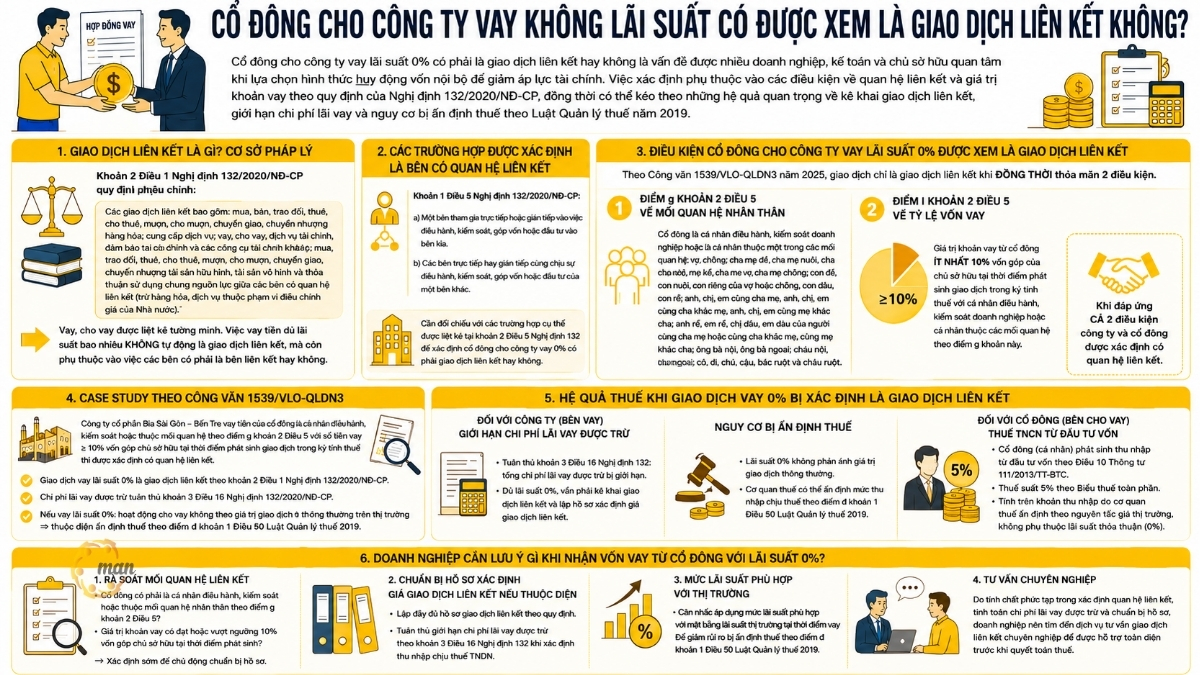
Whether a shareholder lending to a company at an interest rate of 0% constitutes an related-party transaction is a matter of concern for many businesses, accountants, and owners when choosing internal fundraising methods to reduce financial pressure. In reality, not every interest-free loan is considered a related-party transaction. The determination depends on the conditions regarding the related-party relationship and the value of the loan as stipulated by regulations. Decree 132/2020/ND-CP, This could also lead to significant consequences regarding the declaration of related-party transactions, limits on interest expense deductions, and the risk of being subject to tax assessments. Tax Administration Law of 2019. This article will provide a comprehensive analysis of the legal basis, tax authority guidelines, and practical considerations to help businesses correctly identify regulations, minimize risks, and ensure compliance with the law.
What are related-party transactions? What is the legal basis for defining them?
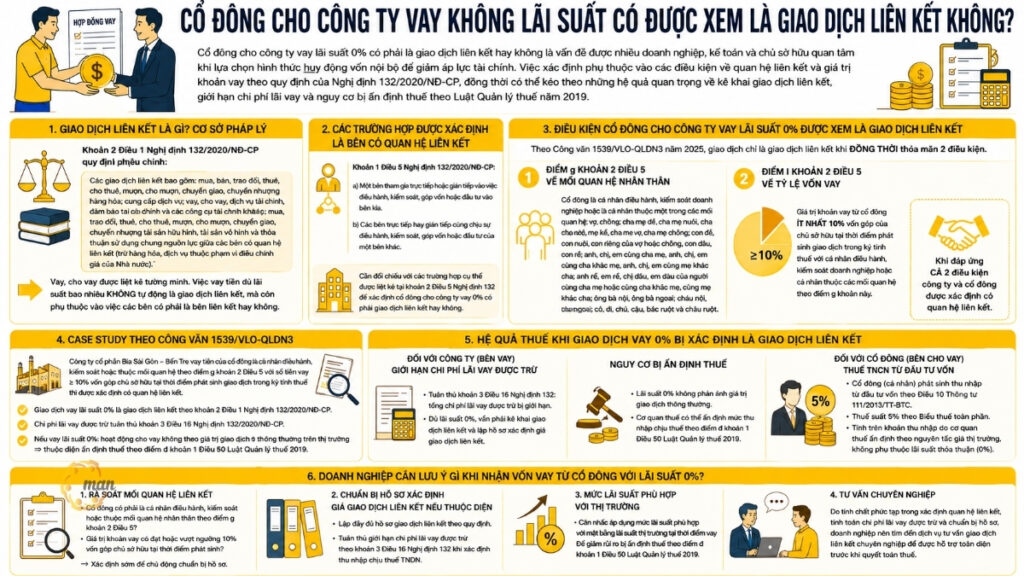
Before analyzing the specific case of a shareholder lending to a company at an interest rate of 0%, it is necessary to understand the concept of related-party transactions as defined by current regulations. Clause 2, Article 1 of Decree 132/2020/ND-CP stipulates the scope of application as follows:
Related-party transactions subject to this Decree include transactions involving the purchase, sale, exchange, lease, rental, borrowing, lending, transfer, and assignment of goods; provision of services; borrowing, lending, financial services, financial guarantees, and other financial instruments; purchase, sale, exchange, lease, rental, borrowing, lending, transfer, and assignment of tangible and intangible assets; and agreements for the purchase, sale, and shared use of resources such as assets, capital, and labor, and cost sharing between related parties, excluding business transactions involving goods and services subject to state price regulation as stipulated by law on pricing.
Thus, borrowing and lending activities are explicitly listed within the group of transactions regulated by Decree 132. This means that borrowing money, regardless of the interest rate, is not automatically considered a related-party transaction; it also depends on whether the parties involved in the transaction are related parties or not.
The cases identified are related parties.
Clause 1, Article 5 of Decree 132/2020/ND-CP clearly states:
Related parties (hereinafter referred to as 'related parties') are parties that have a relationship falling under one of the following cases: a) One party directly or indirectly participates in the management, control, capital contribution, or investment in the other party; b) The parties are directly or indirectly subject to the management, control, capital contribution, or investment of another party.
To determine whether a shareholder lending to a company at interest rate 0% constitutes an related-party transaction, it is necessary to compare it with the specific cases listed in Clause 2, Article 5 of Decree 132/2020/ND-CP.
The condition that shareholders lend to the company at an interest rate of 0% is considered an related-party transaction.

Not every instance of a shareholder lending to a company at an interest rate of 0% is considered a related-party transaction. According to the guidelines... Official document 1539/VLO-QLDN3 In 2025, this transaction will only be identified as a related-party transaction if it simultaneously satisfies the following two conditions.
Point g, Clause 2, Article 5 stipulates personal relationships.
Point g, Clause 2, Article 5 of Decree 132 stipulates:
Two businesses are managed or controlled in terms of personnel, finance, and business operations by individuals who are related to one of the following: spouse; biological parents, adoptive parents, stepfather, stepmother, parents-in-law; biological children, adopted children, stepchildren of the spouse, daughter-in-law, son-in-law; siblings with the same parents, half-siblings, half-siblings; brother-in-law, sister-in-law, daughter-in-law, son-in-law of a person with the same parents or half-siblings; paternal grandparents; grandchildren; aunts, uncles, and nieces/nephews.
This condition applies to cases where the shareholder is an individual who manages or controls the business, or is an individual who has one of the aforementioned blood or marital relationships with the business's manager or controller.
Point 1, Clause 2, Article 5 regarding the loan-to-value ratio
Besides the condition regarding personal relationship, point l, clause 2, Article 5 stipulates an additional condition regarding the transaction value:
Businesses that have transactions involving the transfer or acquisition of at least 25% of owner's capital contributions during the tax period; or borrowing or lending at least 10% of owner's capital contributions at the time of the transaction during the tax period with individuals managing or controlling the business or with individuals in a relationship as stipulated in point g of this clause.
Therefore, if the loan from the shareholder accounts for at least 10% of the owner's equity at the time the transaction occurs during the tax period, along with the personal relationship condition, then the company and the shareholder are determined to have an affiliated relationship.
A real-world case study based on Official Letter 1539/VLO-QLDN3
A typical example of the situation. Shareholders lend money to the company at an interest rate of 0.%. The tax authorities provided specific guidance in the case of Saigon Beer - Ben Tre Joint Stock Company. According to Official Letter 1539/VLO-QLDN3 of 2025:
Saigon Beer - Ben Tre Joint Stock Company may borrow money from shareholders if the shareholder is an individual who manages or controls the business, or an individual who is in a relationship as stipulated in point g, clause 2, Article 5. vA loan amount of at least 10% of the owner's equity at the time the transaction occurs during the tax period is considered an affiliated transaction. Therefore, a loan transaction with an interest rate of 0% between the Company and its shareholders is considered an affiliated transaction as stipulated in Clause 2, Article 1 of Decree No. 132/2020/ND-CP.. TThe total interest expense deductible when determining taxable income for corporate income tax purposes for SAIGON BEER - BEN TRE JOINT STOCK COMPANY with related-party transactions is regulated in Clause 3, Article 16 of Decree No. 132/2020/ND-CP.
If a company borrows money from individual shareholders at an interest rate of 0.1% (1% interest rate) or 0.3% (1% interest rate), this lending activity, which is not based on the normal market transaction value, is subject to tax assessment as stipulated in point d, clause 1, Article 50 of the Law on Tax Administration No. 38/2019/QH14..Shareholders who are individuals generating income from capital investment as stipulated in Article 10 of Circular No. 111/2013/TT-BTC dated August 15, 2013, of the Ministry of Finance, will have their income from capital investment taxed according to the full tax schedule with a tax rate of 5%.
A similar situation that is often encountered in practice is the case The director lent the company money without charging interest. Regarding the principles for determining related-party transactions, this case also needs to be compared with the same set of criteria regarding personal relationships and loan ratios as analyzed above.
Tax consequences when loan transaction 0% is determined to be a related-party transaction.

Once a shareholder-to-company loan transaction is identified as an related-party transaction, both the company (borrower) and the shareholder (lender) incur separate tax obligations that need to be considered.
For the company (borrower): Limits on deductible interest expense.
According to Official Letter 1539/VLO-QLDN3 of 2025, the total interest expense deductible when determining taxable income for corporate income tax purposes for enterprises with related-party transactions is stipulated in Clause 3, Article 16 of Decree 132. This means that even if the company does not actually pay interest to shareholders (due to the 0% interest rate), the transaction being identified as a related-party transaction still entails the responsibility to comply with the regulations on the limit of deductible interest expense applicable to enterprises with related-party transactions in general, and also requires the declaration and retention of records determining the price of related-party transactions in accordance with regulations.
Risk of tax assessment under the 2019 Tax Administration Law
Besides the issue of interest costs, loan transactions with interest rates of 0% also carry the risk of being assessed for tax by the tax authorities. According to the guidance in Official Letter 1539/VLO-QLDN3 of 2025:
In the case where a company borrows money from individual shareholders at an interest rate of 0%, this lending activity, which is not based on the normal market transaction value, is subject to tax assessment as stipulated in point d, clause 1, Article 50 of the Law on Tax Administration No. 38/2019/QH14 dated June 13, 2019, of the National Assembly.
In other words, because the 0% interest rate does not accurately reflect the market transaction value, the tax authorities have a legal basis to determine the corresponding taxable income.
This is also why businesses need to complete all the necessary procedures. declare related party transactions, loan to the director When loans arise from the business's operators or controllers and satisfy the aforementioned related-party relationship conditions, this is to avoid being caught off guard during tax settlement.
For shareholders: Personal income tax obligations from capital investments.
Even if a shareholder lends money to the company at an interest rate of 0%, personal income tax obligations still arise according to current legal regulations. Specifically, according to Official Letter 1539/VLO-QLDN3 of 2025, in this case, the individual shareholder is determined to have generated income from capital investment as stipulated in Article 10 of Circular 111/2013/TT-BTC, and the tax rate for income from capital investment is applied according to the full tax schedule with a tax rate of 5%.
Points to noteThe 5% tax rate is calculated on income determined by the tax authorities based on market prices, regardless of whether the agreed-upon interest rate between the parties is 0%. This is a point many shareholders and businesses easily overlook, leading to under-declaration of tax obligations and potentially resulting in tax arrears and penalties later on.
What should businesses consider when receiving loans from shareholders at an interest rate of 0%?

From the above analysis, it can be seen that shareholders lending to the company at an interest rate of 0% is not simply an internal financial transaction, but also entails many legal and tax consequences that businesses need to proactively review. Below are some practical notes for accountants, business owners, and shareholders.
Review the relationship between the parties.
Before securing a loan from shareholders, a company should carefully review two factors:
- Is the lending shareholder an individual who manages or controls the business, or has a personal relationship with the lender as stipulated in point g, clause 2, Article 5?.
- Will the expected loan value reach or exceed the 10% equity contribution threshold at the time of borrowing?.
Early identification allows businesses to proactively prepare their documentation, avoiding a reactive approach during tax settlement.
Prepare documentation for determining transfer pricing if applicable.
If a shareholder lends money to a company at an interest rate of 0%, and this is identified as a related-party transaction, the business needs to prepare thoroughly. Affiliated transaction records In accordance with regulations, and in compliance with the limits on deductible interest expenses as stipulated in Clause 3, Article 16 of Decree 132, when determining taxable corporate income.
The interest rate is in line with the market.
To minimize the risk of being assessed tax under point d, clause 1, Article 50 of the 2019 Tax Administration Law, businesses and shareholders can consider applying an interest rate that is consistent with the market interest rate at the time of borrowing.
Due to the complexity involved in determining related-party relationships, calculating deductible interest expenses, and preparing tax returns, businesses should seek professional assistance. related party transaction advisory services Professional assistance is needed to ensure a comprehensive review before tax settlement.
Conclude
A shareholder lending to a company at an interest rate of 0% does not automatically mean that the transaction is classified as an related-party transaction. The business needs to compare the conditions for related-party relationships under Article 5 of Decree 132/2020/ND-CP and consider the value of the loan to determine the true nature of the transaction. When the conditions are met, the loan at an interest rate of 0% will fall within the scope of the law on related-party transactions, leading to obligations regarding declaration, compliance with regulations on deductible interest expenses, and potential risks arising during tax audits and inspections.
Furthermore, businesses should also note that lending transactions with interest rates of 0% may be subject to tax assessment by the tax authorities if they do not conform to normal market transaction principles. At the same time, for individual shareholders, the personal income tax liability from capital investment still needs to be determined according to current regulations if applicable.
To mitigate tax risks and ensure compliance, businesses should proactively review shareholder-company loans from the moment the transaction occurs, prepare all relevant documentation, and seek advice from a specialized consulting firm on related-party transactions such as MAN – Master Accountant Network. Accurately assessing the nature of the transaction from the outset will help businesses minimize the risk of future tax audits, assessments, and penalties.
Contact MAN – Master Accountant Network For expert support and advice!
Contact information MAN – Master Accountant Network
- Address: No. 19A, Street 43, Tan Thuan Ward, Ho Chi Minh City
- Mobile/Zalo: 0903 963 163 – 0903 428 622
- E-mail: man@man.net.vn
- Google Business Profile: View MAN – Master Accountant Network's Google Business Profile
- LinkedIn Founder: View expert Le Hoang Tuyen's LinkedIn profile.
Responsible for production and professional content review by: Mr. Le Hoang Tuyen – Founder & CEO of MAN – Master Accountant Network. He is a CPA Vietnam auditor with over 30 years of in-depth experience in accounting, auditing, taxation, and corporate legal consulting.
Frequently Asked Questions about Shareholders Lending to a Company at Interest Rate 0%
Not always. Shareholders only incur personal income tax obligations on capital investments at a rate of 5% when the transaction is identified as a related-party transaction as guided by Circular 1539/VLO-QLDN3 of 2025, meaning it simultaneously satisfies the conditions regarding personal relationship and the loan ratio of 10% or more.
If the loan from shareholders does not reach the level of the owner's equity at the time the transaction occurs, then according to point l, clause 2, Article 5 of Decree 132/2020/ND-CP, this transaction is not considered a related-party transaction based on the debt ratio criterion, and therefore there is no requirement to prepare related-party transaction documentation according to this criterion.
If a shareholder's loan to a company at interest rate 0% is actually a related-party transaction but the enterprise fails to declare it or comply with the interest expense limit as stipulated in Clause 3, Article 16 of Decree 132/2020/ND-CP, the enterprise may face the risk of having its taxable income adjusted or assessed by the tax authorities during tax audits and inspections.
In addition to loan agreements and payment documents, businesses need to review their obligations to declare related-party transactions, retain supporting documents for these transactions, and prepare documentation for determining the price of related-party transactions if required by Decree 132/2020/ND-CP.
Even if the transaction is not a related-party transaction, businesses still need to prepare complete loan agreements, retain supporting documents, properly account for transactions, and fulfill relevant tax obligations to ensure transparency and mitigate risks during tax audits.Are individual shareholders who lend money to a company (0%) always subject to personal income tax?
For loans with capital contributions under 10%, is it necessary to create related-party transaction documents?
Would the company be negatively affected if it did not review related-party transactions when shareholders provided loans?
What documents does a company need to prepare when engaging in loan transactions with shareholders?
Are there any tax considerations regarding loan transactions between shareholders and companies that are not related-party transactions?