





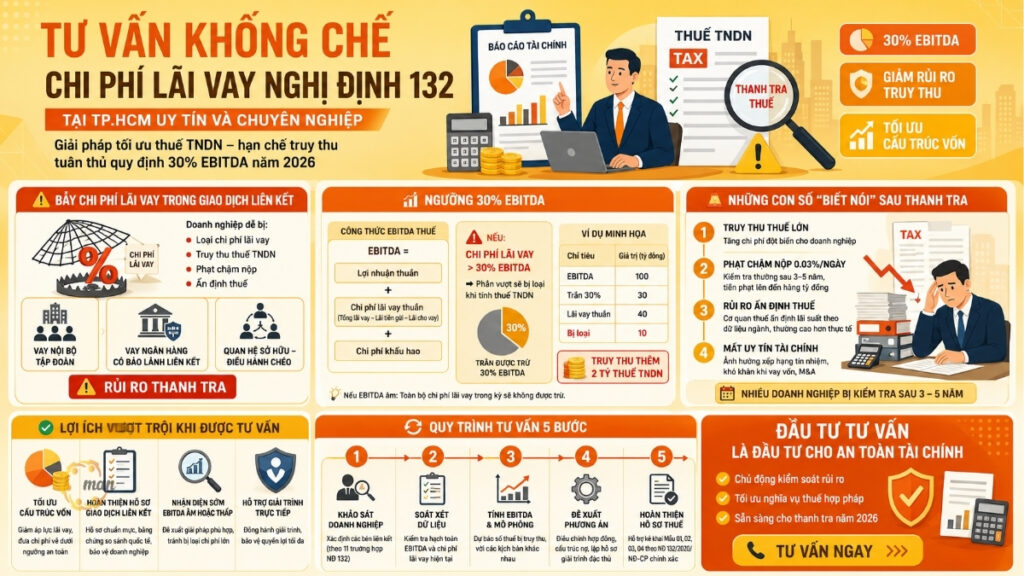
Amidst tightened tax audits of related-party transactions in 2026, many businesses are facing the risk of having interest expenses disallowed, being subject to back taxes on corporate income tax, and facing late payment penalties simply due to misinterpreting the 30% EBITDA cap regulations. Decree 132/2020/ND-CP. In particular, not only multinational corporations but also domestic businesses that borrow internally, borrow from banks guaranteed by affiliated parties, or have cross-ownership or management relationships may be subject to control.
This article provides an in-depth look at the advice on controlling interest expense under Decree 132, from determining whether a business has related-party transactions, the formula for calculating the 30% EBITDA threshold, regulations on carrying forward interest expense to the next period, to common risks when settling taxes. Simultaneously, the article offers solutions to optimize capital structure, complete related-party transaction documentation, and minimize the risk of tax arrears, helping businesses comply with regulations while legally optimizing their tax obligations.
Interest expense trap in related-party transactions

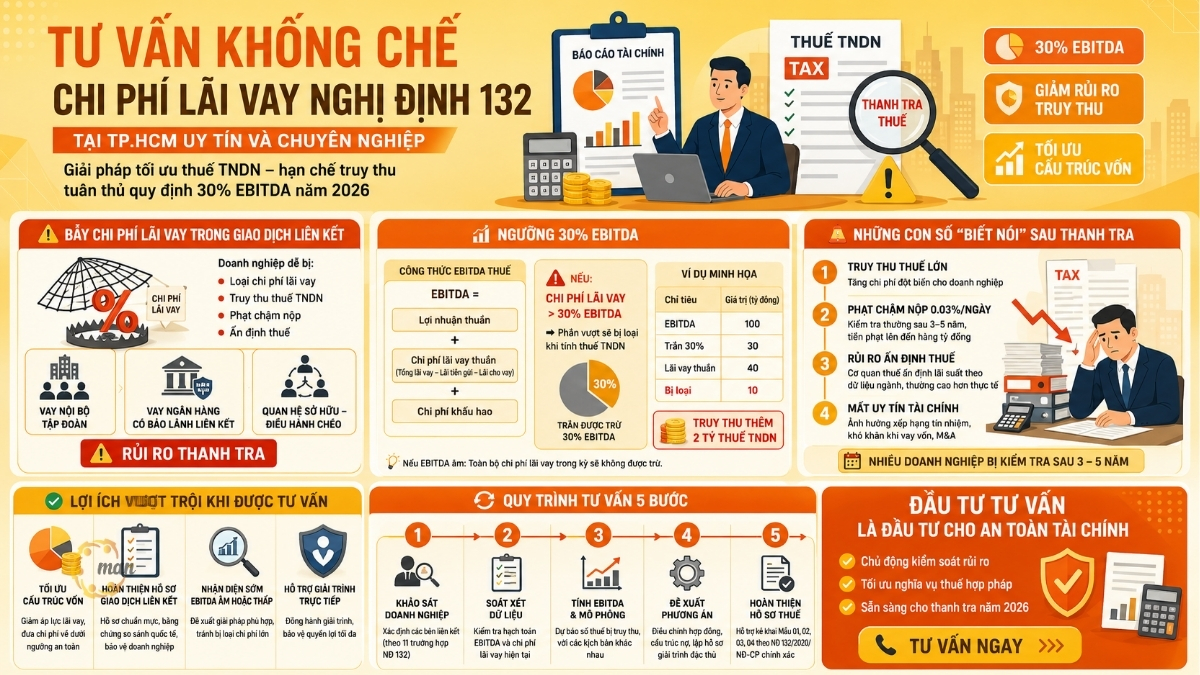
According to Article 16 of Decree 132/2020/ND-CP, interest expenses of enterprises with related-party transactions will be capped at a certain level when determining taxable corporate income. This is a mechanism aimed at combating transfer pricing and revenue erosion (BEPS). However, the line between deductible expenses and disallowed expenses is very thin without proper guidance on the interest expense cap under Decree 132.
Many businesses still mistakenly believe that only multinational corporations are subject to these regulations. However, the 2026 tax audit revealed that the following entities are frequently subject to back taxes:
- Domestic intercompany lending: Companies within the same group provide each other with capital without interest, or with interest rates lower or higher than market rates.
- Bank loans with affiliated company guarantees: This is the most common case where businesses unknowingly become involved in related-party transactions. Simply by having an individual executive or parent company guarantee a bank loan, that loan immediately becomes an affiliated transaction.
- Under the guise of management: Businesses that have a common management or control relationship, or share a common owner who holds a certain percentage of capital contribution as stipulated by regulations.
All of the above cases give rise to related-party transactions, and therefore, consulting services on controlling interest expense under Decree 132 become an indispensable legal shield.
Consequences of not understanding control rules

Before the tax authorities issue their audit conclusions, most businesses are unaware of serious "blind spots" in determining deductible interest expenses. A lack of understanding or incorrect application of the control rules under Decree 132/2020/ND-CP not only increases tax obligations but also leads to a series of financial, legal, and reputational consequences for the business. To clearly see the extent of the risks, let's analyze each issue below.
30% EBITDA Threshold: A Tax Accountant's Nightmare
The 30% EBITDA rule for controlling interest expense is a tricky one. If a company's net interest expense exceeds this threshold, the excess will be disallowed as a deductible expense when calculating corporate income tax. This directly increases the financial burden on the company, even when its actual business operations are facing difficulties.
The numbers speak for themselves after the inspection.
If businesses lack professional advice on controlling interest expenses under Decree 132, the consequences will be extremely serious:
- Sudden tax collection: Imagine a business has interest income of 100 billion VND but its EBITDA is only 100 billion VND. According to regulations, the business is only allowed to deduct 30 billion VND in expenses. The remaining 70 billion VND is added back to taxable income, meaning the business has to pay an additional 14 billion VND in corporate income tax (at tax rate 20%).
- Late payment penalties: Tax authorities typically conduct audits after 3-5 years. With a late payment penalty of 0.031 TP3T/day, the interest can amount to billions of VND, paralyzing cash flow. If you had received advice on controlling interest expense under Decree 132 from the outset, this risk would be completely avoided.
- Tax assessment risk: When related-party transaction records are unclear or reports are not submitted on time, tax authorities have the right to assess interest rates based on industry data, often higher than the actual amount paid by the business.
- Financial credibility loss: Being penalized for tax violations directly impacts credit ratings when applying for bank loans or conducting M&A transactions, making it difficult to raise capital later on.
Related-party transaction advisory services are changing the landscape.
The best solution is to search. related party transaction advisory services From reputable professional firms such as the Big 4 and MAN – Master Accountant Network, you will receive support and advice from transfer pricing experts to control interest expense under Decree 132, ensuring optimal benefits.
MAN not only helps you declare correctly, but also assists in restructuring capital, converting debt, or optimizing cash flow to overcome legal hurdles in the most legal and transparent way possible.
Current legal basis
To ensure that advice on controlling interest expenses under Decree 132 is highly persuasive, a deep understanding of current legal regulations is necessary.
Clause 3, Article 16, Decree 132/2020/ND-CP
This is the most crucial basis. The regulation states:
“"The total interest expense incurred that is deductible when determining corporate income tax for enterprises with related-party transactions shall not exceed 30% EBITDA."”
Proper application of this provision requires precise accounting data analysis skills, which MAN Consulting, under Decree 132, is committed to providing to businesses.
EBITDA tax calculation formula
To accurately determine the deductible interest expense under Decree 132/2020/ND-CP, businesses must first correctly calculate EBITDA using the method applicable for tax purposes. This is a fundamental indicator that determines the threshold for deductible interest expense under Clause 30% and is also the basis for assessing the risk of being subject to back taxes during tax settlement. The standard tax-grade EBITDA formula is determined as follows:
Taxable EBITDA = Net Profit + Net Interest Expense + Depreciation Expense |
In there:
Net interest expense = Total interest expense – (Interest on deposits + Interest on loans) |
Note: If EBITDA is negative, all interest expenses for the period will not be deductible. This is a point that businesses need to pay special attention to and require advice on controlling interest expenses under Decree 132 to find a solution.
Rules for carrying forward interest expense to the next period.
Decree 132 allows businesses to carry forward non-deductible interest expense from the current period to the next tax period if the EBITDA of the subsequent period has remaining room. However, the carry-forward period cannot exceed 5 years from the year following the year in which the non-deductible interest expense was incurred. Monitoring and managing the balance of interest expense carried forward is a crucial link in the advisory content for controlling interest expense under Decree 132.
A real-world example illustrating interest rate risk.
To help businesses understand the importance of consulting on controlling interest expenses under Decree 132, consider a realistic inspection scenario at a business:
Company X's actual profile (Fiscal year 2025): Company X has a loan from its parent company to invest in a production line. The financial statements show the following figures:
| Financial indicators | Value (billion VND) | Note |
| Total interest expense incurred (1) | 50 | Interest rate on loans from the parent company |
| Interest received on bank deposits (2) | 10 | Income from temporary cash flows |
| Net profit from business operations (3) | 40 | Indicators on the income statement |
| Depreciation costs during the year (4) | 20 | Depreciation of fixed assets |
Steps for analysis and calculation according to Decree 132:
- Step 1 – Calculate net interest expense: Net interest expense = (1) – (2) = 40 billion VND.
- Step 2 – Determine the EBITDA index according to tax regulations: EBITDA = (3) +40 + (4) = 100 billion VND
- Step 3 – Determine the ceiling for deductible interest expense (30% EBITDA): Maximum ceiling = 100 x 30% = 30 billion VND
- Step 4 – Determine the disallowed expenses and resulting tax obligations: Non-deductible interest expense is VND 10 billion, additional corporate income tax payable is VND 2 billion.
Note: If a business makes a false declaration, this amount will be increased by a penalty of 20% for incorrect declaration and late payment interest of 0.03%/day (the total could reach nearly 3 billion VND after 1 year).
Without the guidance on controlling interest expense under Decree 132, Company X could easily overlook interest expenses from banks guaranteed by affiliated parties, leading to incorrect EBITDA calculations and facing the risk of significant tax arrears during final settlement.
The outstanding benefits of receiving advice on controlling interest costs under Decree 132.

Investing in consulting services to control interest expense under Decree 132 brings four core benefits to the sustainable development of businesses:
Optimizing capital structure
Experts specializing in advising on controlling interest expenses under Decree 132 will analyze the Debt-to-Equity (D/E) ratio. In addition, MAN will propose options for increasing charter capital or converting debt into equity to reduce interest expense pressure, thereby bringing costs below a safe threshold while still ensuring sufficient working capital.
Complete the in-depth Transfer Pricing Documentation.
Consulting services for controlling interest expense under Decree 132 always include the preparation of a Local File, a Master File, and a Country-by-Country Profit Report. A comprehensive set of documents with benchmarking from reputable international databases will protect businesses from any doubts raised by tax authorities.
Early identification of risks of negative or low EBITDA
For newly established businesses, EBITDA is often very low. In that case, almost all interest expense will be excluded. MAN will advise on controlling interest expense under Decree 132 by establishing a roadmap for recognizing and capitalizing interest expense into work-in-progress assets (according to accounting standards and tax regulations) to protect the interests of the business.
Direct support for settlement and explanation.
When an inspection team arrives, the consulting unit responsible for controlling interest expenses under Decree 132 will represent the enterprise in explaining the reasonableness of the loans, proving that the transactions comply with market price principles, thereby minimizing the amount of tax to be collected.
Procedures for providing advice on controlling interest expense under Decree 132.
To ensure accuracy, our consultation process for controlling interest expense under Decree 132 is standardized through 5 steps:
- Survey and Identification: Identifying affiliated parties according to the 11 cases stipulated in Decree 132.
- Review accounting data: Examine how EBITDA and current interest expense are accounted for.
- Calculation and Simulation: Forecasting the potential amount of back taxes to be collected based on different business scenarios.
- Develop a solution: Propose contract adjustments, debt restructuring, or prepare a specific explanatory document.
- Completing tax reports: Assisting with the most accurate declaration of Forms 01, 02, 03, and 04 according to Decree 132/2020/ND-CP.
Frequently Asked Questions when advising on controlling interest expense under Decree 132
During the process of providing consulting services on controlling interest expense under Decree 132, MAN often receives the following questions:
Yes. This regulation applies not only to FDI enterprises but to all enterprises with related-party transactions. Domestic enterprises are still subject to this regulation if they borrow capital from companies within the same group, with the same owner, the same manager, or if the bank loan is guaranteed by the related party.
A bank loan is only considered a related-party transaction if there is an accompanying related-party element, most commonly when the parent company, major shareholder, or executive guarantees the loan. In that case, even though the lender is the bank, interest expense may still be subject to the 30% EBITDA threshold.
Yes. The portion of interest expense exceeding the 30% EBITDA limit is allowed to be carried forward to the next tax period if the business has remaining deductible space in the following year. However, the maximum carry-forward period is only 5 consecutive years from the year following the year in which the disallowed interest expense was incurred.
Some cases are excluded from this regulation, including: Loans from credit institutions and insurance companies; ODA loans; preferential government loans; loans for national target programs or social housing and public welfare projects as prescribed by the State.
Businesses should prepare complete documentation identifying related-party transactions, including Forms 01, 02, 03, 04, loan agreements, guarantee documents, EBITDA calculations, interest expense documents, and documents proving that the interest rate is consistent with market pricing principles.
Businesses can reduce risk by restructuring their capital: increasing charter capital, converting a portion of debt into equity, adjusting disbursement schedules, or allocating expenses appropriately to keep interest rates within safe limits. This is a solution often applied before the tax settlement period to limit tax arrears and optimize legal tax compliance.Are businesses that are not FDI companies required to apply the 30% EBITDA restriction?
Are regular bank loans considered related-party transactions?
If EBITDA is negative, can a business deduct interest expense?
Which types of loans are not subject to the 30% restriction?
What documents do businesses need to prepare to avoid being subject to back taxes during an inspection?
How can the risk of having interest expense disallowed be reduced?
Conclusion: Investing in financial advice is investing in financial security.
Regulations on interest expense limits under 30% EBITDA in Vietnam are increasingly aligning with international standards. Therefore, laxity in managing related-party transactions will no longer be acceptable in 2026.
Seeking advice from a firm specializing in controlling interest expense under Decree 132, such as MAN – Master Accountant Network, is not only about legal compliance but also a smart financial strategy to protect your business's profits and reputation. Act today to control risks and optimize your tax payments legally.
Contact Contact us today to receive a free, in-depth consultation on controlling interest costs under Decree 132!
Contact information MAN – Master Accountant Network
- Address: No. 19A, Street 43, Tan Thuan Ward, Ho Chi Minh City
- Mobile/Zalo: 0903 963 163 – 0903 428 622
- Email: man@man.net.vn
Content production by: Mr. Le Hoang Tuyen – Founder & CEO MAN – Master Accountant Network, Vietnamese CPA Auditor with over 30 years of experience in Accounting, Auditing and Financial Consulting.