



The conditions for exemption from preparing a Price Determination File are a matter of particular concern to many businesses with related-party transactions when settling their taxes. According to the regulations... Decree 132/2020/ND-CP and Decree 20/2025/ND-CP According to amendments and additions from Decree 132/2020/ND-CP, not all businesses with related-party transactions are required to prepare transfer pricing documentation if they meet certain criteria regarding revenue size, transaction value, or standard profit margin. The article below will analyze in detail the conditions for exemption from preparing transfer pricing documentation, and also highlight important considerations to help businesses reduce risks during tax audits.
What is a transfer pricing document?

Transfer Pricing Documentation is a set of documents prepared by a company to demonstrate that transactions with related parties are conducted according to the Arm's Length Principle, meaning that the price and terms of the transaction are equivalent to those of independent transactions in the market.
According to Decree 132/2020/ND-CP, this document is used to explain to the tax authorities that the enterprise has not engaged in profit shifting or transfer pricing between related parties to reduce its tax obligations.
According to current regulations, a complete set of valuation documents includes three layers (three-tiered documentation):
- Local FileFocus on specific transactions of taxpayers in Vietnam, analyzing their functions, assets, risks, and valuation methods.
- Master File: Provides an overview of the group's global business operations, including organizational structure, intangible asset strategy, and internal financial policies.
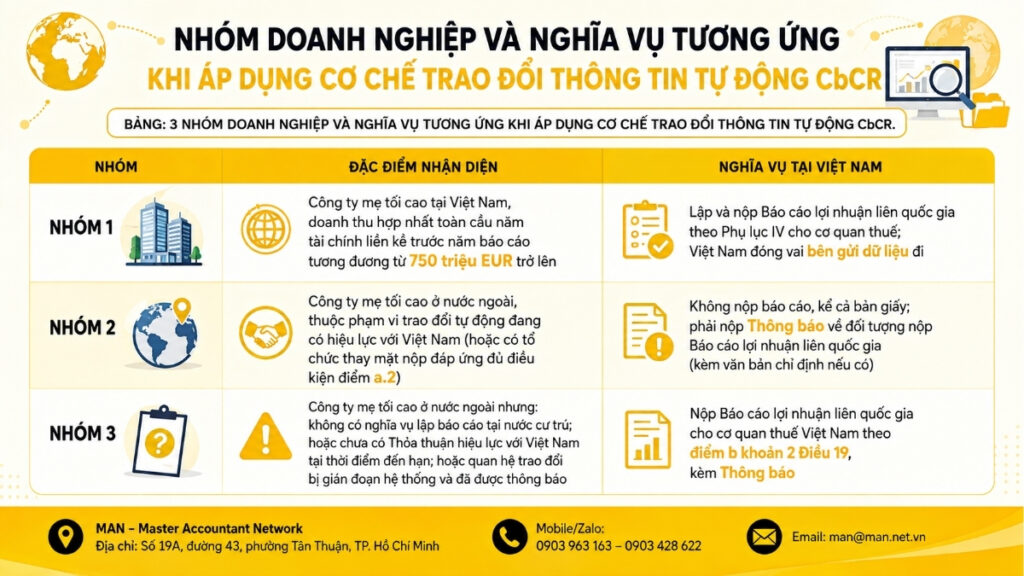
- Country-by-Country Profit Reporting (Country-by-Country Report – CbCR): A report that allocates the group's earnings, taxes, and economic performance indicators across each country where the group operates.
This documentation is mandatory for businesses that engage in related-party transactions, unless they meet specific exemption conditions.
Entities required to prepare Transfer Pricing Documentation
To determine whether a business is eligible for exemption from preparing a Price Determination Document, it is first necessary to identify the scope of Decree 132/2020/ND-CP. Businesses that are required to declare and prepare the documentation (if not exempt) include those with related-party transactions and falling under one of the following 11 detailed related-party relationship categories:
- One party directly or indirectly holds at least 25% of the other party's equity contribution.
- Both parties have at least 25% equity capital contributed by a third party, either directly or indirectly.
- One party is the largest shareholder in terms of equity capital of the other party and directly or indirectly holds at least 10% of the total shares of the other party.
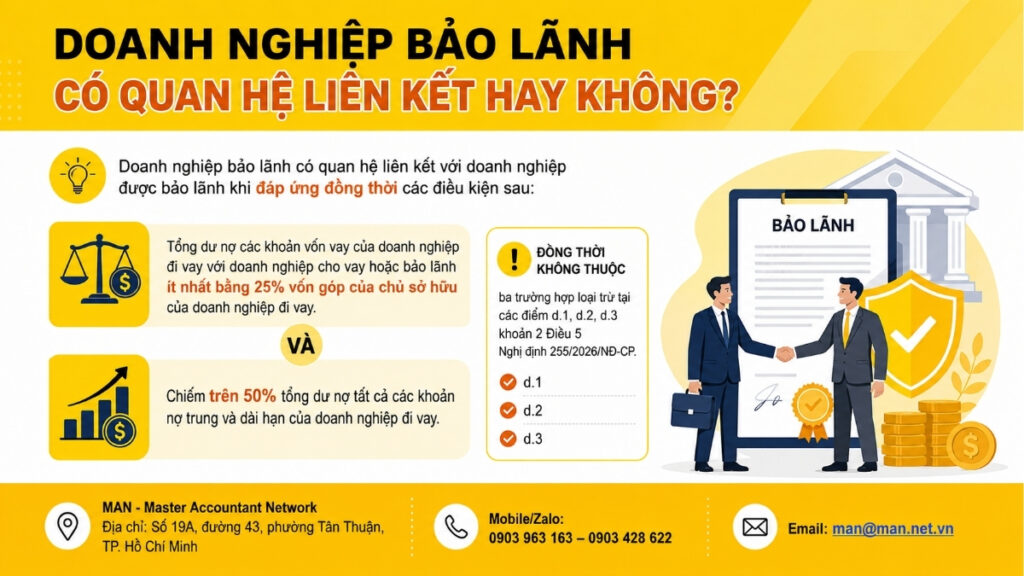
- One party guarantees or lends capital to the other party in any form (including third-party loans secured by the financing of an affiliated party) provided that the loan amount is at least 25% of the borrower's equity and accounts for more than 50% of the total value of the borrower's medium and long-term debts.
- One party may appoint members of the other party's executive or controlling board, provided that the number of members appointed by the first party exceeds the total number of members of the second party's executive or controlling board; or one party may directly appoint a member of the other party's Board of Directors or Supervisory Board.
- Both parties may have more than 50% members on their board of directors or may have the right to appoint a member of the Board of Directors or Supervisory Board designated by a third party.
- Both parties are managed or controlled in terms of personnel, finances, and business operations by individuals belonging to one of the following family relationships (spouse, biological father, adoptive father, biological mother, adoptive mother, biological child, adopted child, biological brother, biological sister, biological sibling, brother-in-law, sister-in-law, daughter-in-law, paternal grandfather, paternal grandmother, grandchild, maternal grandfather, maternal grandmother, grandchild, aunt, uncle, cousin, and nephew/niece).
- The two businesses have a head office and permanent establishment relationship, or both are permanent establishments of a foreign organization or individual.
- Businesses are controlled by an individual through that individual's capital contribution to the business or direct participation in its management.
- Other cases in which an enterprise is actually under the management, control and decision-making power over the production and business activities of another enterprise.
- Businesses that have transactions involving the transfer or acquisition of at least 25% of owner's equity during the tax period; or borrowing or lending at least 10% of owner's equity at the time of the transaction during the tax period with individuals managing or controlling the business or with individuals belonging to one of the family relationships mentioned in case h.
If a business falls under the above categories and has related-party transactions (buying and selling goods, services, borrowing, etc.), the next step is to compare them with the revenue and profit thresholds to find the conditions for exemption from preparing a Price Determination Document.
Detailed analysis: Conditions for exemption from preparing a price determination dossier as prescribed by regulations.
The tax authorities classify exemptions based on scale, risk nature, and specific legal agreements. Below are three main groups of conditions:
Group 1: Exempt from filing based on revenue size and transaction value.
This is the most common exemption from preparing a Price Determination Report for small and medium-sized enterprises (SMEs). To qualify for this scenario, the business needs to simultaneously meet the following two criteria within a tax period:
- Total revenue generated during the tax period: Less than 50 billion VND.
- Total value of related-party transactions arising during the tax period: Less than VND 30 billion.
Note: The revenue of VND 50 billion is defined as net revenue from sales and services on the income statement. The value of related-party transactions is VND 30 billion, calculated based on the total purchase and sale transactions (without offsetting). For loans, the transaction value is calculated as the total outstanding loan balance during the period, not just interest expense.
Group 2: Exempt from filing based on Advance Pricing Agreements (APAs)
If a business has signed an Advance Pricing Agreement (APA) with the tax authorities and this agreement remains in effect, the business will be exempt from preparing a Pricing Documentation for transactions falling within the scope of the APA.
- Businesses are required to submit annual APA reports as stipulated in the Circular guiding APA regulations.
- If a business has other related-party transactions outside the scope of the signed APA agreement, it must still prepare a Pricing Documentation for those transactions (unless other exemption conditions are met).
Group 3: Exempt from filing for businesses with simple functions and standard profit margins.
This applies to businesses operating in the manufacturing, distribution, or simple processing sectors, with a high degree of transparency regarding profits. Conditions for exemption from preparing a Price Determination Report in this group include:
- In terms of scale: Revenue during the tax period is less than 200 billion VND.
- In terms of operational nature: The business only performs simple functions and does not own or exploit intangible assets that generate significant added value.
Regarding the net profit margin (EBIT – Earnings before interest and taxes divided by Revenue): It must meet the minimum requirements specified for each industry.
- Distribution Sector: EBIT margin of 5% or higher.
- Manufacturing Sector: EBIT margin of 10% or higher.
- Processing Industry: EBIT margin of 15% or higher.
Example: A foreign direct investment (FDI) enterprise in Binh Duong specializing in the processing of electronic components (without owning core technology) has a projected revenue of VND 180 billion in 2025. If the company's EBIT profit reaches VND 27 billion (15%) or more, the company fully satisfies the conditions for exemption from preparing a valuation report under the simplified functional category.
Clearly distinguish between "Exemption from filing" and "Exemption from declaration" to avoid legal risks.
One of the most serious mistakes accountants often make is equating the exemption from preparing a Price Determination File with not having to perform any transfer pricing procedures.
In fact, the legal regulations make a very clear distinction:
- Exemption from declaring related-party transactions: This only applies when the taxpayer only has transactions with related parties that are subject to corporate income tax in Vietnam, apply the same corporate income tax rate, and neither party enjoys corporate income tax incentives during the tax period. In this case, the enterprise is not required to submit Appendix I (form for declaring information on related-party transactions).
- Exemption from filing: Businesses must still fully declare information in Appendix I attached to the corporate income tax return. In the section on exemption cases, businesses must check the box corresponding to the condition for exemption from filing the price determination document that they meet.
If a business fails to prepare the necessary documents because it believes it is exempt but forgets to declare Appendix I, the tax authorities may consider this a violation of tax procedures and have the right to assess the tax based on comparative data from the tax authorities.
See also: Instructions for declaring related-party transactions on HTKK (Vietnam Tax Declaration System).
Why should you prepare a contingency plan even if you are eligible for exemption from preparing a valuation report?

Businesses are advised to prepare supporting documents even if they are exempt. This is because:
- Tax authority's right to inspect: Even if you meet the conditions for exemption from preparing a Price Determination File, the tax authority still has the right to request you to explain the reasonableness of related-party transactions during tax audits and inspections at your headquarters.
- The market price principle is immutable: Exemption from filing documents does not mean the right to transfer pricing. Businesses must still ensure that the prices/profit margins applied are appropriate to the market. Without supporting documentation (even simple documentation), businesses will be at a significant disadvantage when engaging with inspection teams.
- Controlling interest expense (Clause 3, Article 16, Decree 132): Even if exempted from filing, the regulation on the ceiling for interest expense (30% EBITDA) still applies to all businesses with related-party transactions. Preparing clean financial data helps you effectively control this risk.
Practical experience: Many businesses that qualify for exemption from preparing transfer pricing documentation (those with revenues under 50 billion VND) have incurred large loans from their parent companies with unusually high interest rates. During inspections, tax authorities do not request to review transfer pricing documents but disallow the interest expense, arguing that the interest rate does not serve normal business purposes or exceeds market interest rates.
Common mistakes when determining exemptions from preparing valuation reports.

During our consultations, we identified the following common mistakes that cause businesses to lose their exemption rights or be unfairly penalized:
- Incorrect transaction value threshold calculation: Transactions that are not "non-monetary" or transactions conducted through a third party (but with the designation of the affiliated party) are not included in the total.
- Incorrect application of EBIT ratio: A business that both manufactures and distributes applies the 5% ratio (for distribution) to all revenue, resulting in failure to meet the conditions for exemption from preparing the Actual Cost Determination Report for the manufacturing industry (10%).
- Using intangible assets but still requesting exemption: Some businesses receive technology transfer from their parent company and pay annual royalties. This action is considered the exploitation of intangible assets, and therefore cannot qualify for the "exemption from filing for businesses with simple functions" scheme, even if their revenue is below 200 billion VND.
- Lack of evidence retention: When asked about the reasons for achieving EBIT level 10%, the accountant failed to provide a cost allocation statement or corresponding comparative data analysis.
Practical solutions to help businesses maintain sustainable compliance.
After identifying the errors, businesses need to implement specific solutions to protect their rights regarding the exemption from preparing price determination documents and optimize tax management:
Develop an Intercompany Pricing Policy.
Even if exempt from filing a complete set of documents, businesses should still have a concise pricing policy document. This document describes how the business determines selling prices, service fees, or interest rates on loans with related parties. Having a policy readily available at the beginning of the fiscal year helps businesses maintain consistency in accounting and makes it easier to explain the situation during unexpected audits.
Standardize the accounting document system and classify its functions.
Businesses should require their accounting department to separate revenue and expenses for each business segment (Production, Distribution, Services). This is crucial for the exemption from EBIT-based reporting requirements. Incorrect functional classification can lead to the application of the wrong minimum EBIT threshold, causing the business to lose eligibility for the exemption from preparing cost determination reports.
Regular staff training and expert consultations.
Regulations on transfer pricing are frequently subject to minor updates in their implementation guidelines. Businesses should organize training sessions for their finance departments or hire a consulting firm to conduct quarterly health checks. These checks help to identify potentially risky transactions that do not qualify for exemption from the transfer pricing documentation requirement, allowing for timely corrective action.
Conclude
Understanding and correctly applying the conditions for exemption from preparing valuation reports is a significant advantage that helps businesses save resources and focus on core business activities. However, the line between exemption and violation of regulations is often very thin if businesses do not have thorough preparation in terms of data and documentation.
In the context of increasingly transparent and stringent tax administration in 2026, the best advice for managers is: Always act in accordance with the rule of law and be prepared with justifications, even if you are exempt from filing. If your business has a complex transaction structure, please consult [website/link]. In-depth transfer pricing consulting services from experts.
Contact information MAN – Master Accountant Network
- Address: No. 19A, Street 43, Tan Thuan Ward, Ho Chi Minh City
- Mobile/Zalo: 0903 963 163 – 0903 428 622
- Email: man@man.net.vn
Content production by: Mr. Le Hoang Tuyen – Founder & CEO MAN – Master Accountant Network, Vietnamese CPA Auditor with over 30 years of experience in Accounting, Auditing and Financial Consulting.