





The assessment of related-party transaction tax is a major concern for many businesses as they approach the 2026 corporate income tax settlement period. Even a single error in declaration, documentation, or proving the reasonableness of related-party transaction expenses can lead to the tax authorities assessing taxable income, collecting back taxes, and imposing penalties during audits and inspections. So, exactly under the new regulations, which cases will result in a business being subject to tax assessment? This article provides a comprehensive overview, helping businesses identify risks early and proactively prevent them from the beginning of the tax period.
Why are businesses with related-party transactions more susceptible to tax assessment?

The essence of tax assessment is a measure applied by the tax authorities when taxpayers cannot independently determine, or cannot prove, that their tax obligations are consistent with the nature of independent transactions. Decree 255/2026/ND-CP In fact, Clause 3, Article 21 directly stipulates the cases in which tax authorities have the right to determine the transfer pricing of related-party transactions. This is a core provision that any business with related-party transactions needs to understand before entering the 2026 corporate income tax settlement period.
The specific legal provisions regarding the basis for tax assessment, as stipulated in Decree 255/2026/ND-CP, make tax management more transparent than before, but also impose higher compliance requirements.
Cases for assessing related-party transaction tax according to Decree 255/2026/ND-CP
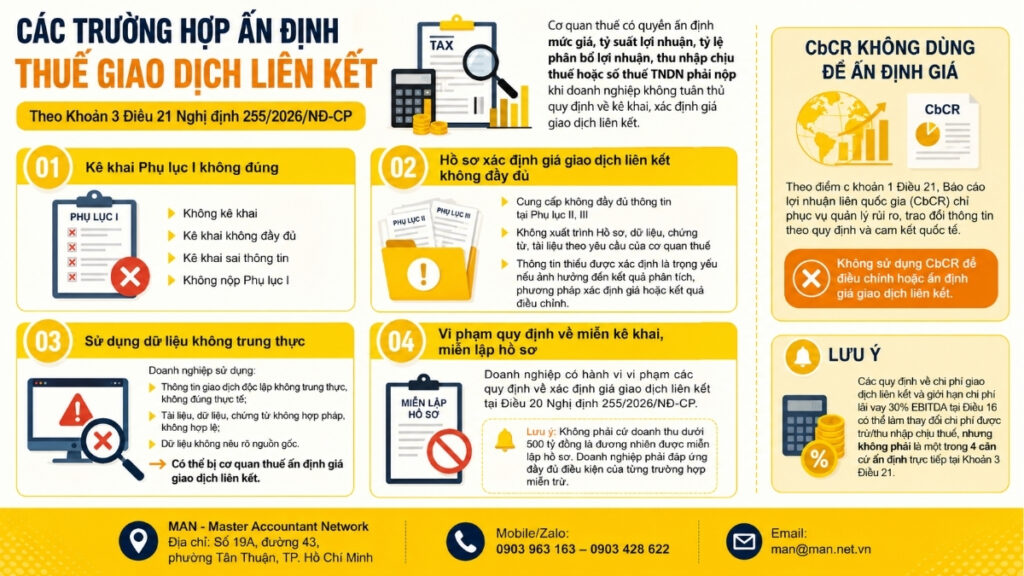
According to Clause 3, Article 21 of Decree 255/2026/ND-CP, the tax authority has the right to determine the transfer pricing in the following four cases:
Failure to declare, incomplete declaration, incorrect declaration, or failure to submit Appendix I.
This is the most common and highest-risk scenario in practice. According to regulations, businesses that have related-party transactions but fail to declare them, declare them incompletely, or fail to submit Appendix I issued with Decree 255/2026/ND-CP are subject to assessment.
Notable new features: The act of providing false information as stated in Appendix I has been officially added to the group of grounds for tax authorities to determine transfer pricing.
Previously, under Decree 132/2020/ND-CP, incorrect declaration of information (as opposed to non-declaration or incomplete declaration) was usually only handled through adjustments and regular tax collection. Now, with Decree 255/2026/ND-CP, even if the company has submitted all documents on time, incorrect information in Appendix I can still be used by the tax authorities to determine the transfer pricing, leading to significant tax consequences. This is why businesses need to be especially careful in reviewing data before submitting Appendix I.
Incomplete information is provided in Appendices II and III.
Besides Appendix I, the obligation to declare related-party transactions also includes providing complete information in Appendix II and Appendix III issued with Decree 255/2026/ND-CP. Incomplete information provided by businesses in these two appendices is also one of the grounds for tax authorities to make assessments. This shows that the compliance obligation of businesses does not stop at Appendix I, but extends to the entire system of appendices for declaring related-party transactions.
Using dishonest information from the database.
The third case relates to the quality and reliability of the data that businesses use to determine transfer pricing. If a business uses untruthful information, including comparative data, market data, or unreliable databases, to prepare or declare its records, the tax authorities have the right to reject it and proceed to determine transfer pricing based on the tax authorities' own databases or available commercial data.
Violation of regulations regarding the determination of exemption cases.
The final case involves businesses incorrectly determining their eligibility for exemption from reporting or preparing transfer pricing documentation under Article 20 of Decree 255/2026/ND-CP. Many businesses mistakenly assume they are automatically exempt, for example, if their revenue is below VND 500 billion, without fully verifying the accompanying conditions (no revenue or expenses from the exploitation of intangible assets; net profit margin meeting the prescribed threshold, etc.). When this determination of exemption is found to be in violation, the business loses its exemption rights and simultaneously falls under the category of transfer pricing.
Important Note: According to point c, clause 1, Article 21 of Decree 255/2026/ND-CP, the Country-by-Country Report (CbCR) cannot be used to adjust or fix the price of related-party transactions, but only serves the purpose of risk management and information exchange in accordance with Vietnam's commitments in international tax agreements.
In addition to the four direct grounds in Clause 3, Article 21, businesses also need to be aware of other related regulations that may indirectly lead to similar consequences, typically Article 16 of Decree 255/2026/ND-CP on the exclusion of related-party transaction expenses that are inconsistent with the nature of independent transactions, or interest expenses exceeding the 30% EBITDA ceiling. Although not included in the officially defined list, these regulations still contribute to adjusting taxable income upwards if the business cannot prove the reasonableness of the transaction.
What should businesses do to avoid being subject to related-party transaction tax under Decree 255?

To proactively avoid the risk of having related-party transaction tax assessed from the beginning of the tax period, businesses should simultaneously take the following steps:
- Carefully review the data before submitting Appendix I: Thoroughly review to ensure the declared information is absolutely accurate, as even a single incorrect declaration will be used as a basis for independent assessment according to the new point in Clause 3, Article 21 of Decree 255/2026/ND-CP.
- Verify the completeness of Appendices II and III: Ensure that all information regarding related-party transactions and pricing methods is provided in full, avoiding any localized omissions that could lead to price manipulation.
- Verify the origin and reliability of comparative data: Only use databases with clear and legitimate sources when documenting transfer pricing, avoiding the risk of having the entire methodology rejected during an audit. Solution hire someone to prepare related party transaction documents. Data from specialized, industry-experienced organizations like MAN – Master Accountant Network – ensures that comparative data is highly convincing.
- Accurately verify the exemption conditions: Refer to Article 20 of Decree 255/2026/ND-CP before independently determining whether a business is exempt from declaration or documentation requirements, to avoid confusion that could lead to violations of the regulations on determination. Exemptions.
- Review the entire list of affiliates: Carefully review the following affiliated relationship, with particular attention to the newly added group of borrowing and lending transactions.
- Determine whether a business falls under the transitional category: According to Article 3 of Decree 20/2025/ND-CP, based on the transitional provisions in Clause 3, Article 23 of Decree 255/2026/ND-CP, in order to apply the correct roadmap.
Conclusion: Proactively comply to avoid being subject to related-party transaction tax.
Decree 255/2026/ND-CP not only tightens and expands the scope of management of related-party transactions, but also clearly legalizes them, making the tax management process more transparent, while also imposing stricter compliance requirements for businesses. At the same time, the Decree also reflects a shift from a purely "risk management" model to a "compliance management and voluntary compliance support" model, as evidenced by the supplementary provision in Clause 10, Article 21, regarding the responsibility of tax authorities in supporting businesses in declaring and determining the price of related-party transactions.
Specifically, Decree 255/2026/ND-CP adds the act of incorrectly declaring information (such as misclassifying related-party transactions or incorrect values) to the list of activities subject to tax assessment. Therefore, businesses need to be even more cautious with every declared figure, as even a small error can lead to significant tax consequences. Proactively reviewing and declaring correctly and completely from the beginning of the 2026 tax period, instead of waiting until the tax authorities intervene, is the only and most effective way for businesses to avoid the risk of having their related-party transaction tax assessed under the new regulations.
Contact MAN – Master Accountant Network For free support and advice!
Contact information MAN – Master Accountant Network
- Address: No. 19A, Street 43, Tan Thuan Ward, Ho Chi Minh City
- Mobile/Zalo: 0903 963 163 – 0903 428 622
- E-mail: man@man.net.vn
- Google Business Profile: View MAN – Master Accountant Network's Google Business Profile
- LinkedIn Founder: View expert Le Hoang Tuyen's LinkedIn profile.
Responsible for production and professional content review by: Mr. Le Hoang Tuyen – Founder & CEO of MAN – Master Accountant Network. He is a CPA Vietnam auditor with over 30 years of in-depth experience in accounting, auditing, taxation, and corporate legal consulting.