



Before delving into a detailed analysis of the legal regulations, this article focuses on addressing a typical situation at a foreign direct investment (FDI) enterprise as follows:
- Parties involved: Company A (Export Processing Enterprise in Vietnam) and Parent Company B (Singapore).
- Current debt situation: A owes B an accumulated goods debt of approximately $1.6 million USD and is making monthly offsetting payments.
- Transaction occurred as follows: In 2026, Company A imported fixed assets worth USD 80,000 from China. However, Company B directly signed the contract and made the payment on behalf of Company A to the supplier in China.
- The company's objective: Company A wants to record an increase in fixed assets, depreciate them, and pay Company B by offsetting the debt (or converting it into an interest-bearing loan) to optimize costs without generating immediate cash flow.
Related-party transactions involving the import of fixed assets from the parent company are becoming a hot topic for tax audits in FDI and export processing enterprises (EPEs). Many businesses find themselves in a situation where the parent company signs contracts and makes payments to foreign suppliers, then offsets the debt or converts it into an internal loan without fully assessing the risks regarding asset ownership, depreciation conditions, interest expense limits under Decree 132/2020/ND-CP, and contractor tax obligations.
In reality, even a small error in the structure of a contract or import document can lead to the disallowance of all depreciation expenses, the inability to deduct interest expenses, or the reassessment of related-party transaction prices during tax settlement. Let's analyze and explore this further with MAN – Master Accountant Network.
The legal nature of related-party transactions when importing fixed assets from the parent company.
To properly assess risks and choose appropriate solutions, it is first necessary to clarify the legal nature of related-party transactions when acquiring fixed assets from the parent company. Correctly identifying the related-party relationship and asset ownership will be the foundation for determining whether the enterprise can recognize the fixed assets, depreciate them, and account for expenses legitimately. Below are the core legal factors that need detailed analysis.
Identify the relationship
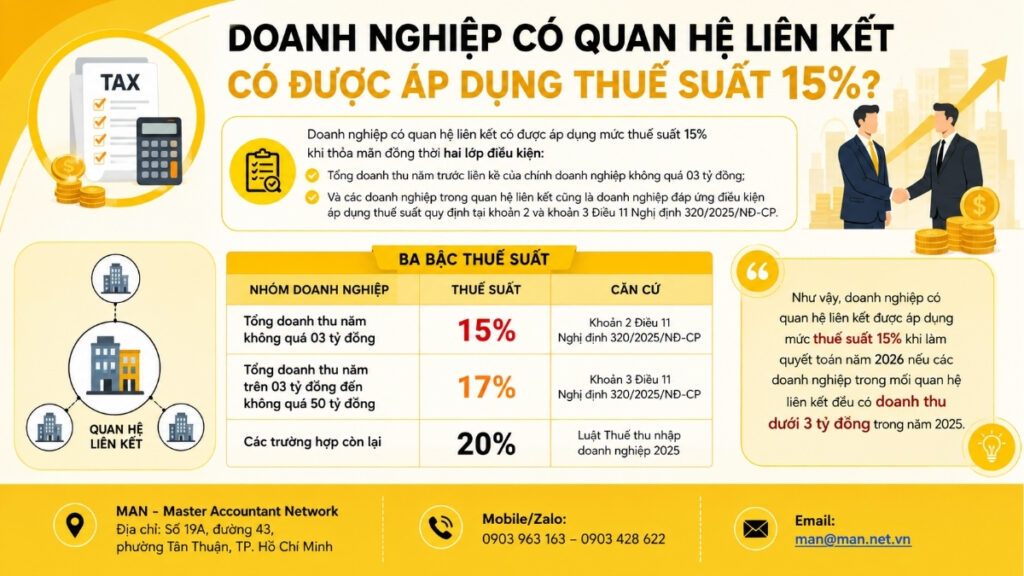
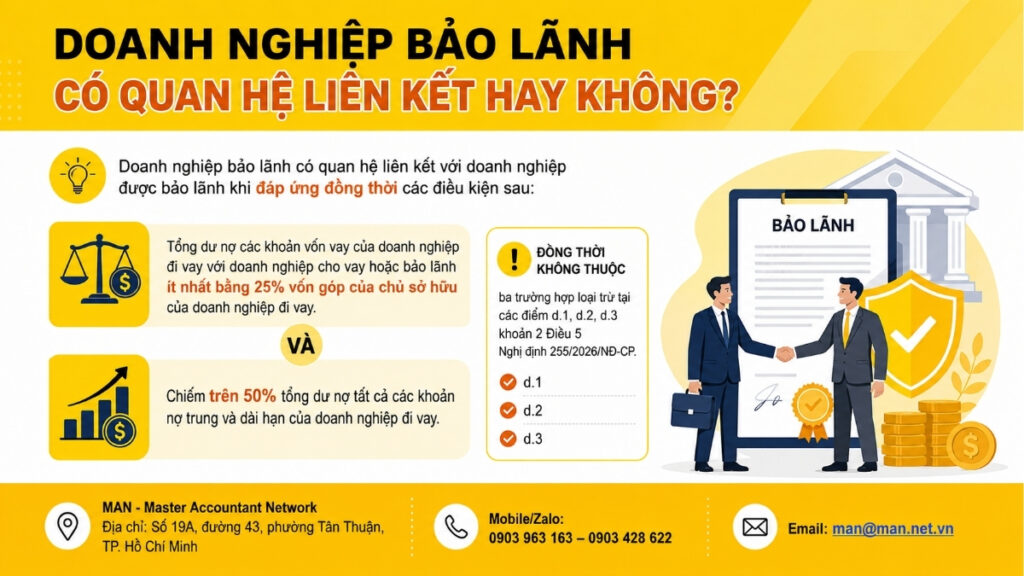
According to Clause 2, Article 5 of Decree 132/2020/ND-CP, Company A and Company B are considered related parties when:
- An enterprise directly or indirectly holds at least 25% of the equity of the owner of the other enterprise.
- Both businesses are directly or indirectly controlled by a third party (parent company-subsidiary model).
Therefore, all transactions involving the purchase and sale of assets, payments made on behalf of others, or loans between A and B are considered related-party transactions and are subject to strict regulation by the Tax authorities to combat transfer pricing.
The issue of asset ownership: A key point for calculating depreciation.
In reality, many businesses mistakenly believe that they can depreciate assets simply because they are located at their factory. However, according to Circular 45/2013/TT-BTC, assets can only be depreciated and deducted as expenses if the business can prove ownership.
In the case where Company B (Singapore) is the party contracting with the Chinese supplier and directly making the payment, legally, the initial ownership belongs to B. If Company A records the increase in fixed assets and depreciates them without a contract transferring ownership from B to A (internal sales contract or asset transfer agreement), the risk of the tax authorities disallowing the entire depreciation expense is very high.
Risks related to corporate income tax and non-deductible expenses.

Tax authorities typically assess based on legal documentation, cash flow, and the actual economic nature of the transaction. If the related-party transaction structure when acquiring fixed assets from the parent company is not properly designed from the outset, the business may face the risk of having depreciation expenses disallowed, interest expense deductions not allowed, or asset valuations being reassessed. Below are the key risks that businesses need to pay particular attention to:
Risk of excluding depreciation expense
For an asset to be recognized as a fixed asset of Company A, the documentation must ensure continuity and legality:
- Contract: A sales contract between B and A, or an agreement for B to purchase/pay on behalf of A (where A is the ultimate owner).
- Customs documents: The import declaration form must clearly state Company A as the importer and beneficiary. Note the "Exporter" and "Payment Method" sections on the declaration form.
- Payment documentation: There must be actual cash flow or a valid set of debt offsetting documents between A and B (contrasting with the amount B has paid to the Chinese side).
If any of these elements are missing, the related-party transaction when importing fixed assets from the parent company will be considered a form of "asset leasing" or "asset borrowing," in which case A will not be allowed to deduct depreciation expenses.
The issue of offsetting debts.
Since Company A owes Company B $1.6 million, importing additional assets worth $80,000 and offsetting the debt is a reasonable economic transaction. However, according to Corporate Income Tax and Value Added Tax regulations, debt offsetting must:
- This is clearly stipulated in the original contract or its addendum.
- There are periodic (monthly/quarterly) accounts receivable reconciliation statements signed by both parties.
- For export processing enterprises, even though they are not subject to VAT on imported goods, the offsetting process must still be transparent to prevent the tax authorities from reassessing the value of assets.
Converting debt into loans: A solution or a "double-edged sword"?

To address the problem of mounting debt, many businesses choose to create a loan agreement for this $80,000 asset.
Interest rate cap under Decree 132 (EBITDA 30%)
This is the most important regulation. According to Clause 3, Article 16 of Decree 132/2020/ND-CP: The total deductible interest expense shall not exceed 30% of EBITDA.
- Risk: If Company A is operating at a loss, its EBITDA will be low or negative, resulting in the entire interest expense paid to B being disallowed as a deductible expense.
- Note: Any interest not deductible this year will be carried forward to the next period, but not exceeding 5 years.
Contractor Tax (FCT) obligations and Double Taxation Avoidance Agreements
When Company A pays interest on a loan to Company B in Singapore through debt offsetting, the Contractor Tax obligation arises immediately:
- Corporate income tax: 5% on interest income.
- Procedure: A must complete form 01/NTNN within 10 days from the date of debt offsetting.
Note: Singapore has a double taxation avoidance agreement with Vietnam; businesses need to check their tax exemption/reduction notification records under the agreement to optimize their tax payments.
Procedures with the State Bank of Vietnam
According to Circular 12/2022/TT-NHNN, if a debt is structured as a loan with a term exceeding one year, the enterprise must register the foreign loan.
- Warning: Without registration, all interest/principal payment transactions (including offsetting) will be considered a violation of foreign exchange management laws, resulting in interest expenses not being accepted by the Tax authorities.
Prepare a Transfer Pricing Documentation File.
Even if a company only imports $80,000 worth of fixed assets, it is still required to fulfill its obligations regarding reporting related-party transactions.
- Complete Appendix I (Decree 132): Submit along with the annual corporate income tax return.
- Create a Local File: If total revenue exceeds VND 50 billion and total value of related-party transactions exceeds VND 30 billion.
- Exemption case: If revenue is less than VND 50 billion and related-party transactions are less than VND 30 billion, the enterprise is exempt from preparing the Price Determination Document but must still declare Appendix I.
Proposed solution for the case.
To ensure the safety of related-party transactions when importing fixed assets from the parent company in this case, the business needs to avoid risks by:
- A contract can be drawn up between the parent company abroad (B) and the subsidiary company in Vietnam (A), but then it must be proven that the loan is genuine and used for the intended purpose of production and business.
- Interest rates must follow the Arm's Length Principle because it is a related-party transaction.
- Interest expense may be subject to limitations under regulations on interest expense in related-party transactions (30% EBITDA under Decree 132/2020/ND-CP on related-party transactions).
- A contractor tax (FCT) liability arises for interest paid to a foreign organization (Singapore).
Foreign Contractor Tax (FCT) arises from interest payments to foreign organizations in Singapore.
In Vietnam, interest payments to foreign organizations and individuals are subject to Contractor Tax according to Circular 103/2014/TT-BTC. In the case where Company A pays interest to its parent company B (Singapore) by offsetting the debt, the following points need clarification:
Taxable subjects and tax rates
Interest income is income generated in Vietnam by Company B. Specifically:
- Tax rate: Contractor corporate income tax is 51% of the total interest expense.
- VAT: According to Clause 8, Article 4 of Circular 219/2013/TT-BTC, lending activities by foreign organizations are not subject to VAT. Therefore, in this case, FCT only includes 5% Corporate Income Tax.
The time at which tax obligations arise when offsetting debts.
This is a common mistake businesses make. According to regulations:
- Contractor tax obligations arise at the time a Vietnamese enterprise makes payment to a foreign contractor.
- Offsetting liabilities with payment. Company A's action of offsetting interest on loans against existing goods debt is considered a completed payment. Therefore, A must declare and pay FCT tax immediately upon making the offsetting entry in the books.
How to calculate FCT tax
If the contract stipulates that A is liable for tax:
Taxable revenue for corporate income tax = Actual interest paid / (1 – 5%) |
The contractor tax (FCT) is then determined:
Contractor's Corporate Income Tax = Taxable Revenue x 5% |
If the contract stipulates that B is liable for tax:
Contractor's Corporate Income Tax = Actual Interest Paid x 5% |
Double Taxation Agreement (DTA)
Vietnam and Singapore have a Double Taxation Avoidance Agreement (DTA). However, for interest income from loans, most agreements (including the one with Singapore) still allow Vietnam (the source country) to levy taxes at preferential rates (usually 10% or 5%). Since the 5% rate under Circular 103/2014/TT-BTC on contractor tax (FCT) is already the lowest rate, applying the DTA usually does not further reduce the amount of tax payable, but businesses must still follow the procedure for notifying tax exemptions and reductions under the agreement to ensure compliance.
Conclude
Related-party transactions involving the import of fixed assets from the parent company are not merely accounting issues, but a comprehensive problem concerning legal structure, taxation, and foreign exchange management. A single misstep, from asset ownership and payment processing to debt offsetting mechanisms and interest expense limits under Decree 132/2020/ND-CP, can lead to risks such as the disallowance of depreciation expenses, retroactive collection of contractor taxes, or reassessment of related-party transaction prices during audits.
For FDI and EPE businesses, the safest approach is not "legalization later," but rather designing the right transaction structure from the outset, ensuring marketability, complete documentation, and cash flow that accurately reflects the economic nature of the transaction.
If your business is currently involved in asset purchases, internal borrowing, or debt restructuring with your parent company, an early review will significantly reduce the risk of tax arrears in upcoming tax settlements. Check it out now. deep transfer pricing services Contact MAN for advice on structuring related-party transactions in a systematic, practical, and tax-safe manner for 2026.
Contact information MAN – Master Accountant Network
- Address: No. 19A, Street 43, Tan Thuan Ward, Ho Chi Minh City
- Mobile / Zalo: 0903 963 163 – 0903 428 622
- Email: man@man.net.vn
Content production by: Mr. Le Hoang Tuyen – Founder & CEO MAN – Master Accountant Network, Vietnamese CPA Auditor with over 30 years of experience in Accounting, Auditing and Financial Consulting.