


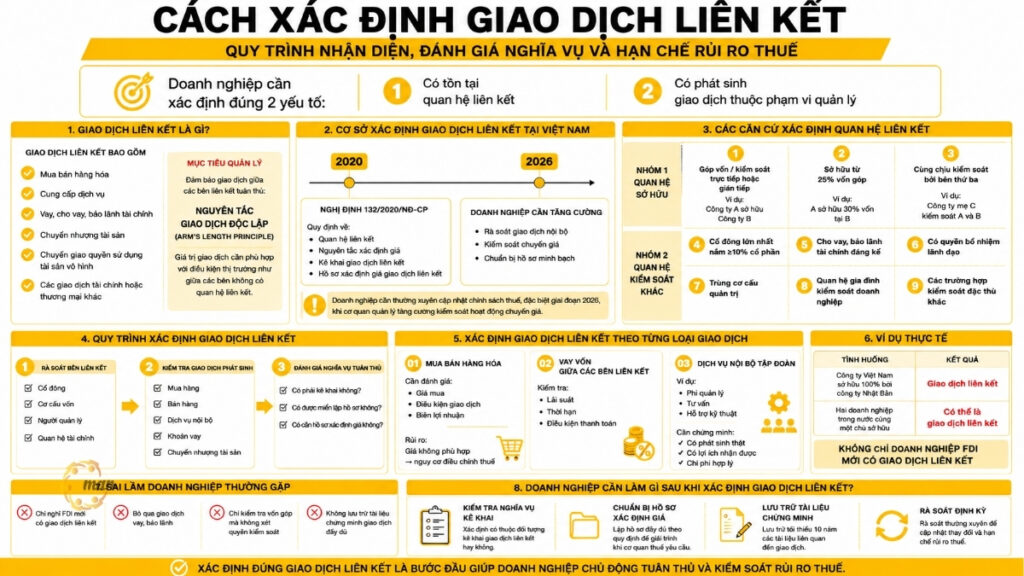



The transition roadmap for interest expense deductions in 2026 is becoming a focal point in corporate income tax management for businesses with related-party transactions. With the continuation of the legal framework from Decree 132/2020/ND-CP and its amendments in Decree 20/2025/ND-CP, the regulation on interest expense ceilings under Article 30% EBITDA is not only a technical declaration issue but also directly affects tax deduction rights and corporate cash flow. This article fully analyzes the 5-year principle, FIFO mechanism, the calculation of taxable EBITDA in 2026, and important new points to note so that businesses can maximize the carryforward capacity while minimizing risks during tax settlement and audits.
Overview of regulations on limiting interest expense.

Before delving into the transition roadmap for deductible interest expenses, we need to understand the basis of this regulation. According to international best practices on base erosion and profit shifting (BEPS), Vietnam applies a ceiling on deductible interest expenses when determining corporate income tax.
Formula for calculating EBITDA
EBITDA is not just a number on a financial report, but EBITDA adjusted for tax purposes. The specific formula is:
EBITDA = Net profit from business operations + Interest expense + Depreciation expense |
Note: Interest expense here refers to the total interest expense incurred during the period, excluding interest on deposits and loans (this is a point that needs special attention to accurately determine the 30% threshold).
Subject to regulation
This regulation applies to taxpayers with related-party relationships and related-party transactions. If a business falls under this category, the total deductible interest expense must not exceed the total net profit from business operations during the period plus interest expense and depreciation expense.
The nature of interest expense carryforward
Many businesses are concerned that any interest expense exceeding the 30% limit will be "lost." In reality, the law allows for a flexible carryover of interest expense. This excess amount will be considered a potential "tax asset," retained and carried forward to subsequent years if the business has sufficient EBITDA in that year.
The groundbreaking new points from Decree 20/2025/ND-CP impacting the year 2026.
2026 marks the stable implementation of new provisions in the management of related-party transaction taxes. Two major changes directly impact the transition roadmap for interest expense:
Relaxing the definition of "affiliated party" for credit institutions.
Previously, many businesses that only borrowed from banks (accounting for over 25% of equity and over 50% of total debt) were considered to have affiliated relationships. From 2025-2026, the new regulations have excluded independent banks from the list of affiliated parties unless they interfere in management and operations. This helps thousands of businesses escape the 30% control cycle and completely changes the way the outstanding interest balance to be carried forward is determined.
Mechanism for "releasing" outstanding loan interest
For businesses that still have disallowed interest expenses from the 2020-2024 period, 2026 is the golden time to implement the transition roadmap for interest expense deductions. The new regulations allow for the prioritized handling of these outstanding amounts in a more transparent manner on the corporate income tax return.
Details of the interest expense transition roadmap as per regulations.

To properly implement the interest expense transition roadmap, businesses need to strictly adhere to two golden rules:
- Duration
- Transfer order.
Five-year transition principle
The portion of non-deductible interest expense (exceeding 30% EBITDA) is carried forward to the next tax period when determining total deductible interest expense. The continuous carry-forward period shall not exceed 5 years from the year following the year in which the non-deductible interest expense was incurred.
For example: Interest expenses disallowed in 2021 will have a deadline for carryforward in the 2026 tax year. After 2026, if not fully carried forward, the remaining amount will be permanently disallowed.
Priority order and FIFO method
In the transition period for interest expense deductions, businesses must apply the "First In - First Out" principle. When calculating deductible interest expense for 2026:
- Calculate the actual interest expense incurred in 2026.
- Check for room for maneuver (30% EBITDA of 2026 minus actual interest expense of 2026).
- If there is still room for maneuver, carry forward interest payments from the oldest year (e.g., 2021), then move on to more recent years.
Necessary and sufficient conditions
For the interest expense transition plan to be accepted by the tax authorities, businesses must:
- Declare all information as specified in Appendix I attached to the Decree on Related-Party Transactions.
- EBITDA figures must be based on audited financial statements (for entities where audited statements are required).
- Ensure the loan is reasonable and valid (for business production purposes, and the registered capital has been fully contributed).
Instructions on the steps for settling taxes and carrying forward interest expenses for 2026.
Below is a four-step standardized process for safely implementing the interest expense transition:
- Step 1 – Review related party relationships and related-party transactions: Businesses need to redefine their list of related parties according to the new criteria for 2026. If no related-party transactions occur during the year (even if there is a related-party relationship), the business may not be subject to the 30% interest expense restriction, thereby opening up opportunities to carry forward the maximum amount of outstanding interest expenses from the previous year.
- Step 2 – Calculate EBITDA and the limit: To determine taxable EBITDA, the maximum limit is determined by the formula EBITDA x 30%. If EBITDA is negative, this limit equals 0, meaning that all interest expense incurred during the year must be carried forward to subsequent years.
- Step 3 – Reconcile accumulated interest balances over the years: A detailed table tracking the disallowed interest amounts for the years 2021, 2022, 2023, 2024, and 2025 needs to be created. This includes amounts carried forward in previous periods and remaining amounts that can be carried forward to 2026.
- Step 4 – Filing the declaration on HTKK: On the 2026 Corporate Income Tax return, in the Appendix on related-party transactions, accurately fill in the figures for "Interest expense carried forward to the next period" and "Interest expense from previous periods carried forward to this period". Errors in these items can disrupt the carry-forward of interest expenses and cause difficulties during tax audits.
Interaction between Interest Transfer and Loss Transfer
In practice, many businesses often confuse loss carryforward with interest expense carryforward because both have a 5-year term. However, these two mechanisms are completely different in terms of legal nature, application timing, and impact on taxable income. The table below will help clarify the core differences so that businesses can build an accurate tax optimization strategy.
| Characteristic | Transfer losses | Interest rate forwarding |
| Nature | Net loss after tax adjustment | Interest expenses exceeded 30% EBITDA |
| Duration | 05 consecutive years | 05 consecutive years |
| Order of application | This is usually done after determining taxable income. | This is done when determining deductible expenses. |
Note: Businesses should prioritize calculating the transition period for interest expense deductions. Since deductible interest expenses reduce taxable income, this can create new tax losses or reduce the amount of interest carried forward. Be cautious with interest expenses nearing their 5-year expiration date and prioritize their carry-forward.
A real-world scenario regarding the interest expense transition roadmap.
The scenarios below illustrate optimizing the transition path for interest expense in different business contexts, from post-crisis recovery phases to large-scale restructuring operations.
Situation 1: Businesses leverage growth momentum to "write off" interest payments.
Company X had disallowed interest expenses of VND 10 billion in 2021. During the period 2022-2025, due to the impact of the pandemic, the company's EBITDA was low, so no interest expenses were carried forward. In 2026, the company secured a large contract, with projected EBITDA of VND 100 billion, resulting in interest expenses of VND 15 billion in 2026.
- The 30% EBITDA threshold is 30 billion VND.
- Allowance for carryover = 30 billion - 15 billion (additional) = 15 billion VND.
- Result: The company was able to carry forward the entire VND 10 billion in interest expense from 2021 to 2026. This is the final year in the transition period for carrying forward the interest expense from the 2021 debt. Without this EBITDA jump, the VND 10 billion would have been eliminated.
Situation 2: Risks associated with business mergers
Company A will merge with Company B in 2026. Company A currently has outstanding interest expense of VND 5 billion. According to regulations, the rights to carry forward interest expense are usually inherited by the acquiring company; however, separate tax settlement documents for the period prior to the merger are required to legally establish this balance.
See also: Transfer pricing services
Risk management advice
To protect the carryforward of interest expense deductions before tax audits and inspections, businesses should note the following:
- Avoid the "thin capitalization" phenomenon: Although Vietnam does not yet have an official thin capitalization law, an excessively high debt-to-equity ratio will draw the attention of tax authorities to the "commerciality" of the loans.
- Avoid the "thin capitalization" phenomenon: Although Vietnam does not yet have an official thin capitalization law, an excessively high debt-to-equity ratio will draw the attention of tax authorities to the "commerciality" of the loans.
- Local File: Must explain the purpose of borrowing and the economic viability of borrowing from an affiliated party instead of borrowing from an external source.
- Document retention: Retain all tax returns and related party appendices from the previous five years. This is the sole evidence to prove the balance in the interest expense carryforward schedule.
Conclude
The interest expense carryforward schedule is not merely a technical indicator on the related-party transaction appendix, but a factor that directly impacts a company's tax obligations and cash flow for the next five years. Understanding the 30% EBITDA principle correctly, applying the FIFO mechanism accurately, and closely monitoring the carryforward deadline will help businesses avoid losing their legal deduction rights, especially for interest expenses that are due in 2026.
In the context of increasing tax audits on related-party transactions, proactively reviewing them early is always safer and more effective than reactive handling during tax settlement. If your business has outstanding interest expense balances or is unsure about how to calculate taxable EBITDA, now is the right time to conduct a comprehensive audit before tax settlement to ensure tax compliance and minimize future risks.
Contact MAN – Master Accountant Network today for detailed advice and support!
Contact information MAN – Master Accountant Network
- Address: No. 19A, Street 43, Tan Thuan Ward, Ho Chi Minh City
- Mobile/Zalo: 0903 963 163 – 0903 428 622
- Email: man@man.net.vn
Content production by: Mr. Le Hoang Tuyen – Founder & CEO MAN – Master Accountant Network, Vietnamese CPA Auditor with over 30 years of experience in Accounting, Auditing and Financial Consulting.