


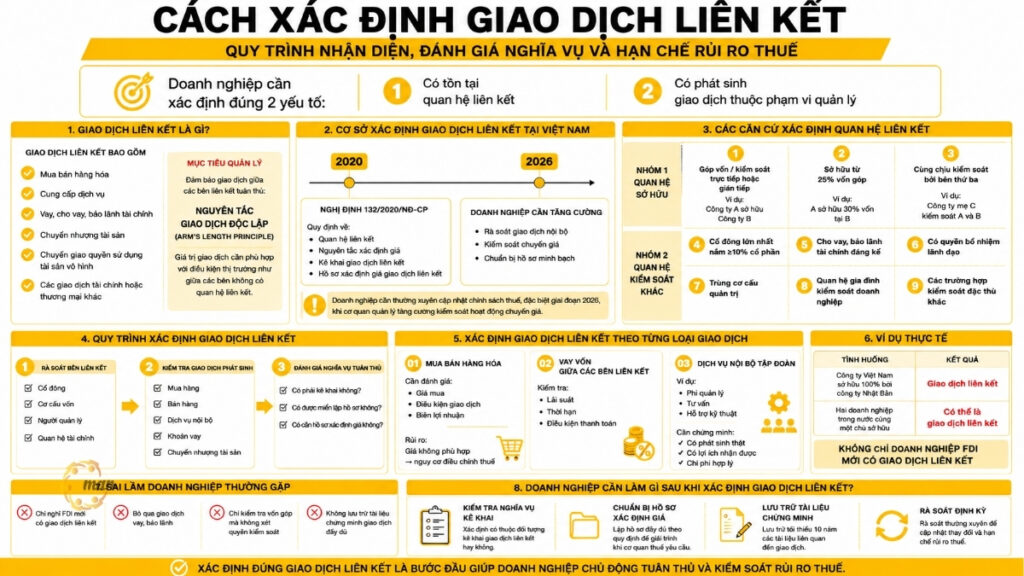



Transfer pricing service fees are becoming one of the strategic expenses that FDI businesses must seriously consider in the context of increasingly stringent tax management. As regulations at Decree 132/2020/ND-CP With the stable implementation of the Global Minimum Tax (Pillar Two) mechanism according to the standards of the Organisation for Economic Co-operation and Development (OECD) being strongly applied, building transfer pricing documentation is not only aimed at meeting compliance requirements but also serves as a long-term financial risk management tool. So, are transfer pricing service fees in 2026 truly a necessary investment or just an additional cost for businesses? This article will analyze the cost structure, risks from low-cost services, and criteria for selecting reputable consulting firms to help FDI businesses make informed decisions.
Why should businesses be wary of cheap services?

In the context of increasingly stringent regulations on related-party transactions under Decree 132/2020/ND-CP, choosing transfer pricing services based solely on low cost can pose significant legal and financial risks for FDI enterprises. In reality, many transfer pricing applications are rejected during audits due to a lack of in-depth analysis or the use of substandard comparative data. To better understand why businesses need to be cautious about cheap service packages, let's analyze three important aspects below.
Settlement season and the pressure of valuation documentation.
In Vietnam, tax season is always the most stressful period for the finance department. For businesses with related-party transactions, this pressure is multiplied many times over because:
- Deadline pressure: By regulation, businesses must complete and retain the Transfer Pricing Documentation (Local File and Master File) before submitting their Corporate Income Tax Return. Delays can result in heavy administrative penalties and increase the risk of being placed on a priority inspection list.
- Data complexity: Transactions such as royalties, internal management fees, and especially interest expenses frequently reach the 30% EBITDA threshold. Separating and demonstrating the reasonableness of these fees requires extremely high levels of expertise.
- Multi-layered legal system: The intertwining of Decree 132/2020/ND-CP, Decree 20/2025/ND-CP, Law on Tax Administration No. 38 The latest Circulars guiding VAT tax regulations in 2026 create a "matrix" that, without expert advice, makes it very easy for internal accountants to make mistakes in classifying transactions.
Reference: Conditions for exemption from preparing Transfer Pricing Documentation
The consequences of complacency and "copying" services.“
Many businesses, in an attempt to save money, choose service providers offering extremely low transfer pricing fees. However, the final cost is often many times greater:
- Formalistic filings: Low-cost entities often use pre-made templates and only change the company name. They lack in-depth analysis of functions, assets, and risks (FAR analysis), which is the heart of a professional transfer pricing filing. When tax authorities conduct on-site audits, these filings will be immediately rejected because they do not accurately reflect the economic nature of the business.
- Outdated or inaccurate benchmarking data: Finding comparable companies requires access to expensive international databases such as Orbis, Moody's, or Bloomberg. Cheaper services often use rehashed data that is inconsistent across industries or scales, leading to inaccurate profit margin results. Consequently, businesses may have their profit margins assessed by tax authorities, resulting in back taxes and late payment penalties (currently 0.031 TP3T/day).
- Reputation and compliance rating risks: Once found guilty of serious fraud or transfer pricing violations, a company's compliance rating with the General Department of Taxation will be lowered, leading to more frequent inspections and audits in the future.
Standard transfer pricing service provider
Solution Transfer pricing consulting services The standard is not about creating a thick file of documents, but about building a sustainable "defense strategy":
- Detailed Functional, Asset, and Risk Analysis (FAR Analysis): Accurately assess the current operational status of the business to select the most appropriate valuation method.
- Internationally standardized data: We use copyrighted data sources, updated in real time to ensure objectivity and credibility.
- Support during audits: A reputable consulting firm will commit to protecting data and providing direct explanations to the tax authorities, instead of abandoning the business when problems arise.
Latest update on transfer pricing service fees 2026
Transfer pricing service fees in 2026 are composed of several factors: the scale of related-party transactions, the complexity of the value chain, and the specific requirements of the corporation. Below is a table of reference transfer pricing service fees:
| Category | Implementation content | Estimated fee (VND) |
| Review and prepare Appendix I | Examine related-party transactions, identify entities exempt from filing requirements, and prepare declarations in accordance with Decree 132/2020/ND-CP. | 15,000,000 – 35,000,000 |
| Local File | Industry analysis, FAR analysis, and benchmarking for specific trades. | 80,000,000 – 180,000,000 |
| Corporate profile (Master File) | We provide consulting services for the localization of reports from the parent company, ensuring consistency with data in Vietnam. | 40,000,000 – 75,000,000 |
| Country-by-Country Reporting (CbCR) | Compile and analyze global tax allocation and revenue data according to BEPS standards. | 60,000,000 – 130,000,000 |
| Compliance (Full) Solution Package | Complete package: Appendix I, Local File, Master File, and Financial Year Risk Advisor. | 150,000,000 – 300,000,000 |
| Consultation on advance pricing agreements (APAs) | Assist in negotiations with tax authorities to finalize pricing methods for the future (3-5 years). | Contact MAN – Master Accountant Network |
Overall, transfer pricing service fees in the Vietnamese market in 2026 will vary significantly depending on the scope of work, the complexity of related-party transactions, and the requirements for international comparative data. FDI enterprises need to understand that this cost is not simply the filing fee, but also includes economic analysis, benchmarking data development, and risk management consulting according to OECD standards and regulations in Decree 132/2020/ND-CP and Decree 20/2025/ND-CP amending and supplementing Decree 132. Therefore, instead of choosing a service based solely on the lowest price, businesses should comprehensively assess the professional capacity, data sources, and support capabilities during tax audits to ensure that the investment in transfer pricing service fees provides long-term legal and financial protection.
Factors affecting transfer pricing service fees

In reality, transfer pricing service fees do not have a fixed price for all businesses. Consulting costs are usually determined based on the complexity of the related-party transaction, the specifics of the industry, and the data analysis requirements. The following key factors will directly affect the amount a business needs to invest in preparing transfer pricing documentation.
- Number of related-party transactions: Businesses that only engage in the buying and selling of goods will have lower fees than businesses that also have transactions related to copyrights, loans, and technical services.
- Business sectors: Specialized industries such as pharmaceuticals, high technology, or logistics with complex supply chains require consultants to have in-depth industry knowledge to conduct competitor analysis.
- Comparative data quality: If a business requires data from niche markets or regional data (APAC, ASEAN), the data retrieval fees from international organizations will be higher.
Reference: Transfer pricing service price list
Warning about the risks from low-cost service providers.
During peak tax settlement periods, many inexperienced companies offering transfer pricing services at only one-third of market rates are frequently cited as potential risks for business leaders.
Data infrastructure shortage
To find 3-5 independent, qualified comparable businesses, the Master Accountant Network (MAN) must sift through hundreds or thousands of businesses globally using complex financial filters. Cheaper services often don't invest in specialized software (like Bureau van Dijk's Orbis). They frequently reuse outdated datasets from 2-3 years ago or fabricate data from unreliable sources. This often leads to their applications being rejected at the data validation stage.
A "Prevention" mindset instead of a "Management" mindset.“
Cheap services only focus on getting the paperwork done. In contrast, a true transfer pricing expert will ask: “Why is the company’s profit margin lower than the industry average? Is it due to excessively high management costs or the market entry strategy?” They help businesses adjust their pricing policies from the beginning of the year instead of simply documenting what has already happened.
Information security risks
Transfer pricing records contain core business secrets of the corporation such as cost structure, customer lists, and profit margins for each product line. Unreliable entities often lack ISO-standard security procedures, leading to the risk of information leakage to competitors or third parties.
Criteria for selecting a reputable and professional transfer pricing service provider.

To ensure that the transfer pricing service fees you pay provide real value, evaluate the service provider through the following:
Practical experience
Don't just look at the number of years established. Ask for a list of similar projects in the same industry. A firm that has successfully defended a case for an electronics manufacturing corporation will understand the risks of "material waste" or "processing costs" better than a firm that only deals in trading.
In-depth expertise
The consulting team must have a thorough understanding of Decree 132/2020/ND-CP and always stay updated on international practices of the OECD such as the Global Minimum Tariff (Pillar Two), and understand the nature of the Arm's Length Principle.
Authority and credibility
Reputable consulting firms are often members of prestigious professional associations (such as VACPA, VAA) or international consulting networks. Documents stamped by a reputable consulting firm generally receive higher credibility from tax audit teams.
Absolute reliability
Trust is demonstrated through a commitment to accountability. Ask them: “If this application is rejected and the business is subject to back taxes, to what extent will the consulting firm assist in explaining the situation?” A reputable firm will always have provisions to support clients throughout the post-audit process.
The process for implementing professional transfer pricing services by MAN – Master Accountant Network.
To build a legally valid transfer pricing documentation that adequately protects businesses against tax audits, the transfer pricing service implementation process needs to be carried out in a systematic and standardized manner. In practice, professional consulting firms often apply a multi-stage process based on OECD guidelines and regulations in Decree 132/2020/ND-CP, including the following main steps:
Phase 1: Transaction Survey and Classification
This is the most crucial foundational step, where consultants work closely with businesses to gather input data:
- Collect all contracts, invoices, and payment documents between related parties during the fiscal year.
- Conduct screening and identify key, high-risk related-party transactions for prioritized in-depth analysis.
Phase 2: FAR (Function, Asset, Risk) Analysis
Based on the collected data, MAN experts will proceed to create a profile of the company's economic activities:
- Conduct direct interviews with core department heads to clarify which entity within the corporation is making strategic decisions, which entity owns tangible/intangible assets, and which party is bearing market risk, bad debt, or inventory.
- This is a crucial step in accurately determining a company's position and expected profit margin within the global value chain.
Phase 3: Economic Analysis (Benchmarking Study)
After thoroughly understanding the nature of the operation, MAN – Master Accountant Network will proceed to demonstrate the objectivity of the transaction price:
- Access and utilize international copyrighted databases to search for independent companies with high similarity in industry and risk profile.
- Implement adjustments for working capital, inventory, or specific market factors to ensure absolute comparability as required by the tax authorities.
Phase 4: Finalizing the application and providing strategic advice.
The end result is a complete set of documents, not only for compliance but also for governance:
- Drafting and standardizing Local Files and Master Files using specialized languages (Vietnamese and English) ensures data consistency across borders.
- Provide strategic recommendations and optimization options for future pricing structures to minimize the risk of tax arrears in subsequent years.
See details: Reliable transfer pricing service
New developments in transfer pricing management in 2026
Businesses need to pay particular attention to emerging trends in 2026 to adjust their investment in transfer pricing service fees:
- The rise of Big Data: The General Department of Taxation of Vietnam has integrated a transaction management system linked to customs and banking data. Discrepancies in data between declarations will be automatically detected and alerted by the system.
- Multilateral inspection: With the Automatic Exchange of Information (AEOI) mechanism, Vietnamese tax authorities can easily verify the profit levels recorded by parent companies abroad and compare them with those of their subsidiaries in Vietnam.
- Focus on intangible assets: The transfer of profits through franchise fees and trade secrets will be scrutinized intensely for their actual local value contribution.
Conclusion and recommendations
The transfer pricing service fee that businesses pay today is essentially an "insurance" for financial security over the next five years (the typical tax audit period). Choosing a cheap, low-quality consulting firm is like building a massive structure on a weak foundation.
Recommendations for FDI businesses:
- Conduct a tax health check annually.
- Prioritize the quality of the application over the price of the service.
- Choose a reputable partner capable of long-term collaboration and with practical experience in handling audits and inspections.
Contact information MAN – Master Accountant Network
- Address: No. 19A, Street 43, Tan Thuan Ward, Ho Chi Minh City
- Mobile/Zalo: 0903 963 163 – 0903 428 622
- Email: man@man.net.vn
Content production by: Mr. Le Hoang Tuyen – Founder & CEO MAN – Master Accountant Network, Vietnamese CPA Auditor with over 30 years of experience in Accounting, Auditing and Financial Consulting.