


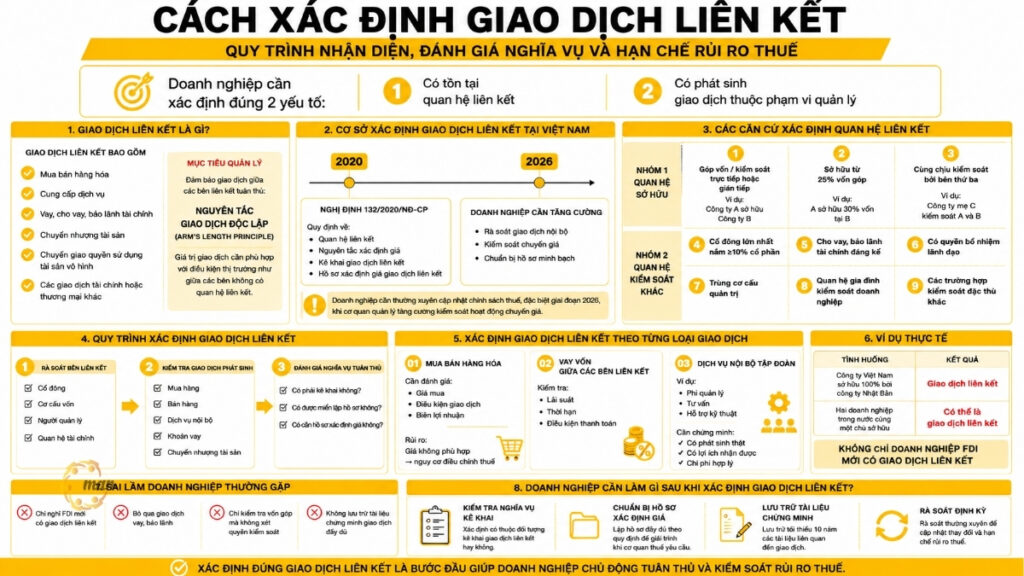



The issue of the impact of interest expense limits is becoming a top concern for businesses with related-party transactions. The application of the 30% EBITDA ceiling aims not only to combat transfer pricing but also to encourage businesses to build sound financial structures. This article will analyze in detail the impacts of interest expense limits from the latest legal perspective. Decree 20/2025/ND-CP amend, supplement from Decree 132/2020/ND-CP.
Why are businesses affected by interest expense restrictions?
According to Decree 132/2020/ND-CP, when a business has related-party relationships (such as borrowing capital from the parent company, using the name of the managing company, or having a bank debt ratio that is too high compared to equity capital according to the old criteria), the total Interest expense is deductible. When calculating corporate income tax, there will be limitations.
In practice, the impact of interest expense limitations begins to emerge when total net interest expense exceeds the company's EBITDA. This regulation applies to loans from independent banks as well, if the company is classified as having related-party transactions.
Key changes in 2026
The year 2026 marks the removal of bottlenecks from Decree 20/2025/ND-CP. This new provision reduces the impact of interest expense restrictions on businesses that purely borrow from banks for investment and business operations without intending to engage in transfer pricing. This brings greater fairness to capital-intensive domestic corporations.
See details: The latest 2026 regulations stipulate limits on interest expense deductions.
A detailed analysis of the impact of controlled interest expense.
To fully understand the nature and extent of the impact in practice, a detailed analysis of the effects of controlled interest expenses is needed from various perspectives, ranging from tax obligations and capital structure to cash flow and the financial performance of businesses in the context of applying the new regulations.
The impact of controlled interest expense on corporate income tax obligations.

This is the most direct and noticeable impact. When the impact of interest expense is capped, any interest expense exceeding the 30% EBITDA ceiling will be considered an unreasonable expense.
- Increase taxable income: Businesses must add these disallowed expenses back into their taxable income.
- Increased tax liability: Although businesses actually have to pay interest on loans from banks or partners, the tax budget still increases, creating short-term financial pressure.
Beyond simply increasing corporate income tax obligations in the short term, the impact of interest expense limits also forces businesses to reconsider how they raise and allocate capital. Interest expenses are no longer deductible. Overall, the problem of optimizing financial structure and controlling leverage becomes a strategic requirement, directly affecting the long-term sustainability of the business.
The impact of interest expense on capital structure is controlled.
To adapt to the impact of controlled interest expenses, many businesses have been forced to restructure their balance sheets:
- Reduce financial leverage: Limit loans with high interest rates.
- Increase equity capital: Convert debt into equity (Debt-to-Equity swap) to thicken the denominator of EBITDA and reduce the absolute amount of interest expense.
- The issue of thin capitalization: Regulations controlling interest rates indirectly prevent businesses from relying primarily on borrowed capital, thus making the financial system more sustainable.
Beyond simply forcing businesses to adjust their capital structure and level of financial leverage, the impact of controlled interest expenses directly impacts internal operational efficiency. In fact, changes in the debt-equity structure are quickly reflected in actual cash flow and taxable profits, creating significant financial pressure in the production and business process.
The impact of interest expenses on cash flow and profits is controlled.

The impact of controlled interest expense creates a difference between accounting profit and taxable profit.
- Cash flow pressure: Businesses have to allocate a portion of their operating cash flow to pay corporate income tax on disallowed expenses, reducing the capital available for reinvestment.
- Profitability indicators: Indicators such as ROE (Return on Equity) may decline due to unusually high tax costs compared to actual business performance.
Besides putting pressure on cash flow and creating discrepancies between accounting and taxable profits, the impact of controlled interest expense is even more apparent in the context of businesses with complex capital structures and cross-border relationships. For multinational corporations (FDI), this regulation is not simply a matter of costs or cash flow, but is also closely linked to transfer pricing risks, double taxation, and global profit allocation strategies.
The impact of controlled interest expense on multinational corporations (FDI)
For FDI companies, the controlled impact of interest expense is a tool to prevent the transfer of profits abroad through high domestic borrowing interest rates. However, without a clear tax plan, these corporations are easily subject to double taxation in both the borrowing and lending countries.
Strategies for responding to the impact of controlled interest costs.
To minimize the negative impacts of controlled interest expense, businesses need to implement the following solutions simultaneously:
Tax-based EBITDA management
Taxable EBITDA differs from accounting EBITDA. Businesses need to proactively calculate this indicator in advance to adjust their borrowing plans. When projected EBITDA increases, businesses can increase their borrowing; conversely, when EBITDA is low, they need to reduce interest expenses to avoid being subject to borrowing limits.
See details: EBIDA calculation formula.
Take advantage of the mechanism for carrying forward interest expenses to the next period.
The law allows for the carry-forward of disallowed interest expense to subsequent years (up to 5 years) if the EBITDA in that year is large enough to absorb it. Businesses need to maintain detailed records to avoid missing out on this benefit, thereby mitigating the long-term impact of interest expense limitations.
Based on Point b, Clause 3, Article 16 of Decree 132/2020/ND-CP:
"The portion of interest expense not deductible under point a of this clause shall be carried forward to the next tax period when determining the total deductible interest expense, provided that the total interest expense incurred in the next tax period is lower than the amount stipulated in point a of this clause. The carry-forward period for interest expense shall not exceed 5 years from the year following the year in which the non-deductible interest expense was incurred;"
Source: Decree 132/2020/ND-CP on related-party transactions.
Applying the new regulations on excluding related party relationships.
Decree 20/2025/ND-CP has opened up opportunities for businesses to explain their relationships with banks. If they can prove that the loan is independent and that the bank does not control the operation, businesses can escape the impact of the interest expense cap on these commercial loans.
Decree 20/2025/ND-CP supplements regulations aimed at eliminating “negative impacts” on independent bank loans. The new regulation clarifies that credit institutions (banks) are not considered affiliated parties under point d above if:
"Credit institutions do not directly or indirectly participate in the management, control, capital contribution, or decision-making regarding the business operations of the borrowing enterprise; and lending transactions are conducted in accordance with the law on credit institutions, adhering to the principles of independence and market pricing."
Source: Decree 20/2025/ND-CP.
Although the aforementioned response strategies help businesses significantly mitigate the impact of controlled interest expense, in reality, improper application or lack of control from the financial planning stage still poses many risks related to taxation, cash flow, and legal issues. This is also the reason why many businesses are subject to back taxes, late payment penalties, or reassessment of related-party transactions during tax audits.
The central risk when interest expense is constrained.

Identifying the theoretical impact of controlled interest expense is insufficient. In practice, if businesses lack thorough documentation and calculation methods, these impacts can quickly transform into direct legal risks. Below are typical mistakes and their financial consequences that businesses often encounter:
- Risk of tax arrears and late payment penalties: Businesses may miscalculate their EBITDA tax figures, leading to under-declaration of corporate income tax. During a tax audit, the business will not only face tax arrears but also a penalty of 20% on the underpaid tax amount and a late payment penalty of 0.03%/day.
- Risk of losing the right to carry forward interest expenses: If a business does not track and declare the disallowed portion of interest expenses in the annual related-party transaction appendix, the tax authorities may reject its right to carry forward this expense to subsequent years.
- Risks from interest-free loan transactions (0%): Many businesses mistakenly believe that interest-free loans are not subject to restrictions. However, tax authorities have the right to determine the net interest rate based on market prices, leading to the creation of fictitious interest expenses and triggering the 30% restriction.
Thus, the impact of controlled interest expense is not limited to increasing corporate income tax obligations but also profoundly affects the capital structure, cash flow, and financial performance of businesses. With the new updates in 2026, especially from Decree 20/2025/ND-CP, businesses have both more opportunities to resolve obstacles and face higher requirements for financial management and compliance with related-party transactions. Understanding the nature of the regulations correctly, proactively forecasting EBITDA, and developing appropriate borrowing strategies are fundamental for businesses to control risks and optimize tax obligations in the long term.
Conclude
Identifying and controlling the impact of capped interest expense is a mandatory requirement for all businesses using financial leverage. The 30% EBITDA ceiling regulation not only affects corporate income tax obligations but also poses long-term challenges regarding capital structure, cash flow, and financial sustainability.
To mitigate the risk of expense disallowances, tax arrears, and penalties, businesses need to proactively review related-party transactions, accurately calculate taxable EBITDA, and stay updated on new provisions from Decree 20/2025/ND-CP. In cases with complex loan structures or related-party transactions, consulting with MAN – Master Accountant Network – a specialized tax consulting firm, will help businesses develop appropriate compliance plans, optimize legal costs, and ensure peace of mind during tax audits and inspections.
Contact information MAN – Master Accountant Network
- Address: No. 19A, Street 43, Tan Thuan Ward, Ho Chi Minh City
- Mobile/Zalo: 0903 963 163 – 0903 428 622
- Email: man@man.net.vn
Content production by: Mr. Le Hoang Tuyen – Founder and CEO of MAN – Master Accountant Network, CPA Vietnam with over 30 years of experience in accounting, auditing, and financial consulting.
Addressing frequently asked questions about the impact of interest expense limits.
Which businesses are subject to interest expense caps?
The regulations on interest expense deductions apply to enterprises with related-party transactions as stipulated in Decree 132/2020/ND-CP. In some cases, even if borrowing from commercial banks, enterprises may still be subject to these regulations if they meet the criteria for related-party transactions under control.
Can the excess interest expense be carried forward to the following year?
Yes. The law allows the carry-forward of the limited portion of interest expense to subsequent tax periods, up to a maximum of 5 years, if the company's EBITDA in those years is large enough to offset it. However, the company must monitor and declare all relevant information to avoid losing the right to carry forward the expense.
Will bank loans still be subject to interest expense limits from 2026 onwards?
According to the latest updates from Decree 20/2025/ND-CP, businesses can be exempted from affiliated relationships with banks if they can demonstrate that the loan is independent and the bank does not participate in the management or control of the business. This is an important new point that helps reduce the impact of interest expense limits on many domestic businesses.
What risks do businesses face if they do not comply with regulations on limiting interest expenses?
Businesses may have interest expense disallowed during tax settlement, leading to increased taxable income, corporate income tax arrears, late payment penalties, tax assessments, and even potential investigation into related-party transactions if the risk assessment is deemed high.
How should businesses manage the risk of interest expense being subject to limitations?
An effective solution is to proactively forecast taxable EBITDA, review related party relationships, restructure capital sources, and build clear documentation for loans. For complex borrowing models, businesses should seek support from tax consultants to ensure compliance and optimize legal costs.
MAN Editorial Board – Master Accountant Network