


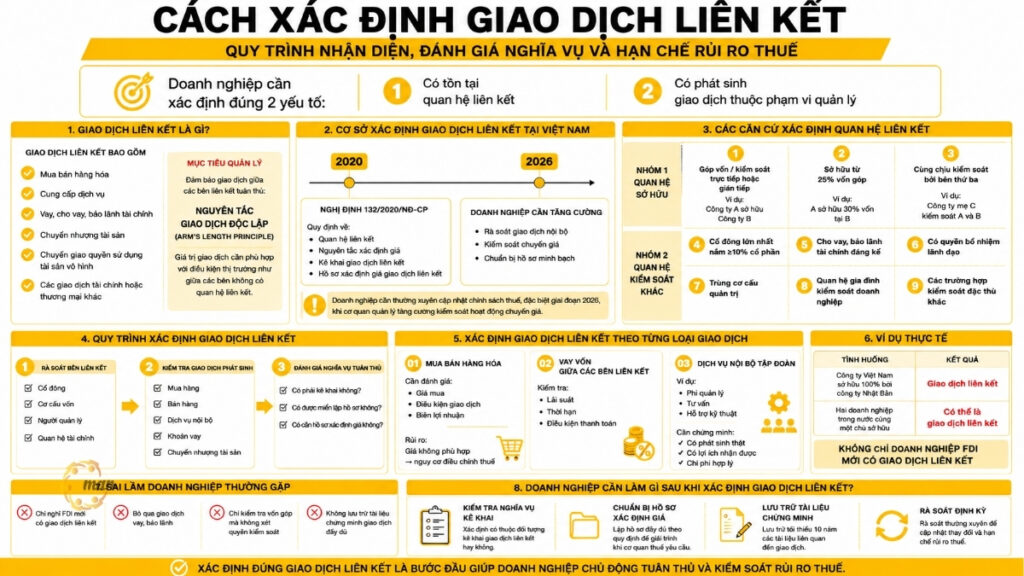



The deductible interest expense in related-party transactions is always a "hot" topic in current accounting periods. Tax audits and inspections, especially for FDI enterprises and parent-subsidiary group models. This goes beyond simply meeting the 30% EBITDA limit. Decree 132/2020/ND-CPFurthermore, businesses must demonstrate the nature of the transaction, the independence of interest rates, and the ability to carry forward interest expense over the years. This article provides an in-depth analysis of the conditions, methods of determination, and common risks, helping businesses understand, correctly apply, and legally optimize the deductible interest expense when calculating corporate income tax in the context of increasingly stringent tax management from 2026.
What are deductible interest expenses?
Deductible interest expense refers to the portion of interest expense arising from legitimate loans that a business is permitted to include as an expense when determining taxable corporate income, according to current laws, especially in related-party transactions.
In other words, this is the actual interest expense that the tax authorities accept as deductible, within legal limits, and subject to the following conditions:
- Within the scope of legal transactions: the loan must have a valid contract and payment documents, and must genuinely serve the production and business activities.
- Adherence to the Arm's Length Principle: Interest rates should not exceed the usual market rate, especially when borrowing between related parties.
- Compliance with the ceiling limit: according to Decree 132/2020/ND-CP, the total deductible interest expense must not exceed 30% EBITDA (earnings before interest, taxes, and depreciation).
- Complete supporting documentation: Contracts, invoices, payment documents, local files, master files, and Country-by-Country Report of Profit and Loss (CbCR) if it is a related-party transaction.
- Carry-forward capability: If the ceiling is exceeded or EBITDA is negative, any uncreditable interest expense for the period can be carried forward to the next period for up to 5 years.
In summary, deductible interest expense refers to the actual interest expense that a business is allowed to deduct when calculating corporate income tax, but it must be transparent, reasonable, and comply with legal regulations.
Why is the Tax Authority particularly interested in interest expenses related to related-party transactions?
The core objective of managing related-party transaction taxes is to prevent "transfer pricing." Businesses often tend to inflate the deductible interest expense in related-party transactions in Vietnam (where the tax rate is higher) to reduce taxable profit, while simultaneously recording revenue in a country with a preferential tax rate.
To ensure fairness, the tax authorities apply the Arm's Length Principle. All transactions between related parties must have the same price and conditions as when conducted with independent external partners.
The core principles for interest expense to be deductible when calculating corporate income tax.
For interest expense incurred in a related-party transaction to be accepted as a deductible related-party interest expense, businesses need to adhere to three "golden" principles:
The principle that substance determines form
Expenses not only require valid invoices but must also demonstrate the actual value they bring to the taxpayer's business operations.
For example: If the parent company charges a management fee (2%) based on revenue but there is no evidence of personnel being assigned to provide support, and no progress reports, this expense will be excluded from deductible interest expenses in related-party transactions.
Matches independent transaction value
The transaction value must fall within the price or profit margin of comparable businesses in the market. Businesses need to use prescribed price comparison methods to protect the reasonableness of the expenditure.
Complete supporting documents
Businesses must maintain complete records:
- Detailed economic contract.
- Non-cash payment documents (required for amounts over 20 million VND).
- Transfer pricing documentation (Local File, Master File).
After mastering the core principles for deducting interest expenses in related-party transactions when calculating corporate income tax, businesses need to consider each specific type of expense, from interest and services to royalties, along with the accompanying deduction conditions, to ensure compliance with regulations and optimize tax benefits.
Detailed analysis of common expense types and deduction conditions.
To understand how the deduction principle is applied, let's explore in detail with MAN – Master Accountant Network each type of expense commonly encountered in related-party transactions and the conditions under which these expenses are accepted for tax purposes.
Interest expense
This is the most debated topic during tax audits. According to Clause 3, Article 15 of Decree 132/2020/ND-CP:
- Interest expense ceiling 30% EBITDA: The total interest expense (after deducting interest on deposits and loans) incurred during the period by the taxpayer that is deductible when determining taxable corporate income shall not exceed the total net profit from business operations during the period plus interest expense plus depreciation expense incurred during the period.
- Rule for carrying forward: The portion of interest expense exceeding the amount specified in tax code 30% is not lost but is carried forward to the next tax period to be deducted from the deductible expenses in related-party transactions for that year. The carry-forward period shall not exceed 5 consecutive years.
To learn more about real-world cases, businesses can refer to the details below. Interest expenses are capped according to the latest regulations of 2025. To be proactive in financial planning.
How to calculate deductible interest expense in related-party transactions
Formula for determining EBITDA for tax purposes:
EBITDA = Net operating profit + Interest expense + Depreciation |
Note: Net profit here excludes income from dividends and distributed profits.
Interest expense is deductible when EBITDA is negative.

This is a financial "trap." If a business incurs heavy losses resulting in negative or zero EBITDA, then all interest expenses incurred during that period will not be deductible. However, the business is still allowed to carry forward all of this interest expense to subsequent years (within 5 years) when EBITDA becomes positive again.
Is interest on personal loans deductible as an expense?
Yes, if the individual is an affiliated party (e.g., owner, operator), then this interest expense is still considered a deductible interest expense in related-party transactions, but it must meet two conditions:
- Interest rates shall not exceed 150%, the basic interest rate announced by the State Bank of Vietnam.
- Total interest expense (including interest on loans from individuals and organizations) must be within the 30% EBITDA limit.
Service fees between affiliated parties
To be considered a deductible interest expense in related-party transactions, the service must provide a direct economic benefit. The tax authorities will exclude:
- Duplicated service costs (multiple affiliated companies providing the same type of service).
- Expenses incurred to serve the private interests of shareholders or the parent company.
- General administrative support costs that are not allocated based on reasonable criteria.
Copyright fees and management fees
This expense is often subject to close scrutiny regarding copyright. If a business pays royalties for a brand whose parent company's ownership has expired, or if that brand does not contribute to revenue in Vietnam, the expense will not be accepted.
Detailed examples with specific data.

To help businesses clearly understand how tax authorities determine deductible interest expenses in practice, the following section will illustrate with specific scenarios and hypothetical figures, closely following the calculation method according to Decree 132/2020/ND-CP and tax settlement practices.
Let's assume the financial information of Company X (which has related-party transactions) is as follows:
- Net profit from business operations: 10 billion VND.
- Interest expense incurred during the period: 6 billion VND.
- Interest earned on bank deposits: 1 billion VND.
- Depreciation cost of fixed assets: 2 billion VND.
In the case of positive EBITDA
To clarify the process of determining deductible interest expense under the 30% EBITDA limit, businesses need to perform the calculations sequentially in the prescribed order. The table below summarizes each step in detail, the applicable formulas, and the corresponding results, helping businesses easily track and compare them when applying them to actual tax settlements.
| Steps to take | Formula to apply | Result |
| Calculate net interest expense. | Net interest expense = Interest expense incurred – Interest on deposits | 5 billion VND |
| Calculating EBITDA for tax purposes. | EBITDA = Net Profit + Interest Expense + Depreciation | 18 billion VND |
| Determine the maximum amount of deductible interest expense. | Cost ceiling = EBITDA x 30% | 5.4 billion VND |
Because the net interest expense (5 billion) is lower than the ceiling (5.4 billion), the entire 6 billion of actual interest expense of Company X is considered a deductible interest expense in related-party transactions.
Low EBITDA case
Let's assume that in 2024, due to market fluctuations, company X's net profit is only 1 billion VND. All other parameters remain unchanged.
Step 1: Calculate the new EBITDA:
EBITDA = Net Profit + Interest Expense + Depreciation = 9 billion VND |
Step 2: Determine the ceiling for 30%, then:
Cost ceiling = 9 billion x 30% = 2.7 billion VND |
Result:
- The actual net interest expense is 5 billion VND.
- Interest expenses deductible for the period amounted to 2.7 billion VND, along with 1 billion VND (deductible from deposit interest), totaling 3.7 billion VND.
- The portion of interest expense that was disallowed (not deductible in 2024) is VND 2.3 billion.
- This amount of 2.3 billion will be carried over to 2025.
Case of carrying forward interest expense to the following year.
In 2025, company X's business is thriving, with EBITDA reaching VND 30 billion. Actual interest expense in 2025 is VND 5 billion (interest on deposits is zero).
| Steps to take | How to determine | Value (billion VND) |
| The maximum amount of deductible interest expense. | 30 x 30% | 9 |
| The remaining ceiling amount is used to deduct interest from the previous year. | 9 – 5 | 4 |
| Interest expense disallowed in 2024 is carried forward. | Within the 5-year limit | 2.3 |
| Interest expense is deductible. | 5 + 2.3 | 7.3 |
| Conclude: In compliance with regulations, the deductible interest expense shall not exceed 30% EBITDA. | ||
From the examples above, it can be seen that determining deductible interest expense depends not only on the 30% EBITDA ceiling calculation formula, but also on the ability to track expense transfers over each period and how the business prepares supporting data. In fact, the same figure can lead to completely opposite conclusions during tax audits, but with different documentation and explanations. This is precisely why Transfer Pricing Documentation is considered a crucial "shield," helping businesses protect the reasonableness of expenses, minimizing the risk of disallowance and retroactive collection during tax audits.
Transfer pricing documentation: A shield protecting businesses.
Complete declaration of all appendices accompanying the corporate income tax return is a mandatory obligation. Even if a business is exempt from declaring and preparing documentation for price determination, it must still declare Appendix I, Form No. 01/GDLK.
See details: Instructions for completing the Appendix on Related Party Transactions
The standard application package structure includes:
- Local FileFocus on analyzing the functions, assets, risks, and pricing methods for each specific transaction in Vietnam.
- Global Corporate Profile (Master File): Provides a broad overview of the company's value chain, profit centers, and global transfer pricing policies. (See details: Instructions for completing the Global Profile)
- Country-by-Country Profit Report (CbCR): Only mandatory if the group's consolidated revenue reaches VND 18,000 billion or more. (See details: Instructions for completing Appendix IV CbCR.)
From the analyses and illustrative examples above, it can be seen that determining deductible interest expense depends not only on the 30% EBITDA limit, but also closely linked to the nature of the transaction, capital structure, the ability to demonstrate the independence of interest rates, and the effective management of the mechanism for carrying forward interest expense across periods. Businesses can only truly optimize tax expenses when approaching interest expense as a comprehensive financial and tax management issue, rather than dealing with it reactively at the settlement stage.
Conclude
In the context of increasingly stringent tax regulations, especially for related-party transactions, correctly understanding and applying regulations regarding deductible interest expenses not only helps businesses comply with the law but also plays a crucial role in long-term financial management strategies. The 30% EBITDA limit, the mechanism for carrying forward interest expenses, and the requirement to prove the nature of transactions all necessitate businesses proactively monitoring, analyzing, and making timely adjustments right from the capital planning stage.
In practice, businesses that establish clear interest expense policies, forecast EBITDA periodically, and prepare thorough documentation of related-party transactions significantly reduce the risk of expense disallowances or tax assessments during audits. If your business is considering reviewing its debt structure, assessing the possibility of interest expense deductions, or completing documentation for determining related-party transaction pricing, early consultation with MAN – Master Accountant Network's team of expert tax consultants will save time, costs, and avoid unnecessary risks.
Contact information MAN – Master Accountant Network
- Address: No. 19A, Street 43, Tan Thuan Ward, Ho Chi Minh City
- Mobile/Zalo: 0903 963 163 – 0903 428 622
- Email: man@man.net.vn
Content production by: Mr. Le Hoang Tuyen – Founder and CEO of MAN – Master Accountant Network, CPA Vietnam with over 30 years of experience in accounting, auditing, and financial consulting.
Answers to frequently asked questions about deductible interest expenses.
If a business hasn't completed its cost determination documentation, will its expenses be disallowed?
There is a very high risk. According to regulations, pricing documentation (Local File, Master File if applicable) must be prepared and readily available upon request from the tax authorities. If the business cannot demonstrate an independent basis for determining the transaction price, the tax authorities have the right to determine the price and disallow related expenses, including interest and service fees.
Will interest expense exceeding the 30% EBITDA ceiling be subject to immediate tax collection?
The portion of interest expense exceeding the ceiling is not deductible in the current period, but this does not mean it will be permanently recovered. Businesses are allowed to carry it forward for up to 5 years if they meet the conditions. However, during peak inspection seasons, many businesses are subject to recovery due to failure to track, declare, or prove the amount of interest expense carried forward.
Can a business that incurs losses for several consecutive years deduct interest expenses?
If EBITDA is negative or zero, all interest expenses incurred during that year are not deductible, even if the interest rate is market-appropriate. This is a point that tax authorities often focus on when examining FDI enterprises that are in the process of expanding investment or restructuring.
During peak tax filing season, what aspects do tax authorities typically scrutinize most closely?
Key issues include: deductible interest expense and its carryforward; service fees, management fees, and royalties paid to related parties; consistency between the Tax Return and the Valuation Report; and unusual fluctuations in profit and EBITDA compared to previous years.
What should be done if errors in related-party transactions are discovered after the tax return has been submitted?
Businesses should proactively review and submit supplementary declarations before the tax authorities announce an inspection decision. Experience shows that early adjustments help reduce penalties and limit the risk of tax assessments.
Editorial Board of MAN – Master Accountant Network