





Interest expense related to related-party transactions is currently one of the "hot topics" causing many businesses to be subject to back taxes of tens to hundreds of billions of VND on corporate income tax after just one inspection.
In reality, many businesses still apply market interest rates and have complete documentation, but are still disqualified from claiming interest expenses simply because they exceed the 30% EBITDA threshold. Decree 255/2026/ND-CP, Even in the case of negative EBITDA, all interest expense is excluded.
So what are related-party transaction interest expenses, why are they subject to strict control, how is the standard 30% EBITDA calculation done according to tax regulations, and most importantly, how can they be legally optimized to avoid tax audits and assessments?
This article will help you:
- Understanding the true nature of related-party transaction interest expenses.
- Understand the rules for controlling 30% EBITDA according to Decree 255.
- Avoid common mistakes that cause businesses to have interest expense disallowed.
- Implement optimal strategies that are safe, legal, and immediately deployable.
What is interest expense on related-party transactions?
Interest expense related to related-party transactions is an expense arising from loans between related parties (between a parent company and a subsidiary, companies within the same group, or parties with controlling power over each other).
Interest expense on related-party transactions includes not only loans from the parent company abroad, but also:
- Intercompany loans within the same domestic group.
- Borrowing from individuals who control businesses
- Indirect borrowing through guarantees, but essentially internal capital.
The tax authorities don't look at the form of the contract, but at the essence of capital control.
This is why many businesses are surprised to be classified as related-party transactions even though they did not borrow directly from the parent company.
This is not a loan from a bank or an independent third party, but rather internal borrowing within the group. The interest expense is calculated based on the interest rate agreed upon by the related parties, but must adhere to the arm's length principle, meaning the interest rate cannot be excessively high or low compared to market rates, to avoid profit shifting aimed at reducing corporate income tax.
With roles and risks:
- Financial flexibility: Helps subsidiaries or member companies in the group easily access capital without depending on banks.
- Optimize cost of capital: Can set reasonable interest rates, reduce overall financial costs.
- Tax risk: If interest expense exceeds 30% EBITDA or the interest rate is unreasonable, the tax authority may exclude interest expense when calculating corporate income tax, leading to an increase in tax payable.
In short, related-party transaction interest expense is a powerful financial tool, but it also carries significant risks if not properly managed and optimized.
Why are interest expenses related to related-party transactions subject to such strict controls?

The primary objective of controlling related-party transaction interest expenses is to prevent transfer pricing. Specifically, related parties may intentionally manipulate the purchase and sale prices of goods and services, or internal loan interest rates, to shift profits from high-tax jurisdictions to low-tax jurisdictions, thereby reducing their tax obligations in Vietnam.
By setting higher-than-market interest rates for internal loans, businesses can easily increase expenses in Vietnam (reducing taxable profits) and transfer money abroad as interest income (which is taxed abroad or exempted under tax agreements). Therefore, regulations regarding... controlling interest expense It was created to prevent this behavior.
The tax authority's perspective on related-party interest expense.
From the tax authority's perspective, interest expense is not simply a financial expense, but rather:
- A tool for manipulating profits quickly and discreetly.
- No complicated input invoices are required.
- It's easy to increase costs simply by adjusting interest rates or loan sizes.
Therefore, the 30% EBITDA rule is designed as follows:
- A quantitative barrier (easy to test, easy to apply)
- No proof of transfer pricing is required; exceeding the threshold will result in disqualification.
Even with market-correct interest rates, interest expenses can still be excluded.
Opportunities and Risks in Borrowing in Related-Party Transactions
Interest expense related to inter-party transactions, arising from borrowing between related parties, offers several benefits:
- Flexible: Easy to transfer capital within the group.
- Interest rates may be set lower than market rates to support the subsidiary.
- Optimization: Utilizing borrowed capital can optimize the financial structure.
However, the potential risks are enormous:
- Interest rate risk: The loan must comply with the arm's length principle, meaning the interest rate must be equivalent to that of a bank loan or independent party. If the interest rate is too high, the interest expense may be adjusted downward by the tax authorities according to the Arm's Length rule.
- Risk of EBITDA control: Even if the interest rate is the market rate, if the total net interest expense exceeds Net Operating Profit plus interest expense and depreciation (EBITDA), the excess will be disallowed as a deductible expense.
Understanding how to classify related-party transaction interest expenses under the 30% threshold is key to ensuring compliance.
Businesses should proactively seek out Consulting services for controlling interest expense 255 Seek support and protection of your financial interests from professional and experienced organizations like MAN – Master Accountant Network.
Current regulations on limiting interest expense.

The most comprehensive and direct regulation governing the management of interest expense in related-party transactions is Decree No. 132/2020/ND-CP.
Scope of application
Article 16, Decree No. 132/2020/ND-CP dated November 5, 2020 of the Government regulating tax management for enterprises with related-party transactions.
The scope of application of this regulation on controlling interest expenses is very broad, including all enterprises with related transactions, regardless of size or business sector, if interest expenses arise.
Interest expense control mechanism: 30% EBITDA threshold
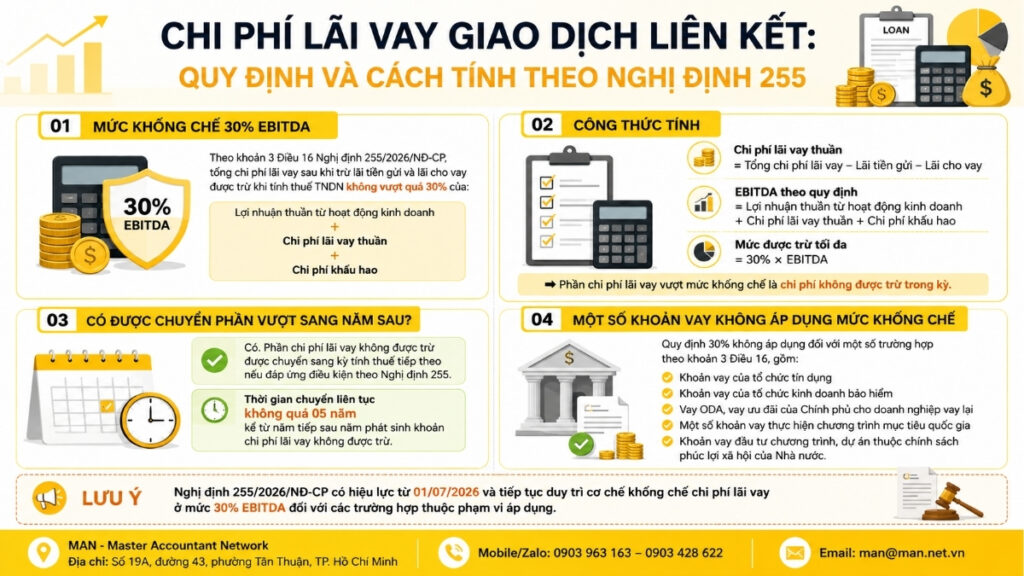
Clause 3 of Article 16 of Decree 255/2026/ND-CP stipulates as follows:
The total interest expense after deducting interest on deposits and loans incurred during the period is deductible when determining taxable income for corporate income tax purposes, provided it does not exceed the total net profit from business operations during the period plus interest expense after deducting interest on deposits and loans incurred during the period plus depreciation expense incurred during the period of the taxpayer. The regulations also specify certain cases where this provision does not apply.
Regardless of how much interest expense related to transactions a business incurs, the tax authorities will only accept a portion of that expense that falls within a safe threshold.
How are non-deductible interest expenses determined?
Non-deductible interest expense in related-party transactions is the portion of total interest expense after deducting interest on deposits and loans incurred during the period that exceeds the amount of total net profit from business operations plus net interest expense plus depreciation expense incurred during the period. This can be rewritten as a practical formula:
Net interest expense = Interest expense incurred during the period – (Interest on deposits + Interest expense on loans incurred during the period) |
To calculate the 30% threshold, accurately determining EBITDA (Earnings Before Interest, Taxes, Depreciation, and Amortization) from a tax perspective is crucial. EBITDA in related-party transactions is not entirely the same as EBITDA according to standard accounting practices.
EBITDA is calculated as follows:
EBITDA = Net profit from business operations + Interest expense + Depreciation expense |
Deduction threshold:
Deduction threshold = 30% x Taxable EBITDA |
Non-deductible portion:
Non-deductible portion = Net interest expense – Deductible threshold |
Businesses need to pay attention to each component:
To accurately determine deductible interest expense on related-party transactions, it is first necessary to understand the components of EBITDA under corporate income tax. The three key factors are: Net profit from business operations, Net interest expense, and Depreciation expense. Below is a summary table of factors affecting interest expense on related-party transactions.
| Indicators | Define | Note |
| Profit from business operations. | Is the profit indicator from business activities on the Business Performance Report. | This profit does not include other income. |
| Interest expense | Total interest expense incurred during the period, serving production and business activities (including related and independent transactions). | Exclude: Interest income, loan interest and calculate on the basis of Net Interest Expense. |
| Depreciation Expense | Total depreciation costs of fixed assets, intangible assets and allocation costs included in production and business costs in the period. |
Understanding the components in the table above is a fundamental step in calculating EBITDA for corporate income tax purposes and determining the maximum deductible interest expense for related-party transactions, thereby avoiding the risk of disallowance of interest expense deductions or tax arrears.
Cases where the interest rate cap mechanism does not apply
The 30% EBITDA control does not apply to all businesses. Specifically, the following cases are excluded:
- Businesses without related-party transactions: If a business does not have any related-party transactions during the period, this interest expense limitation mechanism will not apply.
- Loans that are not related party transactions: If interest expenses arise from loans from credit institutions, banks (independent parties), or from parties that are not related parties, these interest expenses will not be controlled under the 30% EBITDA rule.
- Specialized businesses: Businesses such as public service units, businesses operating in specialized fields (securities, insurance, etc.) with their own regulations or as stipulated in Decree 255/2026/ND-CP are exempt.
In summary, if a business has interest expense related to related-party transactions, it must perform calculations according to the 30% EBITDA threshold.
What happens when a business is disqualified from deducting interest expenses related to related-party transactions?
The deductible interest expense will increase the taxable income of the enterprise, thereby increasing the amount of tax payable. This directly affects the net profit of the company. In addition, non-compliance can lead to the risk of being sanctioned for tax violations during the tax inspection and examination process later. This is the biggest concern that the accounting and finance department of enterprises often faces.
Detailed guide to related-party transaction interest expense: Calculation and application

Calculating deductible interest expenses on related-party transactions requires meticulous attention to detail and a thorough understanding of the nature of the financial indicators as stipulated in Decree 255/2026/ND-CP.
Procedure for calculating deductible interest expense on related-party transactions.
To accurately determine deductible interest expenses in related-party transactions, businesses need to follow the calculation process outlined in Decree 255/2020/ND-CP. This process involves several consecutive steps, from determining net interest expense to calculating taxable EBITDA and comparing it to the 30% threshold.
The table below clearly outlines all the steps, making it easy for businesses to compare and apply to actual data.
| Steps to take | Content | Recipe |
| Step 1 | Calculate Net Interest Expense (NIE) | NIE = Total Interest Expenses Incurred (linked + independent) − Interest Income from Deposits and Loans. This is the basis for comparison with the 30% EBITDA threshold. |
| Step 2 | Determine Net Operating Profit. | Taken from item 30 on the Income Statement. |
| Step 3 | Calculate depreciation expense | Determine all depreciation of fixed assets, intangible fixed assets and allocated costs calculated during the period. |
| Step 4 | Calculate EBITDA based on corporate income tax. | EBITDA = Operating Profit + Total Interest Expenses Incurred + Depreciation Expense. |
| Step 5 | Determine the maximum deductible interest expense (Control Threshold). | Maximum threshold = 30% x EBITDA. |
| Comparative conclusion | Determine deductible interest expenses. | If NIE is lower than the 30% EBITDA Threshold, the entire NIE is deducted. If NIE is greater than the 30% EBITDA Threshold, the excess is excluded from deductible expenses. |
In summary, understanding each step in the table above helps businesses proactively control interest expenses and accurately assess the risk of exceeding the 30% EBITDA threshold. Once NIE, EBITDA and the maximum control level have been determined, businesses can quickly conclude which interest expenses can be deducted and which must be eliminated.
Example illustrating a positive EBITDA scenario.
After understanding the process and each component of tax-determined EBITDA, the next step is to see how these metrics perform in practice.
The example below uses hypothetical figures for Company A to illustrate the entire process of calculating Net Interest Expense, EBITDA, and the 30% threshold. The following table will help you easily visualize and apply it to your business.
| Indicators | Value (Billion VND) | Note |
| Net operating profit | 100 | Indicator 30 Business performance report. |
| Total Interest Expenses Incurred (Intermediate + Independent) | 40 | Interest expense from affiliated parties: 35 billion; Independent: 5 billion |
| Interest income from deposits. | 5 | Excluded when calculating net interest. |
| Depreciation expense | 20 |
Net interest expense (NIE):
NIE = 40 – 5 = 35 billion VND |
Taxable EBITDA:
EBITDA by tax = Operating profit + Total interest expense incurred + depreciation = 100 + 40 + 20 = 160 billion VND |
30% EBITDA control threshold:
EBITDA threshold = 30% × 160 = 48 billion VND |
Conclude: Net interest expense of 35 billion is lower than 48 billion, so the whole is deductible when calculating corporate income tax.
Special case: Negative EBITDA excluding interest expense from related-party transactions.
Negative EBITDA occurs when a business incurs significant operating losses, resulting in negative net operating profit that is greater in absolute terms than the total interest expense and depreciation expense.
When EBITDA is negative, what will the control threshold be?
- Determine EBITDA: EBITDA will be a negative number.
- Maximum threshold: If EBITDA is negative, the result will be a negative number.
- Control principle: According to the General Department of Taxation's guidelines, since the control threshold is a negative number, the maximum deductible interest expense must be zero.
If EBITDA is negative, the maximum deductible interest expense will be determined to be 0.
This means that the entire net interest expense (NIE) of the business will be excluded from deductible expenses for the period. This is a huge tax risk for businesses that are in the investment phase, expanding production, or experiencing business difficulties.
In reality, negative EBITDA is not just an accounting issue, but reflects:
- Businesses are using financial leverage too early.
- Or the capital structure is not suitable for the investment phase.
Many international corporations have proactively accepted accounting losses but adjusted their capital structure to avoid negative EBITDA for tax purposes, thereby preserving deductible interest expenses in the long term.
Detailed illustration with negative EBITDA
If EBITDA is negative, then, as a general rule, all interest expenses are at risk of being disallowed (i.e., not deductible when calculating corporate income tax).
Strategies for optimizing interest costs on related-party transactions.
To avoid the risk of being excluded from interest expenses and optimize legal costs, businesses need to have proactive financial and tax strategies.
Smart Capital and EBITDA Planning
Proactive capital planning is the best defense mechanism. Businesses need to regularly monitor the following indicators:
- EBITDA Forecast: Regularly forecast net profit and depreciation to estimate EBITDA. In the initial investment years, when depreciation is high and profits are not yet available, the risk of negative EBITDA (excluding interest expense) is very high.
- Equity and debt financing strategy: Prioritize increasing equity capital during the initial establishment phase or major expansion to reduce leverage ratios and lessen the pressure of interest expenses.
- Adjust loan timing: If possible, extend the loan schedule or convert internal loans into equity before the end of the tax period.
Diversify funding sources and borrow from independent parties
One of the most effective strategies is to reduce reliance on interest expenses from related-party transactions:
- Borrowing from Banks: Increase borrowing from independent credit institutions (commercial banks). Interest expenses arising from these loans will not be controlled by the 30% EBITDA rule.
- Guarantee: The parent company can guarantee loans to its subsidiaries from independent banks instead of lending directly.
Compliance with the Affiliate Transaction Profile
Whether or not you are excluded from interest expenses, preparing a Linked Transaction File is mandatory.
- The Independent Transaction Principle: Always ensure that internal borrowing interest rates are consistent with market interest rates. Although Decree 255/2026/ND-CP stipulates a threshold of 30% EBITDA, the tax authorities still have the right to inspect and adjust interest rates if they do not comply with the independent transaction principle.
- Documentation: Prepare complete supporting documents (Country Profile, Global Profile, Country-by-Country Profit Report) to defend the applied interest rate.
Regularly conduct reviews
Establish a system for quarterly periodic inspections:
- Quarterly review: Calculate estimated EBITDA and net interest expense for each quarter.
- Sensitivity Analysis: Analyze how much a change in EBITDA would result in exceeding the 30% threshold. From there, the finance department can propose timely business or financial adjustments.
In reality, most of the risk of interest expense disallowance does not stem from intentional violations by businesses, but rather from a lack of a cost control strategy tailored to each stage of operation.
When EBITDA is unstable or negative, addressing the situation at the time of settlement is too late. Instead, businesses need to approach the issue of interest expense on related-party transactions systematically and according to a roadmap, from short-term to long-term.
Below are three levels of strategies to optimize interest expense, helping businesses comply with Decree 255/2026/ND-CP while legally protecting their tax interests.
Short-term strategy (for the fiscal year)
- Review of NIE – EBITDA on a quarterly basis
- Adjusting the timing of expense recognition and depreciation.
- Extend or restructure internal loans.
Medium-term strategy (1-3 years)
- Convert a portion of linked loans into equity.
- Increase independent borrowing with guarantees.
- Adjusting the internal financing model
Long-term strategy (corporate structure)
- Redesigning the linked financial policy
- Standardize related-party transaction records from the start.
- Optimizing taxes while ensuring compliance with BEPS.
Conclude
Interest expenses on related-party transactions are no longer a matter to be dealt with if audited, but have become a factor that needs to be proactively controlled right from the financial planning stage.
Even a small discrepancy in how EBITDA is determined can cause a business to lose all its right to deduct interest expenses.
If your business:
- There are significant interest expenses related to related-party transactions.
- Currently in the investment phase, with low or negative EBITDA.
- Or perhaps the impact of Decree 255 has never been systematically reviewed.
Early assessment and proper restructuring will help businesses avoid the risk of tax arrears, while turning the 30% EBITDA limit into a legitimate tax leverage.
Contact MAN – Master Accountant Network For expert support and advice!
Contact information MAN – Master Accountant Network
- Address: No. 19A, Street 43, Tan Thuan Ward, Ho Chi Minh City
- Mobile/Zalo: 0903 963 163 – 0903 428 622
- E-mail: man@man.net.vn
- Google Business Profile: View MAN – Master Accountant Network's Google Business Profile
- LinkedIn Founder: View expert Le Hoang Tuyen's LinkedIn profile.
Responsible for production and professional content review by: Mr. Le Hoang Tuyen – Founder & CEO of MAN – Master Accountant Network. He is a CPA Vietnam auditor with over 30 years of in-depth experience in accounting, auditing, taxation, and corporate legal consulting.
Frequently Asked Questions about Related-Party Loan Interest Expense
What is net interest expense (NIE)?
Net interest expense is the difference between total interest expenses incurred and income from interest on deposits and loans during the period.
What happens if EBITDA exceeds the 30% threshold?
The portion of interest expense exceeding 30% EBITDA will not be deductible when determining corporate income tax, resulting in an increase in the amount of tax payable.
Can negative EBITDA be used to deduct interest expense?
When EBITDA is negative, the 30% control threshold is also negative, meaning that the maximum deductible interest expense is zero. In that case, the entire net interest expense can be disallowed.
What is a reasonable interest rate for inter-party lending?
Interest rates must adhere to the arm's length principle, meaning they should be equivalent to the interest rates applied by independent parties under similar conditions. If interest rates are too high, the tax authorities may adjust them downward.