


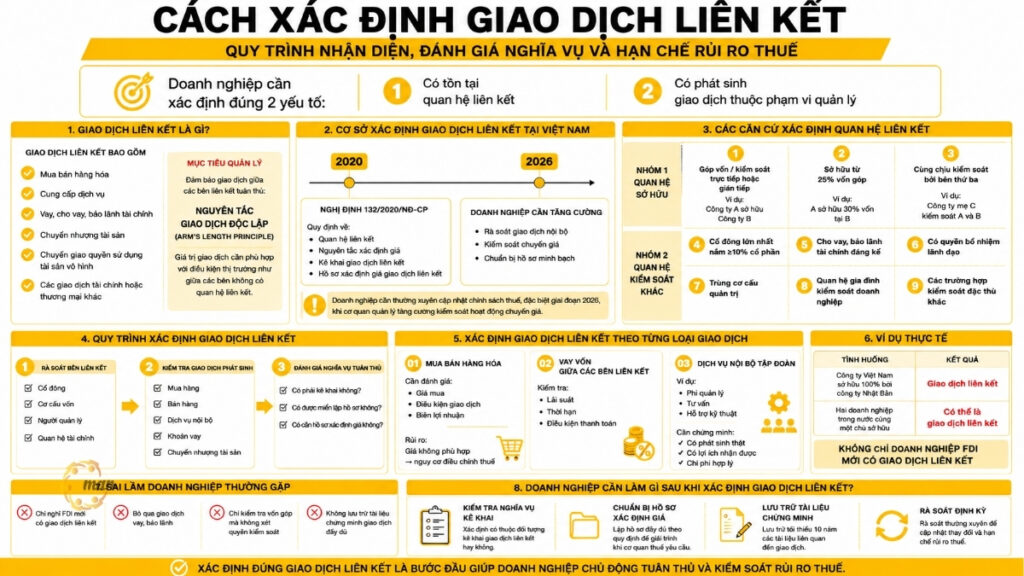



Amidst stricter tax audits of related-party transactions, non-deductible interest expenses are becoming a serious tax risk for many businesses, especially FDI companies and multinational corporations. A single error in applying the 30% EBITDA limitation regulation is all it takes. Decree 132/2020/ND-CP This can also lead to significant tax arrears, prolonged late payment penalties, and tax assessments. This article provides an in-depth, updated 2026 look at the nature, determination, calculation formulas, practical examples, and optimal strategies to help businesses proactively control interest expense and comply with current tax regulations.
What are non-deductible interest expenses?
Non-deductible interest expense refers to the portion of interest expense that a business is not allowed to include as a deductible expense when determining taxable corporate income, due to exceeding the 30% EBITDA limit as stipulated in the regulations on related-party transactions, primarily applicable to businesses with related-party transactions.
According to Decree 132/2020/ND-CP, interest expenses are not deductible when:
- Businesses that have related-party transactions (borrowing capital from related parties or loans guaranteed by related parties);
- Net interest expense for the period exceeded 30% EBITDA.
Key points businesses need to be aware of regarding non-deductible interest expenses.

To avoid the risk of having expenses disallowed and taxes levied during tax settlement, businesses need to pay special attention to the following key points:
- Interest expenses that are not deductible are not permanently lost but are carried forward for up to five years.
- If EBITDA is zero or negative, all interest expenses incurred during the period are disallowed when calculating corporate income tax.
- This regulation aims to combat transfer pricing and thin capitalization, ensuring that tax obligations are determined based on their true economic nature.
To properly apply and mitigate tax risks, businesses need to delve deeper into the nature of the interest expense control mechanism and the reasons why tax authorities are particularly tightening these regulations.
The nature of controlling interest expense
Why are tax authorities particularly interested in interest expenses? The answer lies in the term "thin capitalization." Many multinational corporations use financial leverage by lending to subsidiaries at high interest rates or with excessively high debt-to-equity ratios in order to shift profits from high-tax areas to low-tax areas.
To prevent this situation, Vietnam has incorporated the recommendations of the OECD (Basalt Erosion and Profit Shifting Programme – BEPS) into its domestic laws. Regulations on non-deductible interest expenses in related-party transactions were introduced to ensure fairness and transparency in tax obligations.
See details: The latest regulations impose limits on interest expense deductions.
EBITDA Calculation Formula and In-depth Analysis
This is the most important part of calculating deductible and non-deductible interest expense that businesses need to pay attention to.
Formula for determining the cap (Cap) level
Interest expense is deductible. The maximum for the period is determined as follows:
Ceiling = 30% EBITDA |
In this context, EBITDA for tax purposes differs from accounting EBITDA:
Taxable EBITDA = Net operating profit + Net interest expense + Depreciation expense |
Note: This net profit figure must exclude tax-exempt income (such as dividends) to accurately reflect the company's core profitability.
If EBITDA is negative, can interest expense be deducted?
A question that MAN – Master Accountant Network frequently receives is, "If EBITDA is negative, can interest expense be deducted?" In reality, according to current regulations, when EBITDA is not positive, the 30% ceiling will no longer allow for interest expense deductions in that year. However, we should consider this a "provisional expense" because businesses can retain and carry forward this interest expense to years with more favorable business conditions.
- Consequence: If a business incurs significant losses or depreciation or interest expenses are so high that they result in negative EBITDA, all interest expenses not deductible from related-party transactions for that year will need to be tracked separately and carried forward to the next period.
However, even with the correct formula and accurate EBITDA determination, businesses cannot always include the entire interest expense as a deductible expense in the period. In cases exceeding the permitted threshold, the mechanism for carrying forward interest expense to the next period, as stipulated in Decree 132/2020/ND-CP, is a crucial "lifeline" that businesses need to understand.
Mechanism for carrying forward interest expense to the next period.

Businesses should not be overly concerned when interest expenses are disallowed during the period due to exceeding the 30% EBITDA threshold. In fact, Decree 132/2020/ND-CP has designed a flexible expense carry-forward mechanism, allowing businesses to reallocate the non-deductible interest expense to subsequent tax periods. This mechanism helps reduce financial pressure in the medium and long term, provided that businesses understand and comply with the following principles:
Retention and forwarding periods
Tax laws clearly stipulate the retention period and transitional principles for non-deductible interest expense; businesses should pay particular attention to the following milestones:
- The portion of interest expense that is not deductible will be included in the taxable expenses of subsequent tax periods when determining corporate income tax.
- The period for carrying forward interest expense calculations continuously shall not exceed 5 years From the year following the year in which the interest expense is incurred, it will not be deductible. After this period, if the full amount has not been carried forward, the remaining expense will be permanently written off.
Conditions and order of transfer
In order for non-deductible interest expenses to be carried forward to subsequent tax periods in accordance with regulations and accepted by the tax authorities, businesses need to meet all the conditions and follow the correct carrying order as follows:
- Priority order: Businesses must carry forward the interest expense from older years first (FIFO principle – First In, First Out).
- Sufficient condition: In the year of receiving the transfer, the total interest expense (including interest incurred in that year plus interest carried over from previous years) must not exceed the current year's EBITDA ceiling.
- Declaration procedure: This interest expense must be tracked in detail and fully declared on Form No. 01/GDLK attached to the corporate income tax return.
This mechanism is particularly beneficial for businesses in the investment and expansion phase when EBITDA is low but interest expenses are substantial. As the business stabilizes and EBITDA grows, the previously "provisional" interest payments will be gradually deducted, reducing future tax liabilities.
Legal risks and penalties for violations

Errors in declaring non-deductible interest expenses in related-party transactions not only result in the disallowance of expenses but also lead to administrative penalties under Decree 125/2020/ND-CP.
Tax Assessment Risk
This is the most dangerous risk. If a business fails to declare or inadequately declares related-party transactions, the tax authorities have the right to:
- Loan interest rates are set based on industry data.
- Determine the net profit margin for the business.
- Consequence: Businesses lose the right to determine the amount of tax they have to pay and are often assessed at an unfavorable, high rate.
Specific penalties
Based on tax administration regulations, common penalties include:
- Penalties for incorrect declarations resulting in underpayment of taxes: Penalty under Article 20% for the amount of tax underpaid or the amount of tax exempted, reduced, or refunded in excess of the regulations.
- Penalty for late payment of taxes: Calculated at a rate of 0.031 TP3T/day on the amount of tax overdue.
- Penalties for violations of tax return filing deadlines: From 2 million to 25 million VND, depending on the length of the delay.
- Penalties for violating regulations on information provision: From 2 million to 5 million VND if information and documents regarding related-party transactions are not provided or are provided incompletely as requested.
Risks to business reputation and rating.
Businesses that are penalized for tax violations will have their compliance rating lowered by the tax authorities, leading to:
- Inspections and audits are becoming more frequent.
- It becomes more difficult to obtain tax refunds or investment tax incentives.
In reality, the aforementioned legal risks and penalties exist not only in written regulations but have also arisen specifically during tax audits and inspections. To illustrate how businesses can proactively manage and allocate interest expenses over several years to minimize tax impact, the following section presents a practical case study based on a typical illustrative situation.
Practical Case Study: Cost Allocation Over Multiple Years
To help businesses easily understand how to identify, track, and transfer non-deductible interest expense between tax periods according to Decree 132/2020/ND-CP, the table below illustrates with specific data when a business incurs interest expense exceeding the ceiling in the first year and utilizes the 30% EBITDA margin in the following year to offset the deduction. The data in the table is for illustrative purposes only and does not reflect the data of any specific business.
| Content | 2024 (Interest rates exceeding the ceiling) | 2025 (offset deduction) |
| EBITDA | 100 billion VND | 200 billion VND |
| Net interest expense for the year | 50 billion VND | 30 billion VND |
| Interest expense ceiling | 30 billion VND | 60 billion VND |
| Interest expense is deductible during the year. | 30 billion VND | 30 billion VND (interest accrued in 2024) |
| Interest expense is not deductible. | 20 billion VND | 0 |
| Deductions based on the ceiling | Do not have | 30 billion VND |
| Interest expense carried forward from the previous year. | 20 billion VND (from 2024) | |
| Total interest expense deductible during the year | 30 billion VND | 50 billion VND |
| Result | Interest expense incurred is disallowed and carried over to the next period. | The company deducts the entire amount of disallowed interest expense from the previous year. |
Thanks to increased EBITDA and reduced interest expenses, the company has been able to take advantage of the 30% EBITDA "room" in 2025 to Recover all non-deductible interest expense for the year 2024., in accordance with the cost transfer mechanism stipulated in Decree 132/2020/ND-CP.
Conclude
It is clear that non-deductible interest expense is not simply a disallowed expense, but a strategic financial and tax issue for businesses with related-party transactions. If correctly identified, accurately calculated, and systematically tracked over each period, businesses can significantly reduce the risk of tax arrears and effectively utilize the expense carryforward mechanism under Decree 132/2020/ND-CP.
In the context of increasing tax audits and the application of in-depth data analysis, proactively reviewing capital structure, forecasting EBITDA, and standardizing related-party transaction records are key factors in helping businesses legally protect their tax interests. If your business is facing difficulties in identifying, allocating, or documenting interest expense, don't wait until an audit; discuss this early with a specialized tax and financial consulting firm like MAN – Master Accountant Network to develop a suitable solution today.
Information from MAN – Master Accountant Network
- Address: No. 19A, Street 43, Tan Thuan Ward, Ho Chi Minh City
- Mobile/Zalo: 0903 963 163 – 0903 428 622
- Email: man@man.net.vn
Content production by: Mr. Le Hoang Tuyen – Founder and CEO of MAN – Master Accountant Network, CPA Vietnam with over 30 years of experience in accounting, auditing, and financial consulting.
Editorial Board of MAN – Master Accountant Network