


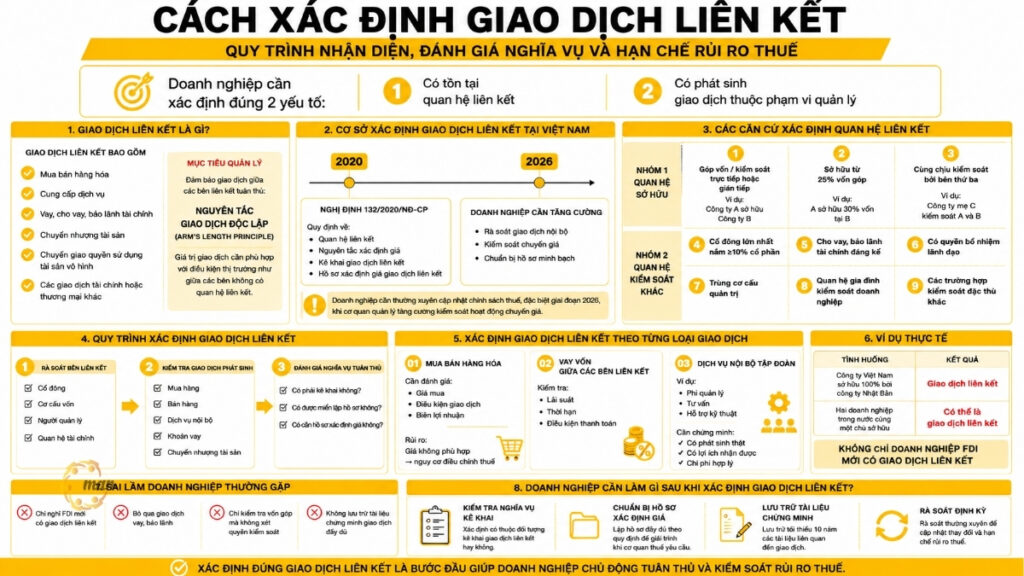



The limit on deductible interest expense is as follows: Decree 132/2020/ND-CP This is one of the tax regulations that has a direct and far-reaching impact on the corporate income tax obligations of businesses with related-party transactions. Even a small error in the determination process can have serious consequences. EBITDAThe scope of application or the portion of interest carried forward to the next period can also lead to the disallowance of expenses, significant tax arrears, and penalties. This article comprehensively summarizes legal regulations, calculation formulas, practical examples, and important notes from a tax expert's perspective, helping businesses understand and correctly apply standards and optimize financial costs safely.
What is the limit on deductible interest expense?
The limit on deductible interest expense is a ceiling stipulated by tax law to restrict the amount of interest expense that businesses can include as deductible expenses when determining taxable corporate income, applicable to businesses with related-party transactions.
Detailed regulations on the limit on deductible interest expenses.

According to Clause 3, Article 16 of Decree 132/2020/ND-CP, the total interest expense after deducting interest on deposits and loans incurred during the period of the taxpayer is deductible when determining taxable corporate income, provided it does not exceed the total net profit from business operations plus interest expense (after deducting interest on deposits and loans) plus depreciation expense incurred during the period of the taxpayer.
Formula for determining taxable EBITDA
To calculate the deductible interest expense limit, we first need to determine the EBITDA ratio from a tax perspective:
Taxable EBITDA = Net operating profit + Net interest expense + Depreciation expense |
In there:
- Net profit from business operations: Taken from item 30 on the Statement of Income.
- Net interest expense: This is the total interest expense incurred during the period, minus interest on deposits and loans.
- Depreciation expense: The total depreciation expense for fixed assets and investment properties recorded during the period.
See details: Formula for calculating EBITDA
The ceiling limit is 30%.
After obtaining the EBITDA figure, the maximum limit for deductible interest expense will be:
Maximum deductible interest expense = 30% x EBITDA tax |
If the actual net interest expense of the business is lower than or equal to this 30% threshold, the entire net interest expense will be included as a deductible expense. Conversely, any amount exceeding this threshold will be excluded from deductible expenses when settling corporate income tax.
Scope of application and important considerations
A common misconception is that many businesses assume that if they only borrow from banks (an independent party), they are not subject to the limit on deductible interest expenses. However, current legal regulations clearly state:
- If a business incurs any related-party transactions during the period (buying and selling goods, lending assets, management fees, etc.), then all of the business's interest expenses (including independent bank loans) will be subject to the 30% EBITDA threshold.
This means the limit applies to total interest expense, regardless of whether that interest is paid to an affiliated or independent party. Here are some important points to note:
- Transaction consistency: Even if the related-party transaction does not incur interest expense (e.g., only the purchase and sale of raw materials), if the business borrows capital from any other source (such as a bank), that interest expense is still subject to the 30% EBITDA threshold.
- Capitalization of interest expense: The 30% ceiling only applies to the portion of interest expense included in the cost of production and business operations during the period. Interest expenses already capitalized into asset value (according to accounting standards) will not be subject to this limit at the time of capitalization.
- Procedure for deducting interest on deposits: Businesses should note that only interest on deposits and loans arising from normal business operations can be deducted. Other financial income is not considered as interest on loans for the purpose of reducing interest expense before calculating the limit.
After clearly defining the scope of application and key considerations regarding the deductible interest expense limit, the next important issue for businesses is the specific calculation method in practice. Understanding the correct formula and procedure will help accountants minimize errors during tax settlement and proactively control the risk of having interest expenses disallowed.
Computational techniques and illustrative examples
To help accountants better understand how to apply the limit on deductible interest expense, consider the following example:
For example: Company A's data for 2024:
- Net profit from business operations: 10 billion VND;
- Total actual interest expense: 5 billion VND;
- Interest earned on deposits and loans: 1 billion VND;
- Depreciation expense for the year: 2 billion VND.
The calculation steps are as follows:
Net interest expense is determined as follows:
Net interest expense = Total interest expense – interest on deposits = 4 billion VND |
Taxable EBITDA:
EBITDA = Net Profit + Net Interest Expense + Depreciation Expense = 16 billion VND |
Determine the limit on the deductible interest expense:
Interest expense control ratio = 30% x 16 = 4.8 billion VND |
Net interest expense (4 billion VND) is less than the regulated ceiling (4.8 billion VND). The entire 4 billion VND in interest expense is fully deductible.
Hypothetical case: If EBITDA only reaches VND 10 billion, the ceiling will be VND 3 billion. In that case, the company will be disqualified from claiming VND 1 billion in net interest expense.
Mechanism for carrying forward interest expense to subsequent periods.
Decree 132/2020/ND-CP contains a very important "open" provision to support businesses: The portion of interest expense that is not deductible due to exceeding the deductible interest expense limit will be carried forward to the next tax period.
- Carry-over period: No more than 5 consecutive years from the year following the year in which the non-deductible interest expense was incurred.
- Method of carrying forward: In subsequent years, if net interest expense is lower than the current year's 30% EBITDA, the company is allowed to add the old interest expense to offset it, but the total must not exceed the current year's 30% EBITDA.
Although the mechanism of carrying forward interest expense deductions to subsequent tax periods somewhat helps businesses reduce short-term pressure, the 30% limitation does not apply to all cases. Tax laws also clearly stipulate which subjects and loans are exempt to ensure the specificity of each sector and the State's regulatory objectives.
Exemptions apply to the 30% restriction.

Not all businesses are required to comply with the limits on deductible interest expenses. The following entities are exempt:
- The taxpayer is a credit institution as defined by the Law on Credit Institutions.
- Insurance businesses are organized in accordance with the Law on Insurance Business.
- Official development assistance (ODA) loans, concessional government loans through the method of relending foreign loans.
- Loans for investment-incentive projects and social welfare projects managed by the State (e.g., social housing).
However, in reality, the number of businesses eligible for exemption from the 30% restriction is not large. The majority of businesses are still subject to full compliance with the regulations. Interest expense is capped. And it is here that risks and mistakes in the tax settlement process frequently arise if the nature and application of Decree 132/2020/ND-CP are not properly understood.
Common risks and mistakes when settling taxes

In practice, many businesses encounter difficulties with the limit on deductible interest expenses due to:
- Incorrect EBITDA determination: Using accounting EBITDA instead of tax-adjusted EBITDA (forgetting to add net interest expense or forgetting to subtract interest on deposits).
- Negative EBITDA: When net profit plus depreciation is still less than 0, the deductible interest expense will be 0. Many businesses still arbitrarily deduct interest expense in this case, which is against regulations.
- Incomplete related-party transaction documentation: Failure to submit Appendix 01 (Information on related-party relationships and related-party transactions) gives the tax authorities the right to impose stricter tax assessments and disallow interest expense deductions.See details: Instructions for completing the Appendix on Related Party Transactions).
In reality, most of the risks and mistakes mentioned above stem from businesses not having a systematic interest expense management strategy from the outset, only addressing the issue during the tax settlement phase. To avoid being caught off guard and minimize the risk of expense disallowance and tax arrears, businesses need to proactively develop optimal interest expense management strategies that are appropriate and comply with legal regulations.
Strategies for optimizing interest costs for businesses.
To effectively manage the deductible interest expense ratio, businesses need to proactively:
- Balancing capital structure: Consider increasing equity capital instead of relying solely on debt if the projected EBITDA is not high enough to absorb interest expenses.
- Optimizing EBITDA: Improving business efficiency and reducing operating costs to increase the denominator in the formula for calculating the interest expense ceiling.
- Closely monitor your interest carryforward plan: Create a tracking sheet for any excess interest carried forward to ensure you don't lose your right to carry forward expenses within 5 years.
It is clear that optimizing interest expense is not limited to technical solutions such as restructuring capital, improving EBITDA, or monitoring excess interest expense carried forward to the next period. It also requires businesses to correctly understand the nature of legal regulations and proactively manage tax risks right from the financial planning stage.
Conclude
The limit on deductible interest expense under Decree 132/2020/ND-CP is not merely a technical regulation in corporate income tax settlement, but also directly impacts the financial strategy, capital structure, and after-tax performance of enterprises with related-party transactions. Misunderstanding the scope of application, inaccurately determining EBITDA, or overlooking the right to carry forward interest expense to subsequent years can all lead to the risk of tax arrears and an unnecessary increase in tax burden.
In the context of increasingly stringent tax audits and inspections of related-party transactions, businesses need to proactively review their documentation, standardize calculation methods, and develop strategies to optimize interest expense deductions from the outset, rather than reacting passively during tax settlement. If businesses are facing difficulties in applying the limits on deductible interest expense, preparing related-party transaction documentation, or need advice on optimal tax solutions tailored to their actual operating model, consulting experienced tax experts will help save costs and mitigate legal risks in the long run.
Contact the expert team at MAN – Master Accountant Network for in-depth consultation, data review, and support in ensuring your business complies with related-party transactions regulations, while optimizing financial performance safely and sustainably.
Contact information MAN – Master Accountant Network
- Address: No. 19A, Street 43, Tan Thuan Ward, Ho Chi Minh City
- Mobile/Zalo: 0903 963 163 – 0903 428 622
- Email: man@man.net.vn
Content production by: Mr. Le Hoang Tuyen – Founder and CEO of MAN – Master Accountant Network, CPA Vietnam with over 30 years of experience in accounting, auditing, and financial consulting.
Frequently Asked Questions about the Limit on Deductible Interest Expense
If a business borrows from a bank and does not borrow from related parties, is there a limit on interest expense deductions?
Yes, if the business has any other related-party transactions (such as selling goods to the parent company, renting warehouse space from a subsidiary...). Once related-party transactions are present, the total interest expense (including bank interest) is subject to a limit.
Can disallowed interest expenses be included in losses carried forward?
No. This expense is not deductible when determining taxable income. However, it is tracked separately and carried forward to subsequent years, as analyzed in the section "Mechanism for carrying forward interest expense to subsequent periods".
Can interest earned on bank deposits be deducted directly from interest expense before the interest expense cap is applied?
Yes. According to Decree 132/2020/ND-CP, interest expense is determined after deducting interest on deposits and interest on loans incurred during the period.
Editorial Board of MAN – Master Accountant Network